Showing posts with label Armenian Genocide. Show all posts

Tuesday, October 6, 2015

The Bienal: Part 2

On Saturday, we went to Beyoğlu and Karaköy for Bienal exhibits. As I explained in my last entry, most of the installations are inside the city, not in a museum or a special venue but in the old mansions and köşks and historical buildings that normally are all boarded up or somehow else impossible to enter. A living part of Istanbul that makes the city and her past as much on display as the art. Each piece and place reflects and echoes some of the fear and darkness of the past, and of the present.


In Beyoğlu, we found an exhibit in a Greek mansion built in 1915. The artist has carved into what looks like slices of trees Armenian symbols and placed them in the ceiling. You lie on yoga mats on the floor and look up at them. The symbols are especially known by local "treasure" plunderers, for when the Armenians were driven out of their villages, they often hid their belongings somewhere in the landscape--or so it was believed--and marked or mapped out the location with these symbols carved into rocks. There are snakes and hawks and scorpions and ghostly figures marching in a line. The house itself is abandoned and dilapidated. You can wander all the floors. The walls themselves are works of art--layers and layers of colors painted one over the other and chipped and rotted and decayed.


Down the road from the Greek mansion, is an empty parking garage scheduled for demolition by the demolition-obsessed city government. Not that it's an architectural wonder or anything--just a vast empty gray space in which an exhibition consisting exclusively of sound has been installed. Clicks and drips and heartbeats and echoes of car noises fill the empty space. A blue collar place about to be gentrified into a upscale mall or hotel.


Down on Bank Street, a few Bienal exhibits are houses in the Salt Gallery, set in the gorgeous 19th century Neo Classic Ottoman Bank designed by Aléxandre Vallaury.


In the basement is an installation called "How Did We Get Here" about the censorship of books and life following the 1980 coup. It echoes what we are going through now--as journalists are attacked on the street, ordinary people are arrested for insulting Erdoğan during discussions in city parks, and a new campaign of coup-era nationalism has been revived resulting in war in the East and mob attacks on Kurds in the West. Among the titles censored by Turkey's military on "moral" grounds are Einstein's Theory of Relativity and the Plague by Albert Camus. The hatred of knowledge and science and intelligence and enlightenment is absolute.

In one section, artist Hale Tanger has reconstructed an apartment from the 1980s--complete with radio blasting military news and children's notebook filled with nationalist slogans and praises to Atatürk. All the rooms are Spartan, black and white, military clean--except for one. A small door leads to a closet full of hidden things--costumes, jeweled mirrors, colorful yarns. Soul and imagination and play stay cowered in the back.
Playing with the toys and costumes in the closet
In the Istanbul Modern, we see a young man with his shirt unbuttoned halfway down to his belly angrily approaching the young student workers one by one. "How dare you put something in this place that the State does not approve of!" he rants at one girl near the entrance. He spends at least an hour stomping from sign to sign, looking for the word "Armenian"--and every time he finds it, he harangues the nearest Bienal worker. It's almost a performance in itself. Will he come back with a mob and attack someone, burn something, kill someone even to deny there are killers in Turkey's past? Was he sent here by some government agency or just lone freak?

The angry young defender of the State

He hates this: A scroll painted with the crimson derived from an Anatolian insect. The secret of extracting the dye is known only now in Armenia. Drawings with the dye gradually give way to a more modern, industrial red--the red of the Turkish flag that blocks out the organic color of the past.


He hates this: a painting by an Australian, Vernon Ah Kee, who saw in the "violence in Turkey's East" a parallel with his government's oppression and massacres of the Aborigines, particularly the Palm Island riots of 2004.

This installation by Sonia Balassanian--an Iranian Armenian--particularly enraged the young man. It is tuff stone from quarries just over the Turkish border in Armenia, across from the ruins of Ani. Each one resembles a head and seems to recall the deportation and murder of Istanbul's Armenians in 1915 as well as the beheadings in the Middle East today. The man tells the young girl manning this installation, "You people have turned this place into a house to worship the Armenians and insult the motherland!"

Another exhibit takes the abstract economics data--graphs, charts, projections, and uses everyday materials to turn them into three dimensional forms. A rainbow colored pattern of sticks are the annual work fatalities in the coal industry, a three dimensional web of colored wire is a graph of industrial pollution over time. They are beautiful, and as Delal says, when I look at them, I get a strange feeling at the front of my forehead, like a part of my brain is developing that wasn't there before: the abstract ideas turned into math, turned into pictures, turned into toys.


One last exhibit is in the museum library, a thought experiment by Lebanese artist, Marwan Rechmaoui. It represents the kind of "partial censorship" prevalent in the world today, where the choices look like they are there, but nevertheless are not--a perfect metaphor for Turkey, where we are constantly being told by the government how free everything is and yet drowned in censorship. the library book shelves are covered with a clear plastic wall. In each section there is one slot where one book can (with difficulty) be pulled out and read. You can see all the others, but not touch them.

In the Italian high school is a film by a director from Inner Mongolia and a video by a German-Turk making a journey across Bulgaria to explore how the Ottoman past is remembered. From the top floor, glancing out the window toward the courtyard, you can see the vast ruins of the dilapidated French orphanage, now hidden behind other buildings in Beyoğlu. It's symbolic in itself--showing how behind the city's facades are gigantic relics of a past erased or purged.


Monday, April 6, 2015

New Spring, New Day, Newroz and Easter

Newroz Eggs/Easter Eggs
It's been a long time since I've posted anything, so this is going to be short--just to get my feet wet again. Yesterday, Delal and colored eggs for Easter, or Paskalya as they say in Turkish. It's one of my favourite times of year here--all the bakeries in Kadıköy carry challah bread, a braided Armenian sweetbread with brightly painted eggs in the middle. And of course, the apple blossoms and cherry blossoms are in full swing, the world famous tulips are starting to pop out of the ground, and the sycamores all have incandescent green buds on them.

And as usual, Delal's granddad pops out with a piece of surprise information.

"When I was a boy," Dede says, "We used to dye eggs for Newroz in the village."

Newroz is the Iranian New Year, celebrated by Kurds in Turkey on March 21st, the equinox. In fact, just last week we had gone to what must have been Istanbul's biggest Newroz festival yet in Kazlıçeşme--easily over 200,000 people in my modest opinion. Newroz has become a sort of national holiday for Kurds--and in recent years is the day for important political announcements. This year, the PKK leader Ocalan wrote a letter to be read out at Newroz celebrations, calling for an end to the armed struggle--a historic step in the ongoing peace process between Kurds and the Turkish government.

The traditions don't include bunnies or baskets. Though there are a few superficial similarities. In my family, we used to buy new clothes for Easter Sunday, usually all bright coloured pastels I never ever wore again. On Newroz, Kurdish women dress up in brightly colored bangled dresses called fistan--red, green, and yellow are the colours of choice, but you'll see orange and purple and turquoise Men, on the other hand, will wear black of khaki şal u şapik --a traditional outfit recently banned by Turkey's so-called "security package."

Other things: people build huge bonfires and jump them for luck, and everyone dances the govend (Turkish: Halay) until their legs snap off.

So how were Dede and friends colouring eggs for Newroz back in the early 1930s? We can only guess that it came from centuries of living in close proximity with Armenians. I found a book published by Ragip Zarakolu's publishing house, Belge. It's called Kedername (Document of Grief) and is a compilation of testimony on the Genocide compiled by Armenia's State Archives. In it was a rather telling description of the Kiğı region with harrowing and heartrending descriptions of the emptying out and murder of Armenians in all the villages near Conag--including Xiwek, Akrag, Hasköy and the town of Xolxol (Yayledere). Of Conag, there isn't much. One witness, a church official from Kiğı and the godfather (kirve) to the head of "the Kurdish village" says that on the road that leads to Conag from Xolxol, you can see a grave stone belonging to Prince Beşar.

"And in fact his descendants still dwell in the area. The ruins of an Armenian church sit in a pile of stones in the fields of Suleyman Beşaroğlu. I observed an interesting ceremony at his house. He had told me about the local saint that protected them and I asked if I could watch the ceremony they held for him, for he was reportedly a very powerful saint. I watched as he drew one by one books wrapped in white cloth from a large trunk. As he unwrapped them, I saw pages from the Bible, richly decorated and written in Armenian and Greek. The village headman couldn't read what was written there but just knew that the words held power."

Anyone who has kept up with my blog knows that there is still a pile of stones from an Armenian church that the villagers treat as holy and possessed of healing powers. Could this be the same stones? Dede doesn't remember anyone named Beşaroğlu (this would have been the late 1800s) and none of the books we have on the area mention anyone bearing that last name or anything resembling it. But it's intriguing--especially since the road from Xolxol to Conag could pass by the village of Hasköy which still has an Armenian cemetery and might explain the grave.

As we discover more and more anecdotal connections with the disappeared Armenians, Turkey brings to bear all its powers to deny the Genocide on the 100th anniversary. The government has scheduled an international commemoration of the Battle of Gallipoli on April 24th, the day also commemorated as the start of the Genocide. Not surprisingly, most foreign dignitaries have declined the invitation. Turkey's pro-government newspapers claim that foreign officials have received threats from ASALA, an Armenian radical group--the only possible explanation in their minds for the refusal to show up.

And as for Newroz, the ruling party seems determined to roll back all progress made on that day as well, refusing to grant permission for a mediator for the Kurdish Peace process among other things. (Other things including a new ban on all social media and a draconian security bill that makes it legal to shoot protesters wearing a scarf over their faces, which you might if you expect to be attacked by thousands of canisters of tear gas.)

In any case, it felt right to colour eggs--somehow a celebration of both my childhood traditions and the traditions of Delal's granddad. There in lay some sort of symbol of who we were--it's hard to explain. Both American and Kurdish, respectful of tradition but forward looking. Together. United. Happy Easter, D. Newroz Piroz Be!

Wednesday, April 23, 2014

The American Indian and the Armenian Genocide

Keşke Birde Türk Bayrağı Olsaydı
'If only there was a Turkish Flag' A picture from a Turkish man protesting the 'Kurdish Opening' back in 2009 as something that would split the motherland.

How does the United States Senate celebrate the Armenian Genocide? We have an old tradition as unchanging as the Christmas Tree or the Black Friday shopping death stampede. First, on Genocide Eve, the Committee on Foreign Relations draws up a bill to recognize April 24th as a day ‘to remember and observe the anniversary of the Armenian Genocide.’ Then the Turkish media, government, and civil groups start to sing the age-old Genocide carols to their American friends. Some of the most popular are ‘The Nature and Scale of the Killings Remain Highly Contentious’, ‘We Warn You Not to Harm US-Turkish Relations’, and the classic ‘We Didn’t Do It And If We Did, They Asked For It.’ Then on Genocide Day, the US Senate refuses to hear the resolution in the general assembly and it goes absolutely nowhere.

So I am going to tell you guys a Genocide story that I stumbled on in my various researches and through my accidental membership in the Turkish Coalition of America—a charity organization made up of Turks and Turkish descendants living in America. (I started getting emails from them when I moved to Istanbul) I think this story nicely illustrates the nature of the whole Genocide issue.

The TCA does a lot of noble work. A quick perusal of their latest newsletter includes scholarships, an aid package for the victims of the Typhoon Haiyan in the Phillipines, a cultural exchange with Canadian youths and a commemoration ceremony celebrating the ties between Turkey and the Native American community.

What ties you may ask?

Well the TCA has been lobbying for the American Indians for quite some time now. (Let me say now that I’m not all that sure that ‘Indian’ is the preferred term. I read in an interview with a Lakota that it was the word aboriginals preferred and have seen the term in the speeches of firebrand Russell Means, so I’m running with it.) Most recently they helped organize the government of Turkey’s funding of a water tower for the Warm Springs Tribe in Oregon. Turkey donated over 200,000 dollars. The TCA had a competition among American Indian Tribes for the grant in 2012. The grant was announced in a newsletter regularly distributed to the tribes and Warm Springs won the bid. (Let that sink in, Turkish lobbying groups have a regular newsletter for the Indians) This was back in October, right after Erdoğan had spent several months gassing and attacking hundreds of thousands of people protesting him in the streets and was presented to us by the press here in Turkey as evidence of how great Turkey had become. Now America’s poor and downtrodden came to Ankara for help, not to Washington.

The Warm Springs tribe was a little baffled, but grateful of course. And I’m glad they got their water tower. They deserved it and I’m sure the other 31 applications that didn’t win were deserving as well. Still, everyone was trying to figure out why a government halfway around the world busy secretly funding Al Nusra radicals in the Syrian Civil War while at the same time sending phalanxes of police against its own citizens in the greatest demonstration of civil unrest in its history was fussing over a small Oregon tribe. Turkish officials cited ‘the historical and cultural connections between Turkey and Native Americans.’  

The TCA has been trying also to sponsor a bill for economic development on Indian lands. Great! If passed, the bill would enable tribal governments to approve development projects sponsored by foreign investors without the approval of the Federal government through the Bureau of Indian Affairs. This is apparently a very time consuming process, full of red tape, which helps cripple tribal economies. Great again. Sounds like a stupid requirement anyway, left over from the bad old days—or rather, the worse old days. I doubt any American Indian would ever say the bad old days are over. But as it turns out, the bill mainly favors one country and one source of foreign investor-Turkey!

Turkey and the TCA also grant scholarships to American Indians. They fly officials to Turkey for economic conferences and they attend native conferences in the States as well. In 2010, an official from the Turkish Trade Ministry became the first foreign official to speak at the annual conference in Las Vegas on tribal economic development. In the same year, Turkey brought members of the Coeur D’Alene tribe to Ankara. Alaskan Representative Don Young, a strong supporter of his state’s tribes said Turkey was “the first foreign country that has shown interest in investing with — cooperation with — a tribe to improve their economic lot.” All this official attention and show of respect must feel like a vindication for a people whose history is filled with diplomatic betrayals, political marginalization, and broken treaties.

So why all this fuss? Why all this effort to support a trampled minority in another country-a minority who more than deserve the support, by the way. Which is kind of the crux point of the issue here. Turkey has chosen a target that no one would ever, in their right mind, argue against. The moral soundness of trying to help American tribes build sustainable economies is unassailable. And when, say, Armenian-American lobbyist argue against the bill, they look like assholes.

Here is what TCA president, Lincoln McCurdy has to say about the motivation on the TCA’s own website:  

"It definitely broadens (Turkey's) political base and it increases the opportunity for Turkish companies to establish operations in this country. A broader political base, in turn, could aid Turkey in recurring Capitol Hill conflicts with Armenian-Americans. In raw population, Armenian-Americans widely outnumber Turkish-Americans. Turkey, though, enjoys considerable high-level clout as an important NATO country. Nearly every year, these competing forces are on display as lawmakers press for an Armenian genocide resolution that takes note of the massacres that took place during the Ottoman Empire's dying days. The resolution routinely fails but keeps coming back; this year's version has 84 House co-sponsors. It's in this context that the Native American investment bill reflects Turkey's cultivation of tribes."

Holy shit! Did he actually write and post that? The main reason we are offering help to a people who have suffered perhaps more, or at least longer, than any other in the world is to build our numbers against the annual Armenian Genocide bill? To drown out the Armenian lobby? First, if I have any American Indian readers at this point, I would love to know what you think on this issue. My advice for you guys would be take the money and run. In my limited experience with American Indians they are too politically canny to be fooled by any of the ideological hocus pocus (been there done that), and practically speaking, the TCA is pursuing a policy that makes sense for the welfare of the tribes and that other countries should follow. And it’s such a shame that this historical and herculean effort is being put forth in the name of genocide denial.

And here is where the issue gets more complicated, because one of the classic denial arguments is “Well, you Americans committed genocide against the Kızılderililer (That’s the Turkish word for Indian and it means ‘Redskins’—yep, that’s right.) So you have no room to talk.” The rather extremist website tallarmeniantale (which pops up in any search on the Genocide, so it’s not so marginal) devotes an entire section to the subject—going as far to suggest that the white genocide of American Indians was attempted by Europeans on ‘the Turk’, their racial brothers. You see pictures of Indian chiefs everywhere in Turkey—in leftist cafes and in the windows of vans and minibusses. Everyone feels both a racial connection as a people with ancestors in Cenral Asia (which they should then feel toward every Asian except maybe the Chinese) and also a political one, as the abused victims of European Imperialism.

This argument is a tacit admission, of course—‘You did it, too!’ they say, but the ‘too’ implies that we did it as well. And it’s always curious that someone would try to clear their name by connecting it to one of the largest massacres of a people in human history. And never mind that Turkey, far from being a hapless victim, was a large empire—and that the Sunni Turks hold the reins of power over minorities who have been here a lot longer than they have, minorities who continue to be driven out and marginalized; a little bit like European descendants hold the reins of power over a minority that have been in the Americas a lot longer than we have. But Turkey has a compulsion to constantly identify itself with the victims, which is why Erdoğan, in command of the military and police, can mastermind an attack on protesters in Turkey’s 80 cities and still feel that he is the underdog. The psychology of victimhood is extremely dangerous here—it’s what justified the Genocide in the minds of the Ottomans in the first place and still forms the core of denial arguments.

And so what of this assertion that white Americans committed genocide. Does anyone deny it? Article II from the Convention for the Punishment and Prevention of Genocide says:

“Genocide means any of the following acts committed with intent to destroy, in whole or in part, a national, ethnical, racial or religious group, as such:
(a)     Killing members of the group;
(b) Causing serious bodily or mental harm to members of the group;
(c) Deliberately inflicting on the group conditions of life calculated to bring about its physical destruction in whole or in part;
(d) Imposing measures intended to prevent births within the group;
(e) Forcibly transferring children of the group to another group.

At some point over the last five hundred years, the conquerors of the Americas have done all of these things to one or more Indian nations. By international law, it certainly classifies as a genocide. I never saw the word in a school history book, though, so out of curiosity I googled 'American Indian Genocide.' (I am not a scholar so that is my research method—sorry) and one of the first articles to pop up was this one by GuentherLewy. He methodically makes the case that the deaths of millions upon millions of Native Americans was not a genocide. So we do genocide denial too! But what is Mr. Lewy’s connection to Turkey? Well, he also is one of the American deniers of the Armenian Genocide and a scholar that Turkey loves to drag out as proof it did nothing wrong (but if we did, so did you!). Mr. Lewy’s purpose seems to be to defend the Jewish Holocaust’s status as the most important genocide in history, if not the only one. Somehow The Holocaust’s exclusive right to the term ‘genocide’ is important to a large number of people.

Another Google search on Turkey’s aid to the American Indians turns up articles in fanatically anti-Muslim websites such as Jihadwatch, the Counter Jihad Report or this one. They make some of the same points I do about Turkey's motivations but for horrible reasons. So some of the most vocal groups keeping up with and speaking out against this issue are racist themselves determined to prove the innate violence and danger of Islam.

And so we have the full immoral picture.

Here you have the wealth of entire country and the efforts of a major lobbying group in the US devoted to helping a group that has suffered much at the hands of various oppressors throughout history. And the help they provide is logical and long overdue. But their aims in doing so are horrifyingly cynical—to secure support in covering up another one of the greatest crimes in history. Think about that a second—you are devoting millions of dollars and hundreds of hours to getting one oppressed group to aid in the oppression of another. Some of the people who oppose this are wildly racist themselves (the jihadwatch type) and their main motivation is hatred and fear of Muslims—which of course supports the Turks assertion that they are the victims of white racism because sometimes they actually are. Another contingent who is helping Turkey deny the genocide is also denying the genocide of the people Turkey is trying to use in its own denial—all in the name of justice to another genocide which they believe only retains it’s legitimacy if it remains the only one.

Turkey’s motivations for targeting the Indians is multifold I think. On the one hand, they have picked a cause which justifiably blackens the American name and in doing so, teach a very expensive lesson to the United States. “See? This is what it feels like when one country meddles in another country’s affairs in the name of human rights.” (The theme of the genocide issue being merely a case of the West meddling in Turkey’s internal affairs is a common one). Politically speaking, if numbers of supporters was their sole goal then they probably should have gone after a group with more clout. Second, they somehow build a sense of moral superiority at a time when their moral clout is going down the toilet."We aren’t oppressing anyone! We have gone into the very den of the oppressor and helped liberate a people." Maybe that explains the timing of the Warm Springs announcement. And third, as was evident from the newspaper coverage of the same Warm Springs grant last year, it’s a tremendous boost to nationalist pride to be the one country capable of supporting a poor minority which not even the once great United States can manage to help. Turkey sends monetary aid to the US—what a propaganda coup! And then there is this perceived racial brotherhood—which infuriates me the most—the belief in race being the root of all this evil in the first place, all coupled with the false belief in a mutual victimhood.

This whole thing stands as a sad example of how historical denial twists and corrupts everything it touches. The TCA is doing a good deed but its motivations stink up the whole thing and corrupts both the justice to the American Indian which was long overdo and the good intentions of those behind the good deed. Turks, as a culture, seem very hospitable, empathetic, sensitive and possessors of a conscience that allows them to sympathize and grieve for, say, the recent deaths on the South Korean ferry in a way that I have not seen another nationality do. And yet this race issue, this nationalism problem fouls it all up. It holds them back as a nation. (And as a man coming out of the South I know what it's like to have a racist culture hold back the progress of your homeland)

It somehow reminds me of a professor of history I heard about recently—who has devoted his entire life to trying to prove that the Ottoman Armenian Balyan family or architects did not in fact build any of the buildings they are credited with. What an incredibly tragic waste of a brain, of a life, of thousands upon thousands of hours of research. He could be devoting himself to something that might actually help his country, but no, instead all that effort is bent upon an absurd racist denial of history.

Even as I write—Haberturk promises a ‘historical’ announcement from the Prime Minister’s office on the Armenian incident of 1915. We are still waiting to hear what Erdoğan will say. It was published on the PM's website at least--an offer to share the grief of those massacred in 1915. An unprecedented step by the Turkish state run by a man so intolerant that all opposition is swiftly crushed.  In any case, on April 24th, may all the world’s butchered and martyred and downtrodden rest in peace. This year is the 99th anniversary. 

Thursday, April 3, 2014

Conag at Election Time With A Side Trip to Harput

A flowering almond (?) tree in Harput

 
WINTER CONAG, HARPUT, AND THE GREAT ELECTION FIASCO OF 2014


Restored House in Harput--The Şefik Gül Kültür Evi

                A lifetime of Social Studies lessons with my old history teacher Mrs. Gibble could not teach me as much as just one week of living in Turkey. I’d intended this rather naively to be a simple travelogue of my recent travels to Harput, an ancient city outside Elazığ, and then on to Delal’s village of Conag for the elections, but one cannot avoid some sort of tragedy or atrocity or the memory thereof once you go East. So I apologize ahead of time—for all the heavy stuff to follow.

It’s been a whirlwind week—last Wednesday, Delal’s phone started getting a storm of messages at around 3:30 in the morning. 37 people in the KCK trial her father, Kemal Seven, is enmired in were released! We were quick to learn that her father was not one of them, but rather one of the 34 the court deemed likely to ‘run way’ if they were let out. There was no explanation for why it happened. Apparently the lucky ones were simply approached by the guards, told they would be let out that day “and very soon at that, so get your stuff packed.” They were kicked out (don’t let the door hit you as you go out) into the pouring rain with no reporters, no supporters, and more importantly, no car waiting for them to carry them from the prison’s remote location in Silivri’s farmland to home or at least to Istanbul—over an hour’s drive away—or anywhere not dark and wet and cold. After some phone calls begged from the guard at the gate, they arranged a ride and showed up on their families’ doorstep just as they had been taken away—in the middle of the night and unannounced. And why? Who knows? This is Erdoğan and Fethullah’s (increasingly  more Erdoğan’s) Turkey and like Cartman or that nasty little toddler in the Tylenol commercial, they can do whatever they want, however they want, whenever they want.  And they’ll cover their asses with news blackouts, misinformation, finger pointing (they’re too dangerous to let go) like they have for centuries.

                Local elections were also this week—when all of Turkey would be selecting its mayors, governors, city council members and village headmen (muhtar). It was considered a vote of confidence on the increasingly authoritarian AKP government and saw a record campaign effort, a record turn out, and a record level of tension. This was after Gezi, after the mob attacks on the Kurdish affiliated HDP party, after the corruption scandals and mass arrests and mass releases of convicted murderers. So Delal and I went to the village, where she is registered, so that she could vote. Because of work, I couldn’t leave on the same day as her, so I flew out on Friday and spent a day wandering around the old city of Harput before catching a bus to Conag.

The famed Urartu fortress of Harput
The lampposts of Harput--in front of an abandoned house
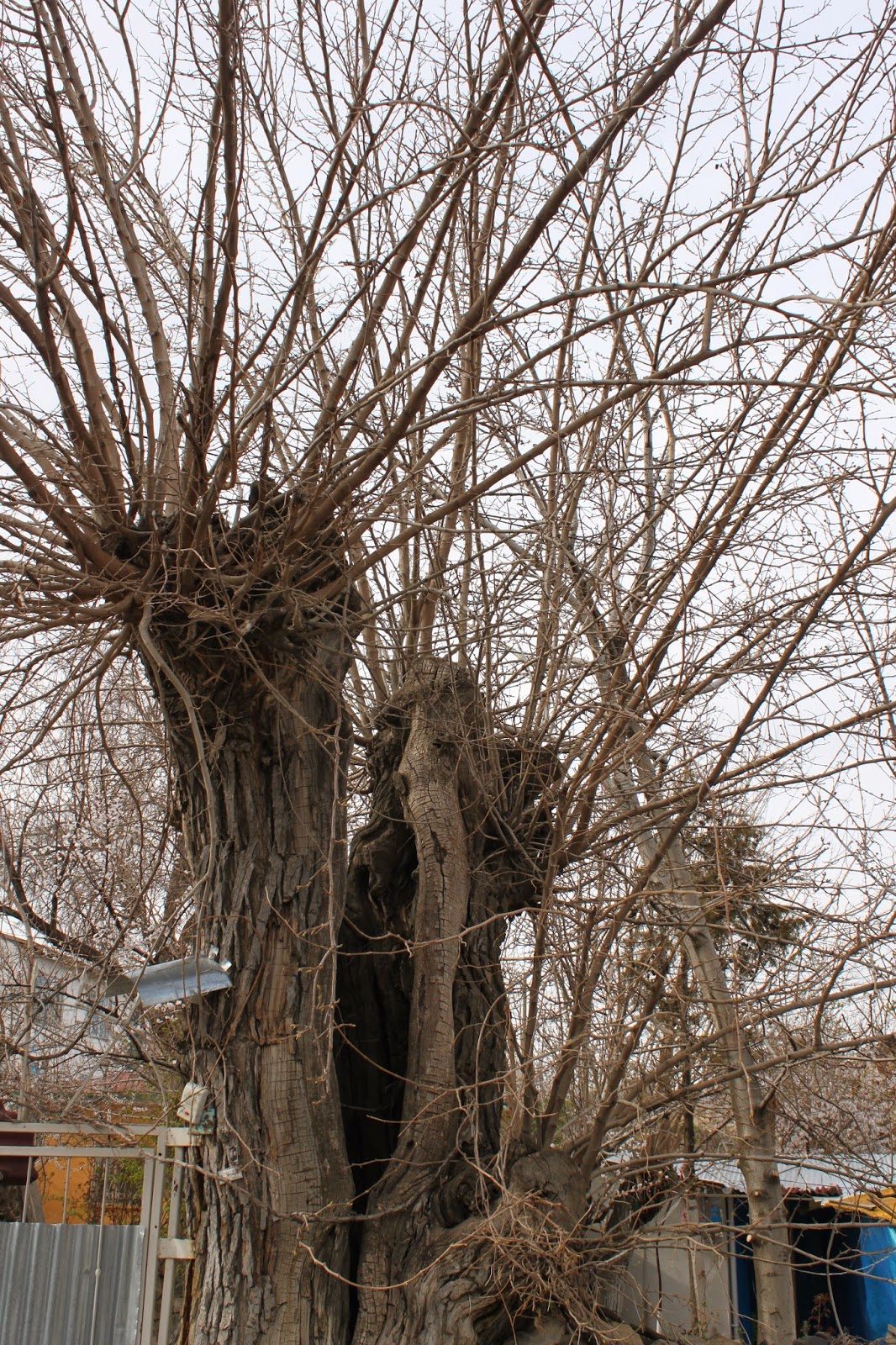
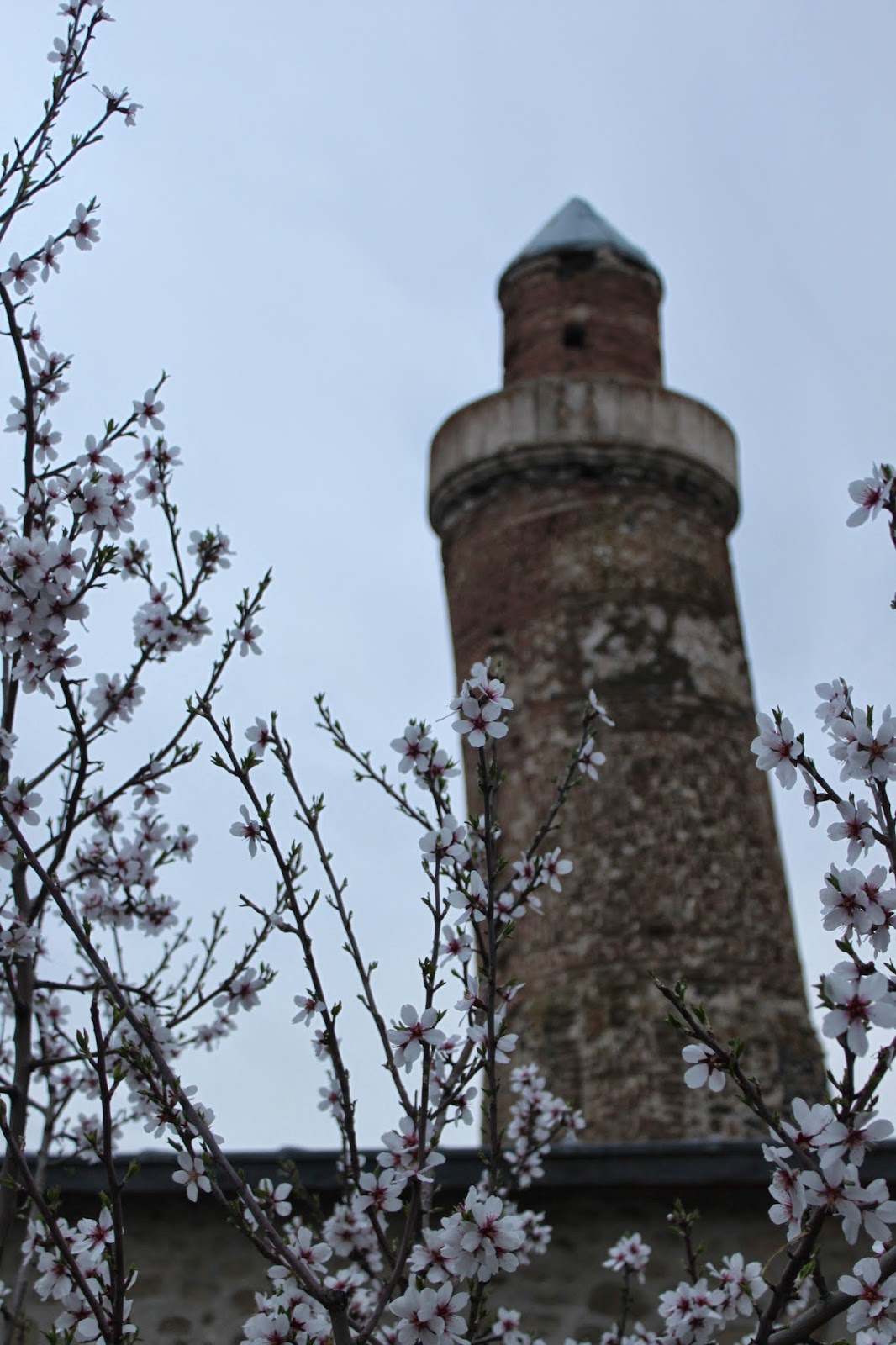
Harput was a nice breather—it’s a centuries, if not millenia-old town on top of a hill just outside the newer concrete city of Elazığ. It commands a sweeping view of the lake ofthe  Keban Dam and the snow-peaked mountains to the East and North—where Dersim lies. The town is like a nostalgiac illusion from a photograph taken centuries ago, with traditional stone houses, a thousand year old mosque, tombs of Muslim saints, flowering almond and apple trees and huge sycamores centuries old. The Great Mosque is a graceful little building from a different age, with a leaning minaret and a courtyard open to the sky—totally unlike any mosque I have ever seen, with no minbar and a design not focused on the kible. It’s surrounded by pink-flowering almond trees and on the East side has a gigantic sycamore erupting through the cement—it’s trunk split in two and bent, like two elbows, as if the tree itself were performing the namaz.

An old sycamore that I thought looked like an elephant (the right one)

A flowering almond in front of an old Harput house
The praying sycamore at the Ulu Camii (Great Mosque)
Across the square from the mosque, commanding a view of Elazığ on the plains below are the dramatic ruins of what was once an Urartu Fortress, dating back some 3000 years ago. You can still wander around its battlements and if you are willing to climb over a gate—as some teenagers and I did, you can plunge down a flight of stairs cut into the rock and explore the pitch black dungeons below.  

The leaning minaret of the Ulu Camii (Great Mosque)
 Harput also is the site of the Syriac Church of Ancient Mary (Kadim Meryem Kilisesi) which sits on a cliff just below the fortress. The church is a rock-walled cube completely sealed off from the world with only a few irregularly shaped windows placed high in the North wall. I climbed all over it and even skirted the walls that overlook a rocky ravine, but I could find no entrance. Upon reading some of Pat Yale’s articles, I found out it had been sealed up for a while now. According to the church’s Facebook site, it dates back to 179 AD—and is thus one of the oldest Christian churches in the world. In fact, a quick, unacademic seach on the internet turned up none older. The Santa Maria in Trestevere located in Rome is, according to Ask.com, the oldest, but it was built in 220 AD. The Duro-Europos Church in Syria is the oldest according to several websites and dates back only to 235 AD.  So if the claim of local Assyrians is true—this is easily the most ancient church in the world, and still in use on special occasions if their Facebook pictures can be believed.

The mosaic of dolphins at the church--no explanation


But I knew none of this when I was scaling the walls looking for a way in. There was a church. It was in the tour books. There had to be a way in. Two Kurdish guys joined me in my quest and, as we scrambled over rocks together (maybe there’s a door on the wall of this sheer drop) I heard them mumbling about what a shame it was that there was nothing here to explain anything—not even a historical marker. “History is always hidden here in the East,” one of them said. And it was at that point that I looked down into the ravine and and noticed the ruins of another building at the bottom. Wondering if I had somehow misunderstood and this new building was the church I was hunting for, I started down the goat paths to explore. I have a picture from the bottom of the ravine showing a collapsed wall and a vast slope of stone and bramble. When I Googled a picture of ancient Harput I turned up a photograph that showed this same slope, only crowded with buildings. The church and the ruins I had hiked to were all that was left of the old Christian Quarter of Harput—called Kharpert by the Armenians.
The view up the now empty hill toward the church and fortress

 
I got a shiver when I saw the picture. It reminded me that Harput had been at the center of the Armenian (and Syriac) Genocide every bit as much as Auschwitz had been part of the Jewish one. Many of the pictures of the famous photographer of the Genocide, Armin Wegner, are from Harput. I won’t reprint them here—it takes a strong constitution to look at them, but here and here is a link. On the very stones I had scrambled over starving Armenian children had laid down to die.
 

Subsequent research made me rather unsure about the church—after history was so thoroughly obliterated in 1915 (and then again so many times it’s hard to count, 1938 and then from the 80s onward there was another memory black out as the government waged its war against the PKK) the real story of the church could easily have gotten lost in the chaos. I found this picture on a sight of old Harput photographs showing the church of Church of Surp Asdvadzadzin (the Holy Mother of God)in the Assyrian district of Kharpert (Harput). But another website detailing the travels of some descendants of Armenian survivors of the Harput massacres say this name belonged to a huge monastery and that it has been reduced to rubble, but that the churches of St. Paul and St. Peter were still standing but used for storage by the municipality. Or this young Armenian woman who visited Harput--one of the comments says the church was Armenian and bought by the Assyrians.

As usual—there is no straightforward reliable historical account as no one is really interested in letting all those skeletons out of the closet. And so, as in Conag itself, there is all this unexplained past, deliberately erased and forcibly expunged from memory.

Edwin Bliss wrote a book called Turkey and the Armenian Atrocities that describe the sack Harput. A mob of Kurdish bandits appear from the North and East to attack the city—which the Ottoman government claims, of course, to have absolutely no control over. They are spontaneously enraged locals who are taking the law into their own hands due to rumors of Armenian insurrection. One eye witness says the approaching Kurds seemed to be ‘bent on destroying every last building.’ (Is that why this hill along the ravine has been completely denuded?) The eye-witness goes on to say

“The next morning after the attack, the Turkish military commander advised and urged leaving the college building, saying: ‘I can’t protect you here.’ Mr. Barnum (an American doctor) replied: ‘ The time has come for plain talk. I saw you standing on the hill there yesterday when our houses were plundered and burned, and you did nothing to prevent it.’ He also speaks of the ‘redifs’ who were Turkish soldiers disguised as Kurds. In other words, official members of the military pretending to be enraged members of a mob.
Elazığ (once called Mezire) on the planes below

The view of the Keban Dam Lake from the Fortress
There is a great continuity in all this—how is the mentality actually changed since the destruction of Harput in 1915? How many Kurdish villagers have I met or read about who tell about Turkish soldiers visiting them during the day and then returning to sack the village at night, but this time dressed as PKK guerillas? Or how about the undercover cops we’ve seen dressed as protesters who either lead or set off violence?
When I think of the Kurds now in prison—being released bit by bit but nevertheless being tried for made-up crimes by a government that in the press pretends to be defending them (like the soldier in Harput pretending to defend Dr. Barnum or the Government in Istanbul denouncing the very atrocities it was instigating with secret telegrams). It outwardly pushes for a peace process by word but not by deed, and this after decades upon decades of secret assassinations, mass graves ,burned villages and forced exile all under the justification of cleaning up ‘baby-killers and terrorists bent on splitting an independent homeland from the Turkish motherland’. I think of the Armenians in the early 20th century who were accused of terrorism for petitioning the government for the right to testify against a Muslim in court. In Kiğı, for instance, ağas could use all sorts of duplicity to steal land (both Kurdish and Armenian) and the Armenian could not sue--if they tried, they were labeled 'instigators of insurrection.' The eye witness I cited above spends the first few paragraphs of his account begging the reader to understand that the Armenians of Harput were not rebellious, were not terrorists, were not revolting against the goverment, because those same excuses were being used to burn their villages and drive them into exile and justify mass execution.
Or consider the ‘spontaneous’ mob attacks on all the buildings these past few weeks of the Kurdish affiliated HDP Party (or the ‘spontaneous mobs’ that drove out the Greeks in 1955) and all the rumors that the government orchestrated the whole thing—I think again of those soldiers who had orchestrated the Armenian massacres and pretended to be helpless against them. And all of these atrocities are covered up at the government’s command using the official news media (which I think now everyone understands is completely untrustworthy) the official government reports (ditto) and finger pointing. They were actually attacking us, you see? Poor us. The Dersimlis are savages. The Greeks are trying to overthrow the government. The Kurds are trying to split the motherland. The Armenians were trying to destroy the Empire. And anyone, like me, who doesn’t agree or at least wants to look at it more complexly and honestly is a foreigner who simply can’t understand the truth, or is lying, or is a propagandist for the enemy or trying to divide Turkey.

So on to Conag.

I woke up early to catch the first dolmuş from Elazığ to Karakoçan and from there, to Conag. On a whim, as I rode out I scribbled down the names of the roadside villages to look up later. My whim turns out to be prescient. In another passage from Bliss’s book, he quotes the same eye-witness:

We were surrounded for a week or ten days by a cordon of burning villages on the plain. Gradually the cordon of fire and fiendish savages drew nearer the city. The attack in the city was planned for Sunday.’

As I traveled by minibus toward Karakoçan on the Elazığ, Bingöl road I passed by several villages on the roadside that had all once been Armenian. Were these then that ‘cordon of burning villages’? Along the edge of the lake you pass Yukarıbağ with its little rest stop and market, once the village of Şeyhhacı with a population of over 600 Armenians and 258 Turks.  After the bridge over the dam lake you pass Muratbağ, once Gülişger.  There’s also Elmapınarı (once Verin Ağntsig), Güntaşı (once Köğvenk) and İçme, of which Bliss writes ‘Survivors are considered Moslems. Males are assembled in church, led out, and made to choose Islam or death. Protestant pastor killed. ‘ A picture of the church and congregation of the now long dead and gone İçme Armenians can be found here. These villages all little clusters of concrete houses and nondescript fields against the background of the lake. These were the villages whose fiery destruction lit the planes and splled the doom for the Armenians in Harput.
Election flags for the BDP against the snowy Mt. Taru (Mt. Silbus is lost in the mist)


I had never been to Conag outside of the summer and so I was thrilled to see these mountains in the Spring. In Karakoçan, I was picked up by the village driver, Şerafettin Abi, and as we pulled out of Karakoçan and started winding up into the mountains along the Peri River, I caught a vision of the famed Mount Silbus covered in snow.  The rocky canyons and ravines which in the summer were all earthy browns were now covered in green lichens and moss. Most of the trees, however, still had no leaves and so the usual splash of green from the poplars and pines and mulberries was absent—it was all wet earth colors, clay reds and deep maroons and orange-browns.

                Dede’s house was cold and we kept it heated with a wood stove. On the morning of the election we woke up to a blizzard. The winds howled down off of the mountains so loud that it sounded like a train barrelling down on us, and snow had piled up on the balcony outside. The valley below was invisible in the white winds. Dede and I sat around the stove during breakfast as he ran through all the local snow stories he knew.
Dede's house in the snow
 

                On March 15th back in the 40s (and this one I’d heard), two teachers from Trakya were busily getting the newly built village school ready for classes when an avanlanche swept down off the mountain and carried away part of the building. ‘We found one of the teachers down by the fountain below the village,’ Dede explained. ‘The other we’d given up for dead, but we went up to the school anyway and started digging in the snow. When the avalanche hit he had been writing on a paper pressed to the wall ‘March 15th, Snow Storm Hits’. And that’s exactly how we found him, nearly frozen to death with that paper still against the wall and his hand frozen to the pen! But alive!’

The hill above the spring and the wind screaming down the slope
                Or the story of the ‘Caravan Breaker’ (Kevrankıran in Dede’s words, though it probably should be Kervankıran) which is what he says the old ones called the Milky Way. ‘You see,’ he explained, ‘In the winter, the caravans would start off at the light of the morning star (Venus) because they knew that dawn was coming, but one night, they woke up to a great light in the sky, and thinking it the sign of morning, they set out. But morning was still far off and the caravan was caught in a terrible snow storm and utterly destroyed. The light in the sky was the Milky Way. They had mistaken it for the morning star.’

The snow off the balcony
                And he ended with the story of Aunt Suzan who came back to the village for her mother’s (and Dede’s wife’s) funeral. The day before she was going to leave, a blizzard hit, and she and her entire family were stuck for two weeks in Conag. ‘There were twenty of us!’ Dede says, ‘All closed up behind the snows in this house! But those were back in the days when the house was alive. My wife had dried food everywhere—kavurma and dried vegetables and honey and dried fruits.’

The view down toward the village center

A dog by the road winding up the mountain
                He ended with this story, I think, because he was thinking the same thing might be about to happen. I watched worriedly as the snow piled up outside.


                I spent the afternoon in Yayladere (Xolxol) the town up above Conag. The voting precincts were located here. Delal was an election monitor in the Yayladere high school (boasting 20 students) which housed 7 ballot boxes. We learned alot about Yayladere. First of all, there were a little over 500 registered voters, and half of those were soldiers and police, none of whom were from the town. As a result, the military has control not only of security but of the politics. And their influence extends far. Some of the BDP election workers we talked to said many of the people said they wanted to vote for the Kurdish party (the BDP) but were afraid to. There's a 3 decade long military presence here, complete with harassment and assimilation policies, and that isn't going to go away overnight. And despite government assurances, the pressure seems to be increasing out. Security cameras (called Mobese) have been set up on the road to the village since last year—God knows why, we waved at them every time we rode by—and several new military bases (karakols) have been built in the area despite government denials.

                We saw all sorts of trickery and deception that day. There were bribes of course. One of the ballot box chairmans told everyone who came in to vote for the AKP before he was told to stop (by Delal). One woman took it upon herself to guide in all the elderly, and was caught going into the ballot box with a man from our village, pushing his hand toward the CHP box despite his repeated requests for the BDP (The CHP was the overwhelming choice of the soldiers out here). Later into the evening, after polls had closed and counting was underway in larger cities, the electricity suddenly went off in both the village and in town, and it didn’t come back on till the next day. There were power outages at ballot-counting time in 22 different provinces of Turkey that night (all blamed by the Minister of Energy on a cat in Ankara). From Bingöl we got reports of stolen ballot boxes and in the days since the election, piles of burnt ballots have been found all over the country. In Istanbul, in Bakırköy, an empty apartment was listed as having 40 registered voters. A man in Zonguldak found out that there 2 imaginary roommates living with him who had somehow voted that day. I am sure the AKP would have made a killing without all the election fixing, but there were some close races in which it probably made a difference.

                So there is the update on my life which seems to be a Social Studies lesson eternally out in the field. And as both Twitter and You Tube are banned (wait, I just found out Twitter is back up!), as more and more meddling is revealed in the recent elections, as the sneaky military influence increases back in Conag—I wonder how many more lessons I have to learn.  

Saturday, August 17, 2013

Day Trips in Conag--

The homemade candles for the 'ziyaret'--all old Armenian or Urartuan places become shrines for local Alevis
Day Trips in Conag (Or Xolxol, or Yalyadere, or Bingöl, or Kurdistan, or old Keghi)


Conag—our little Kurdish Alevi village in the mountains on the border of Dersim (Tunceli) and Bingöl. This was my second visit. (Here for introductory information)

The last time I was here I wrote a lot about how so much was undiscovered and unknown (Forgotten? Erased?). I had that point hammered in just a few notches more this time around. For a variety of reasons—it’s geographical remoteness, the difficulty of access, poverty, the thirty year guerilla war and the desire on the part of the Turkish government to draw attention away from any region that held a lot of Armenians—no one seems to know anything about the place and yet it is full of wonders. Yes, wonders. I will guide you on two brief day trips we took out of Conag as a starting point (It was a long summer and I have a lot to write about).

Pargasor

We rented a taxi one afternoon, wound down the paved road from the town of Xolxol (Yayladere), and turned right off the pavement onto a dirt and rock ‘road’ that went straight up a mountainside. The road was narrow and hair raising—to the right a straight drop down a cliff. It wound through stunted desert forests of oak and juniper with the occasional strand of tall mountain willows and poplars. We passed the village of Çux and pressed further into the wilderness with absolutely stunning views of a canyon that reminded me of the northern rim of the Grand Canyon back in Arizona—a little less steep and deep than the Southern Rim but more richly adorned with tree cover and colors in the rock. Here on the road to Pargasor the earth had stripes of yellow, red, orange and a kind of powder blue green.

The view from the road between Pargasor and Çux--these are the Dersim Mountains.


The village of Pargasor is in ruins—bombed into dust by the Turkish military. Empty shells of houses line the road. I stop here because, as mentioned before, aside from the road, these pile of rocks might explain one major reason why this place is so far off anyone’s radar. Just down from the village is the ruins of a ‘karakol’—a military outpost that was successfully raided by Kurdish guerillas back in the 90s, when the war here was at its peak. Mutual destruction. A decade ago, a trip like ours would have been impossible, by day, harassed and detained and possibly disappeared by the Turkish army, by night running the risk of confrontation with Kurdish guerillas.

The road winds down and down until finally it crosses a bridge that according to the only resource we could find on the region (Cevat Eran’s Bingölün Yayladeresi) is called Horvank Deresi (Creek)—an Armenian name and probably the final reason that no one knows about this place. The Turkish government has taken great pains for the past one hundred years to erase any indication of a strong Armenian presence here. Horvank—as far as I can find with my online Armenian dictionaries—means ‘Deep Monastery’.  I don’t know that this name is accurate or where Cevan Eran even found it because, unlike in most countries, there are no accurate maps of the region except those in the hands of the army, who, for ‘security’ reasons or else for the usual lack of anything systematic here, have not released it to the public. Finding a decent map of the East anywhere in Turkey has been problematic for me.

Horvank Creek is a picture post card—a rocky stream winding down through a canyon of red walls. The stream itself is lined with a bright green explosion of trees and plants—willows and poplars with leaves shimmering in the breezes; purple penny royal (pung in Kurdish), wild yellow daisies and host of water plants that I can’t identify. The water is full of trout (alabalık) and carp (sazan).
The Horvank (Pargasor) River Valley

Horvank Stream
 
 
North of the bridge is a stunning waterfall over a cliff wall riddled with caves--the name is İşkevt (ishkevt) according to Eran's book. The water seems to be coming out of the rim of the rock itself and falls in a sheet on the rocks below.
The falls of Pargasor (İşkevt?)
 

We hiked up to right side of the falls (past berry filled bear droppings) and found two entrances to what looked to me like cave churches I’ve seen all over the country—from the Frygian valley in Eskişehir to the churches of Cappodocchia. There was a dome carved into the cave ceiling beneath which was clearly an altar. Across from the altar on the other wall was an arched niche. There was a second level of caves above the first that according to a lot of people (locals who came here years ago, hearsay, and Eran’s book) have paintings of some sort on the wall, but they are inaccessible now. You’d have to climb up a slick wet rock face to get to them though there used to be a handmade ladder here whose remnants still hang precariously from the cave entrance. Again, according to word of mouth, these caves have been used over the millenia by various peoples—dating all the way back to prehistoric times. A similar cave up toward the town of Kiğı lies outside the village of Avank and is much larger—with writing in an ‘unknown’ script on the wall. I stood on a large rock that looked out over the valley, a vast wilderness of precipice and peak, and wondered if there were others.

The caves from the outside

The window from inside

The altar--above this is a rather smoothe dome that wouldn't show up in a photo


What in the hell is this place? Would a search of Armenian resources turn up anything? With this being on the borders of Mesopotamia could there be any connection with the birth of civilization? You know—that whole thing? From what I understand, archaeology in Turkey is a precarious business. First, no one official seems to really get why its important to study this old crap (in Olympos for example, the  municipality lets tourists tramp all over the ruins, charges them for it, then instead of using the money to help the researchers, keeps it for themselves). Second, sites with a non-Turkish connection are either systematically neglected or destroyed in the endemic nationalism that plagues this country (a guide in the Aegean region told his audience that Lycians were really Turks and proved that this land had always been Turkish while apparently the Turkish archaeologist in charge of the city of Ani used bulldozers to excavate. Bulldozers!) Third—the dams. There are three dams in the Conag region alone drowning, according to local word of mouth, loads of similar sites under water. The Turkish government has drowned a host of priceless Mesopotamian archaelogical sites and plans many more. Finally, there is a history of foreign scientist running off with stuff, which, given the local attitude toward antiquity might have saved countless priceless objects, but still irks people.

A story about the Urartu castle above the town of Xolxol tells it all. Some soldiers or locals went up their digging in search of Armenian gold as late as the nineties. The place has never been touched by archaeologists to my knowledge. After hours of fruitless digging they finally turned up a few skulls. Burials—often one of the richest sources of information. What do they do? In a rage—for how can they sell skulls?—they toss the useless bones off the edge of the castle walls and smash them below.

Still, what the hell is this place, these cave dwellings on the edge of Mesopotamia with Christian churches carved in their sides? Doesn’t anyone professional want to find out? Is it too late?

Day Trip 2—Quşaxli.

A second day trip out from Conag takes us down the same path—in a taxi on the paved road out from Xolxol and then right onto a road that winds straight up the mountain. This time, it’s the road that goes to the village of Hop but we stop just before the village at a path that winds up a peak that our friend from the village of Xıwek says is called ‘Quşaxli’, a word he guesses is Armenian because he can’t think of what it might mean in Kurdish. (It could be pronounced differently—Khushali? Hushali?) No one outside of Xıwek seems to know this word (or this location). A walking path winds around the mountain with a stunning panoramic view of the entire Peri River valley below, the dam, and all the mountains surrounding it. Behind you are the sharp cliffs and crags of Mount Taru.
Our shadows on the grass

The pillars on Quşaxli at sunset (They're the bumps on the tip of the hill)


At the end of the path, on the edge of the precipice, are two pillars of stones. There used to be three here but the third was destroyed by Turkish soldiers. The remaining two are badly damaged. The whole place was plundered in the perennial search for lost Armenian gold. (Any remotely Armenian looking place in the area has been scavenged ruthlessly—even a Turkish friend of ours visiting the village talked about digging up the pile of Armenian stones that serve as the village shrine to see what was buried underneath). Nevertheless, it is still grand. These stone pillars stand on the edge of a steep drop looking north toward the peak of Silbus, the holy mountain, and the old Urartuan castle above Xolxol.
The view as you walk down toward the pillars

The view of Silbus (Surp Luis?) from one of the pillars

Mount Taru as you walk back toward the main road


The rocks themselves are limestone and full of ancient fossils—I mean full. Every inch has impressions of coral, sea worms, and scallops. The numbers of them are stunning—layer after layer all the way down the cliff. I think of the fossils outside of Byblos back in Lebanon and wonder why no paleontologists has made it to this place to figure out what this ancient sea floor is doing atop the Kurdish mountains.
The fossils on the peak of Quşaxli

 We set against one of the ruined pillars and drank a small glass of beer and munched on homemade helva as the sunset over the mountains. We walk back in the sunset light—the view of Mount Taru is heartstopping. A fox follows us just off the road side. We stop by the Şawez fountain and have a drink of spring water and chill the last bottle of beer as the whole valley sinks into a deep pink and purple sunset light.

Let me say one last thing about why the richness of this area is so little known and explored. Emotion plays a role.  Hours of searching for clues about Pargasor and Quşaxli turned up almost nothing—but I did find lots of gaps. The Armenian presence in this area was eradicated. Churches and villages burned. Records burned. People cast into the Peri River in mass. On the net, I found lots of people—modern descendants of survivors—searching for answers, but they seemed to have run into all of the deadends I ran into. The records are gone. The old names erased. The memories deliberately destroyed. And what happened to the Armenians was repeated, in a smaller way, with the Kurds. People fled from this region in the 80s and 90s as villages were bombed and burned and hacked—very little is left. The memory and history was deliberately distorted by the government. No one who knows wants to go back and explore this place and relive these things—many are afraid to. For Armenians and Kurds alike thinking about what these old places mean is nothing but hurt and pain and loss.

One of our friends in the village told us a story—possibly apocryphal--he had heard from one of our local Kurds. The man’s grandfather had been one of the men who helped round up the Armenians. ‘A lot of us Kurds helped them,’ he said. ‘One of the Armenian leaders, just before he was shot, told my grandfather ‘You’re an idiot if you think this is the end, if you think they aren’t going to do the same thing to you one day.’ I found very few people in the villages who have any doubts about the Armenian Genocide or the role their forefathers played or about how the violence came back to them in the end.


Note: Place names are a perennial problem here—there are at least 4 modern languages competing to name the places in this article (Zaza, Kurmanci, Turkish, and Armenian) with a host of ancient languages preceding them. Plus there is a lot of deliberate changing of names to suit the politics of the time. For an interesting article on that—see here. Pargasor for example could be Kurdish or Armenian—sor apparently means stream in Armenian while it means ‘red’ in Kurdish. So if you are reading this, keep in mind that X would be GH in Armenian, could change to Ğ or G or K or H in Kurdish and in English Kh, H, K, C, or who the hell knows. The word Quşaxli might be Khusakri in another transliteration. İşkevt could be Eshkaft or just shkaut or skevt)