Showing posts with label KCK trials. Show all posts

Thursday, April 3, 2014

Conag at Election Time With A Side Trip to Harput

A flowering almond (?) tree in Harput

 
WINTER CONAG, HARPUT, AND THE GREAT ELECTION FIASCO OF 2014


Restored House in Harput--The Şefik Gül Kültür Evi

                A lifetime of Social Studies lessons with my old history teacher Mrs. Gibble could not teach me as much as just one week of living in Turkey. I’d intended this rather naively to be a simple travelogue of my recent travels to Harput, an ancient city outside Elazığ, and then on to Delal’s village of Conag for the elections, but one cannot avoid some sort of tragedy or atrocity or the memory thereof once you go East. So I apologize ahead of time—for all the heavy stuff to follow.

It’s been a whirlwind week—last Wednesday, Delal’s phone started getting a storm of messages at around 3:30 in the morning. 37 people in the KCK trial her father, Kemal Seven, is enmired in were released! We were quick to learn that her father was not one of them, but rather one of the 34 the court deemed likely to ‘run way’ if they were let out. There was no explanation for why it happened. Apparently the lucky ones were simply approached by the guards, told they would be let out that day “and very soon at that, so get your stuff packed.” They were kicked out (don’t let the door hit you as you go out) into the pouring rain with no reporters, no supporters, and more importantly, no car waiting for them to carry them from the prison’s remote location in Silivri’s farmland to home or at least to Istanbul—over an hour’s drive away—or anywhere not dark and wet and cold. After some phone calls begged from the guard at the gate, they arranged a ride and showed up on their families’ doorstep just as they had been taken away—in the middle of the night and unannounced. And why? Who knows? This is Erdoğan and Fethullah’s (increasingly  more Erdoğan’s) Turkey and like Cartman or that nasty little toddler in the Tylenol commercial, they can do whatever they want, however they want, whenever they want.  And they’ll cover their asses with news blackouts, misinformation, finger pointing (they’re too dangerous to let go) like they have for centuries.

                Local elections were also this week—when all of Turkey would be selecting its mayors, governors, city council members and village headmen (muhtar). It was considered a vote of confidence on the increasingly authoritarian AKP government and saw a record campaign effort, a record turn out, and a record level of tension. This was after Gezi, after the mob attacks on the Kurdish affiliated HDP party, after the corruption scandals and mass arrests and mass releases of convicted murderers. So Delal and I went to the village, where she is registered, so that she could vote. Because of work, I couldn’t leave on the same day as her, so I flew out on Friday and spent a day wandering around the old city of Harput before catching a bus to Conag.

The famed Urartu fortress of Harput
The lampposts of Harput--in front of an abandoned house
Harput was a nice breather—it’s a centuries, if not millenia-old town on top of a hill just outside the newer concrete city of Elazığ. It commands a sweeping view of the lake ofthe  Keban Dam and the snow-peaked mountains to the East and North—where Dersim lies. The town is like a nostalgiac illusion from a photograph taken centuries ago, with traditional stone houses, a thousand year old mosque, tombs of Muslim saints, flowering almond and apple trees and huge sycamores centuries old. The Great Mosque is a graceful little building from a different age, with a leaning minaret and a courtyard open to the sky—totally unlike any mosque I have ever seen, with no minbar and a design not focused on the kible. It’s surrounded by pink-flowering almond trees and on the East side has a gigantic sycamore erupting through the cement—it’s trunk split in two and bent, like two elbows, as if the tree itself were performing the namaz.
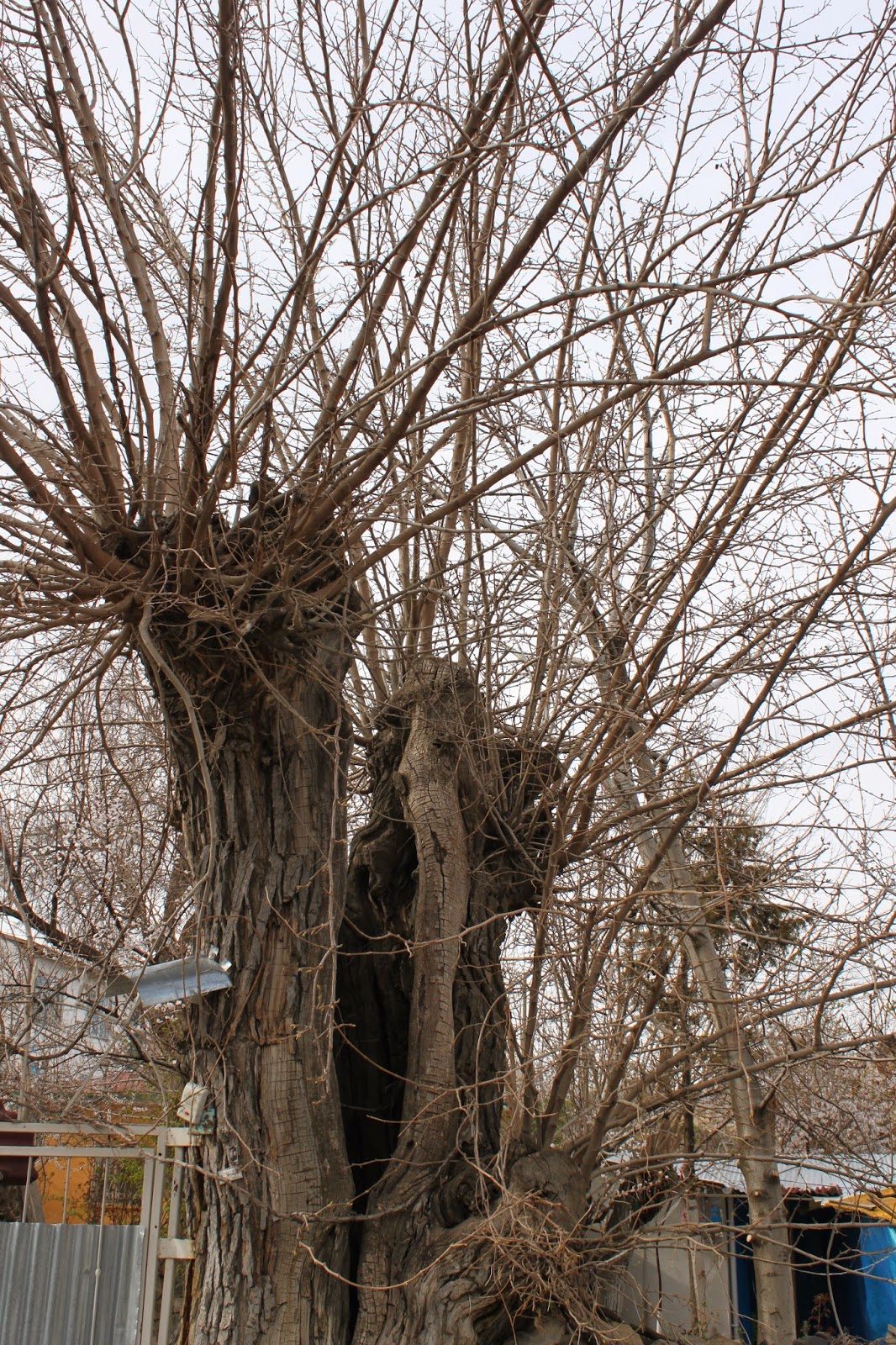
An old sycamore that I thought looked like an elephant (the right one)

A flowering almond in front of an old Harput house
The praying sycamore at the Ulu Camii (Great Mosque)
Across the square from the mosque, commanding a view of Elazığ on the plains below are the dramatic ruins of what was once an Urartu Fortress, dating back some 3000 years ago. You can still wander around its battlements and if you are willing to climb over a gate—as some teenagers and I did, you can plunge down a flight of stairs cut into the rock and explore the pitch black dungeons below.  
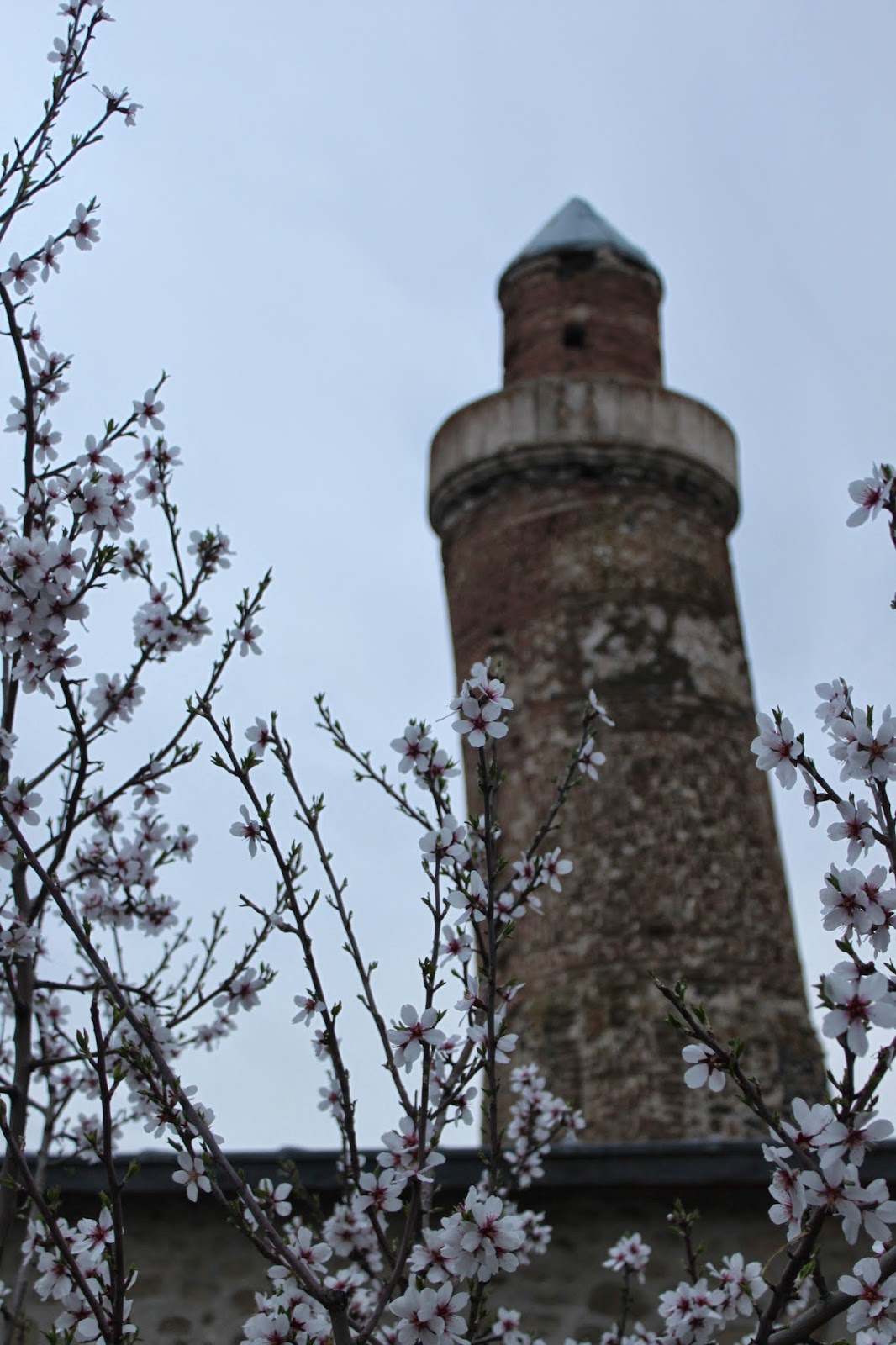
The leaning minaret of the Ulu Camii (Great Mosque)
 Harput also is the site of the Syriac Church of Ancient Mary (Kadim Meryem Kilisesi) which sits on a cliff just below the fortress. The church is a rock-walled cube completely sealed off from the world with only a few irregularly shaped windows placed high in the North wall. I climbed all over it and even skirted the walls that overlook a rocky ravine, but I could find no entrance. Upon reading some of Pat Yale’s articles, I found out it had been sealed up for a while now. According to the church’s Facebook site, it dates back to 179 AD—and is thus one of the oldest Christian churches in the world. In fact, a quick, unacademic seach on the internet turned up none older. The Santa Maria in Trestevere located in Rome is, according to Ask.com, the oldest, but it was built in 220 AD. The Duro-Europos Church in Syria is the oldest according to several websites and dates back only to 235 AD.  So if the claim of local Assyrians is true—this is easily the most ancient church in the world, and still in use on special occasions if their Facebook pictures can be believed.

The mosaic of dolphins at the church--no explanation


But I knew none of this when I was scaling the walls looking for a way in. There was a church. It was in the tour books. There had to be a way in. Two Kurdish guys joined me in my quest and, as we scrambled over rocks together (maybe there’s a door on the wall of this sheer drop) I heard them mumbling about what a shame it was that there was nothing here to explain anything—not even a historical marker. “History is always hidden here in the East,” one of them said. And it was at that point that I looked down into the ravine and and noticed the ruins of another building at the bottom. Wondering if I had somehow misunderstood and this new building was the church I was hunting for, I started down the goat paths to explore. I have a picture from the bottom of the ravine showing a collapsed wall and a vast slope of stone and bramble. When I Googled a picture of ancient Harput I turned up a photograph that showed this same slope, only crowded with buildings. The church and the ruins I had hiked to were all that was left of the old Christian Quarter of Harput—called Kharpert by the Armenians.
The view up the now empty hill toward the church and fortress

 
I got a shiver when I saw the picture. It reminded me that Harput had been at the center of the Armenian (and Syriac) Genocide every bit as much as Auschwitz had been part of the Jewish one. Many of the pictures of the famous photographer of the Genocide, Armin Wegner, are from Harput. I won’t reprint them here—it takes a strong constitution to look at them, but here and here is a link. On the very stones I had scrambled over starving Armenian children had laid down to die.
 

Subsequent research made me rather unsure about the church—after history was so thoroughly obliterated in 1915 (and then again so many times it’s hard to count, 1938 and then from the 80s onward there was another memory black out as the government waged its war against the PKK) the real story of the church could easily have gotten lost in the chaos. I found this picture on a sight of old Harput photographs showing the church of Church of Surp Asdvadzadzin (the Holy Mother of God)in the Assyrian district of Kharpert (Harput). But another website detailing the travels of some descendants of Armenian survivors of the Harput massacres say this name belonged to a huge monastery and that it has been reduced to rubble, but that the churches of St. Paul and St. Peter were still standing but used for storage by the municipality. Or this young Armenian woman who visited Harput--one of the comments says the church was Armenian and bought by the Assyrians.

As usual—there is no straightforward reliable historical account as no one is really interested in letting all those skeletons out of the closet. And so, as in Conag itself, there is all this unexplained past, deliberately erased and forcibly expunged from memory.

Edwin Bliss wrote a book called Turkey and the Armenian Atrocities that describe the sack Harput. A mob of Kurdish bandits appear from the North and East to attack the city—which the Ottoman government claims, of course, to have absolutely no control over. They are spontaneously enraged locals who are taking the law into their own hands due to rumors of Armenian insurrection. One eye witness says the approaching Kurds seemed to be ‘bent on destroying every last building.’ (Is that why this hill along the ravine has been completely denuded?) The eye-witness goes on to say

“The next morning after the attack, the Turkish military commander advised and urged leaving the college building, saying: ‘I can’t protect you here.’ Mr. Barnum (an American doctor) replied: ‘ The time has come for plain talk. I saw you standing on the hill there yesterday when our houses were plundered and burned, and you did nothing to prevent it.’ He also speaks of the ‘redifs’ who were Turkish soldiers disguised as Kurds. In other words, official members of the military pretending to be enraged members of a mob.
Elazığ (once called Mezire) on the planes below

The view of the Keban Dam Lake from the Fortress
There is a great continuity in all this—how is the mentality actually changed since the destruction of Harput in 1915? How many Kurdish villagers have I met or read about who tell about Turkish soldiers visiting them during the day and then returning to sack the village at night, but this time dressed as PKK guerillas? Or how about the undercover cops we’ve seen dressed as protesters who either lead or set off violence?
When I think of the Kurds now in prison—being released bit by bit but nevertheless being tried for made-up crimes by a government that in the press pretends to be defending them (like the soldier in Harput pretending to defend Dr. Barnum or the Government in Istanbul denouncing the very atrocities it was instigating with secret telegrams). It outwardly pushes for a peace process by word but not by deed, and this after decades upon decades of secret assassinations, mass graves ,burned villages and forced exile all under the justification of cleaning up ‘baby-killers and terrorists bent on splitting an independent homeland from the Turkish motherland’. I think of the Armenians in the early 20th century who were accused of terrorism for petitioning the government for the right to testify against a Muslim in court. In Kiğı, for instance, ağas could use all sorts of duplicity to steal land (both Kurdish and Armenian) and the Armenian could not sue--if they tried, they were labeled 'instigators of insurrection.' The eye witness I cited above spends the first few paragraphs of his account begging the reader to understand that the Armenians of Harput were not rebellious, were not terrorists, were not revolting against the goverment, because those same excuses were being used to burn their villages and drive them into exile and justify mass execution.
Or consider the ‘spontaneous’ mob attacks on all the buildings these past few weeks of the Kurdish affiliated HDP Party (or the ‘spontaneous mobs’ that drove out the Greeks in 1955) and all the rumors that the government orchestrated the whole thing—I think again of those soldiers who had orchestrated the Armenian massacres and pretended to be helpless against them. And all of these atrocities are covered up at the government’s command using the official news media (which I think now everyone understands is completely untrustworthy) the official government reports (ditto) and finger pointing. They were actually attacking us, you see? Poor us. The Dersimlis are savages. The Greeks are trying to overthrow the government. The Kurds are trying to split the motherland. The Armenians were trying to destroy the Empire. And anyone, like me, who doesn’t agree or at least wants to look at it more complexly and honestly is a foreigner who simply can’t understand the truth, or is lying, or is a propagandist for the enemy or trying to divide Turkey.

So on to Conag.

I woke up early to catch the first dolmuş from Elazığ to Karakoçan and from there, to Conag. On a whim, as I rode out I scribbled down the names of the roadside villages to look up later. My whim turns out to be prescient. In another passage from Bliss’s book, he quotes the same eye-witness:

We were surrounded for a week or ten days by a cordon of burning villages on the plain. Gradually the cordon of fire and fiendish savages drew nearer the city. The attack in the city was planned for Sunday.’

As I traveled by minibus toward Karakoçan on the Elazığ, Bingöl road I passed by several villages on the roadside that had all once been Armenian. Were these then that ‘cordon of burning villages’? Along the edge of the lake you pass Yukarıbağ with its little rest stop and market, once the village of Şeyhhacı with a population of over 600 Armenians and 258 Turks.  After the bridge over the dam lake you pass Muratbağ, once Gülişger.  There’s also Elmapınarı (once Verin Ağntsig), Güntaşı (once Köğvenk) and İçme, of which Bliss writes ‘Survivors are considered Moslems. Males are assembled in church, led out, and made to choose Islam or death. Protestant pastor killed. ‘ A picture of the church and congregation of the now long dead and gone İçme Armenians can be found here. These villages all little clusters of concrete houses and nondescript fields against the background of the lake. These were the villages whose fiery destruction lit the planes and splled the doom for the Armenians in Harput.
Election flags for the BDP against the snowy Mt. Taru (Mt. Silbus is lost in the mist)


I had never been to Conag outside of the summer and so I was thrilled to see these mountains in the Spring. In Karakoçan, I was picked up by the village driver, Şerafettin Abi, and as we pulled out of Karakoçan and started winding up into the mountains along the Peri River, I caught a vision of the famed Mount Silbus covered in snow.  The rocky canyons and ravines which in the summer were all earthy browns were now covered in green lichens and moss. Most of the trees, however, still had no leaves and so the usual splash of green from the poplars and pines and mulberries was absent—it was all wet earth colors, clay reds and deep maroons and orange-browns.

                Dede’s house was cold and we kept it heated with a wood stove. On the morning of the election we woke up to a blizzard. The winds howled down off of the mountains so loud that it sounded like a train barrelling down on us, and snow had piled up on the balcony outside. The valley below was invisible in the white winds. Dede and I sat around the stove during breakfast as he ran through all the local snow stories he knew.
Dede's house in the snow
 

                On March 15th back in the 40s (and this one I’d heard), two teachers from Trakya were busily getting the newly built village school ready for classes when an avanlanche swept down off the mountain and carried away part of the building. ‘We found one of the teachers down by the fountain below the village,’ Dede explained. ‘The other we’d given up for dead, but we went up to the school anyway and started digging in the snow. When the avalanche hit he had been writing on a paper pressed to the wall ‘March 15th, Snow Storm Hits’. And that’s exactly how we found him, nearly frozen to death with that paper still against the wall and his hand frozen to the pen! But alive!’

The hill above the spring and the wind screaming down the slope
                Or the story of the ‘Caravan Breaker’ (Kevrankıran in Dede’s words, though it probably should be Kervankıran) which is what he says the old ones called the Milky Way. ‘You see,’ he explained, ‘In the winter, the caravans would start off at the light of the morning star (Venus) because they knew that dawn was coming, but one night, they woke up to a great light in the sky, and thinking it the sign of morning, they set out. But morning was still far off and the caravan was caught in a terrible snow storm and utterly destroyed. The light in the sky was the Milky Way. They had mistaken it for the morning star.’

The snow off the balcony
                And he ended with the story of Aunt Suzan who came back to the village for her mother’s (and Dede’s wife’s) funeral. The day before she was going to leave, a blizzard hit, and she and her entire family were stuck for two weeks in Conag. ‘There were twenty of us!’ Dede says, ‘All closed up behind the snows in this house! But those were back in the days when the house was alive. My wife had dried food everywhere—kavurma and dried vegetables and honey and dried fruits.’

The view down toward the village center

A dog by the road winding up the mountain
                He ended with this story, I think, because he was thinking the same thing might be about to happen. I watched worriedly as the snow piled up outside.


                I spent the afternoon in Yayladere (Xolxol) the town up above Conag. The voting precincts were located here. Delal was an election monitor in the Yayladere high school (boasting 20 students) which housed 7 ballot boxes. We learned alot about Yayladere. First of all, there were a little over 500 registered voters, and half of those were soldiers and police, none of whom were from the town. As a result, the military has control not only of security but of the politics. And their influence extends far. Some of the BDP election workers we talked to said many of the people said they wanted to vote for the Kurdish party (the BDP) but were afraid to. There's a 3 decade long military presence here, complete with harassment and assimilation policies, and that isn't going to go away overnight. And despite government assurances, the pressure seems to be increasing out. Security cameras (called Mobese) have been set up on the road to the village since last year—God knows why, we waved at them every time we rode by—and several new military bases (karakols) have been built in the area despite government denials.

                We saw all sorts of trickery and deception that day. There were bribes of course. One of the ballot box chairmans told everyone who came in to vote for the AKP before he was told to stop (by Delal). One woman took it upon herself to guide in all the elderly, and was caught going into the ballot box with a man from our village, pushing his hand toward the CHP box despite his repeated requests for the BDP (The CHP was the overwhelming choice of the soldiers out here). Later into the evening, after polls had closed and counting was underway in larger cities, the electricity suddenly went off in both the village and in town, and it didn’t come back on till the next day. There were power outages at ballot-counting time in 22 different provinces of Turkey that night (all blamed by the Minister of Energy on a cat in Ankara). From Bingöl we got reports of stolen ballot boxes and in the days since the election, piles of burnt ballots have been found all over the country. In Istanbul, in Bakırköy, an empty apartment was listed as having 40 registered voters. A man in Zonguldak found out that there 2 imaginary roommates living with him who had somehow voted that day. I am sure the AKP would have made a killing without all the election fixing, but there were some close races in which it probably made a difference.

                So there is the update on my life which seems to be a Social Studies lesson eternally out in the field. And as both Twitter and You Tube are banned (wait, I just found out Twitter is back up!), as more and more meddling is revealed in the recent elections, as the sneaky military influence increases back in Conag—I wonder how many more lessons I have to learn.  

Saturday, March 1, 2014

Why I Haven't Posted In So Long


 No Hay Banda

 
               I have not put up an entry on this blog in months and most likely whatever readership I had garnered is now gone. But there’s not been much to discuss—everything I’ve been writing about just seems to continue on as is, in all its oppressive monotony. How many times can I talk about the comically unjust trials or the increasingly oppressive government? The details of my wife’s father’s trial seem obscene after a while. When I first wrote about them, there was an urgency to communicate just how bizarre they were, as if exposing this absurdity to the light would somehow make it go away. Now I’ve done that and it only gets more bizarre and nothing changes. We are beating our hands against some gigantic rock and expecting it crumble, but it doesn’t of course. And these days of course, Turkey is embroiled in a greater power struggle and the plight of our people languishing in its prisons seems to take a back seat.

                This morning was a beautiful morning. Outside it was overcast. From our balcony we could see the ever increasing skyscrapers in Ataşehir. Someone was operating a jackhammer in the street and so Delal brought out her bağlama and began to sing. She has an incredibly gorgeous voice and there is kind of a twisting in the gut whenever I hear her sing türkü—half the time I would like nothing more than to lay face down in the floor, cover my face and listen to her—the feelings her singing arouses are that strong and that visceral. I expect most would find that a strange reaction. She taught me a song ‘Bitlis’te Beş Minare’ and we sang it together and though I desperately wanted to write, there seemed no better way to spend a morning than singing  with her.

                It made me think of riding in the car with my mother, niece, and her daughter (my grandniece) Linleigh. This was back during my winter break in Alabama. Linleigh was fussy and my mother started humming something  out of her own head. She has a terrible singing voice in the conventional sense—at least when hushing a baby in a car, but there was something  deeply about it then. All of us hushed and listened, and Linleigh herself quited down and fell asleep. I think my mother’s voice carries so much time and memory that the things that make it unmusical—the gravelly quavering tones caused by the accumulation of age and years—are somehow scars that we know most intimately. She sang to me forty years ago and then to my niece 20 years ago and now to Linleigh and there is somehow the memory of all of us as babies, and all of us having passed into adulthood now and all that has passed inbetween. We are three generations all together and no longer children but growing older and older in the presence of this child to whom all his new and unknown and fresh.

                While I was in Alabama, Delal’s Dad’s trial—the Istanbul KCK trial—was supposed to start, but the defendants boycotted it. They were dissolving the special authority courts, went the argument, to this trial no longer had any legitimacy. So proceedings were postponed till April. This didn’t stop them from announcing a decision anyway, on the day the trial would have ended.  7 people were released. No trial but a decision. No defense presented but a release. It was made clear, yet again, that the legal process was a mere formality. There was a script to follow. Decisions had already been made and these 7 were going to be released no matter what happened in the courtroom. And whose decision was it? The followers of the Gülen cult who are everywhere planted in the judicial system? Or those loyal to the increasingly dictatorial Prime Minister? Or was this a relic of their cooperation back in the old days that no one was going to take care of because one thing that they can all agree on is fuck the Kurds.

                We had a teacher’s meeting the other day. They are called ŞÖK meetings—where all the teachers of one class get together and discuss the students one by one. There’s one boy in my eighth grade class who is rather mouthy, bright but lazy, and generally a pain in the ass to manage. I’m fond of him, though. I like him because he’s witty, because he doesn’t just swallow whatever he’s told, and because he can be quite original. One teacher offers this as an explanation for his behavior problems-- ‘Well, his mother is from the Southeast. Perhaps that blood is the source of things.’ ‘From the Southeast’ is shorthand for ‘Kurd’ when you don’t believe that any race exists except Turks. I couldn’t believe I’d heard what I’d heard—it seemed so ridiculous, especially coming from a teacher, an adult, a person whose job it was to care for these kids. But this kind of racism is so common that no one even thinks to comment on it. And that is an oppressive thing to deal with.

There are constant little indignities that we swallow that seem such a waste of breath to explain somehow. Like how Delal’s dad is brought in handcuffs to the hospital for his check up. A sixty one year old man handcuffed as if he were a dangerous criminal—which of course they are trying to pretend he is with this kangaroo court. Handcuffed to get treatment for diabetes and kidney problems.

So I haven’t felt like writing much because it’s only the same old same old over and over again and you begin to feel sick that nothing changes, that there is something hopelessly toxic about society, that explaining it to anyone is not only useless but somehow obscene. And while a lot of what happened in the protests last year gave me cause to hope for something better—the turn out from all sections of society for the Gay Pride Parade for instance and the the emergence of all sorts of neighborhood organizations trying to build a way of life quite different for themselves—the grander sweep of national and world events makes me think that only ignorance and perfidy and skulduggery prevails, and it prevails indefinitely.

And the next time I write and post a blog—I think it will either be news of my father-in-law’s release or else some short comic sketch. Something that will break with all I have written before and make it irrelevant.
 

Saturday, October 5, 2013

The KCK Trial Resumes

File:Salem witch2.jpg
One of the predecessors of the KCK trials
              

No more long breaks--the KCK trial will now drive forward with occasional weeklong breaks until the government gets what it wants, I presume.

                It's October 1st. We board the bus from home which begins our three hour trip to the courthouse in Silivri. I have taken a personal day from school to do this, but Delal does this every day. Sometimes she comes back at night, which means 6 hours of traveling every day except Wednesday. And we are one of the lucky families in terms of travel time and logistics. Nevertheless, however fortunate we may be relatively speaking, this whole process is stressful, and has a wear and tear on our lives here that increases with time. It's been two years! On the bus ride, I catch a glimpse of a newspaper article about the government shut down in America and I think of all the hysterical shouting about ‘communism’ and ‘dictatorship’ over this watered-down, anemic health care plan—God forbid the US should ever get a taste of what a real dictatorship is like (or real health care) but these games back home irk me today. How could people there be so blind and ignorant?

                By the time we arrive, the trial has already started. I hear Judge Ali Alçın’s voice as we rush down the hall—he is shrieking in that high pitched nasal voice of his, shouting at the lawyers. When we enter he has just finished and things are settling down. I won’t go into too much detail here—the proceedings are monotonous, the same absurdities dragged out again and again, over an over. Two people give their defense today—no one says the name of the first very clearly (none of us catch it) but the second is a man named Kiyaset Mordeniz. Both are local officials for the BDP. The proceedings are the same. Judge Ali asks ‘You were seen at a political rally on such and such a date, what do you have to say to that?’ And both of them give the same answer, ‘First, I was not at that particular rally, and even if I had been, it would not have constituted a crime because the BDP is a legally recognized political party and as an official, I have a right and duty to attend a rally.’ One piece of evidence is that a picture was taken showing one of the men near a building where a political meeting was taking place. Again--'is being near a building enough to prove I joined the meeting and even if I had...' The mentality if frighteningly stupid.

                At one point, Judge Ali starts to quote a personal phone conversation between Mordeniz and his wife. The lawyers stand one by one and issue their objections, private conversations have no place in the courtroom they insist. But Ali shouts them down—he does this alot today—and proceedings resume with this intimate phonecall between a husband and wife.

                It is clear to me that these people are being tried here for being in the BDP on the State’s assumption that it is equivalent to being a member of the PKK. They are arguing against a mentality capable of seeing the world only in a very rigid and twisted way.  People who oppose the government’s line are trying to divide the country and are terrorists.  Any concession you make to anything they do or say is treason. It’s the mentality of McCarthy, of the Witch Trials, of any of history’s frightening and monsterous purges. It’s all spectral evidence and guilt by association and circumstantial evidence and thought crimes—all the things that democracy has spent the last four centuries trying to stamp out. It's a disease.

                At the breaks, we wave to my father in law. We try to talk over the huge distance but even with shouting it’s impossible to hear anything. And after a minute or so, the guards shove them all out anyway. They must vacate the courtroom during the breaks—no choice, no tolerance, no mercy for those who have no other way to see their loved ones. I am sure in the eyes of the hysterical Judge Ali—our personal devil in all this, our Judge John Hathorne—we are also terrorist witches who must be stamped out forever.

That’s a real dictatorship, kids. The Law doesn’t protect you, it attacks you. The State sees you as the enemy and changes its policies as necessary to punish you, and then uses lies and animadversions to hide what it’s doing. Because you are assumed guilty, anything you do is spun to support that claim and as evidence is not really important, nothing you can say can exonerate you. Nothing is certain—not the fairness of judges or the absoluteness of the Constitution—nothing except that the State will win. Things will always be adjusted to ensure that ending. For those back home playing like this is what you are experiencing, you should hang your heads.

Wednesday, September 18, 2013

Kemal Seven's Defense at the so-called 'KCK' trials

ARTICLE as it appeared in Yuksekova News 'The Voice from Hakkari' and also ODATV on September 12th. The English Translation is Mine
Logic from Judge Ali Alçın--the terrorists most deadly tool, the planner!

The Istanbul ‘KCK’ trial put off until tomorrow

The main trial of 205 human rights activists and Kurdish politicians, 95 of whom remain incarcerated without bail, has been adjourned off until tomorrow.
 
Istanbul’s ‘KCK’ trial of 205 human rights activists and Kurdish politicians, 95 of whom remain incarcerated without bail, continued today at Silivri at the 15th Criminal Court located across from the Silivri Penal Institution with the defense of prisoner Kemal Seven,  an educator at one of the BDP’s political academies. At the start of his defense, Seven indicated that he wanted to make a change in the statement he gave the prosecutor. ‘In my statement, It seems I said that I was a member of the Peace and Democracy Party (The BDP). At the time (of my arrest), I was not yet a party member but merely working there. I want this corrected.’ Seven went on to discuss the additional files attached to the indictment prepared against him, specifically a segment regarding his telephone on which the numbers of Abdulkadir Akdağ and Nural Doğan appear*. He asked why this was added to the indictment as evidence of a crime. ‘These people are members and workers of the BDP party. Since I am also a member and worker of the BDP party, isn’t it normal to find their numbers on my phone?’ In regards to his trips overseas which were spun as evidence of links with out-of-country PKK and KCK members, he said ‘In 2003, I went to Germany to visit my brother who had been arrested. As for 2010, I went then to marry my brother off. In any case, millions of people leave the country every day and that’s not a crime, but when a Kurd does it, it’s a crime? Seeing any logic in this is a strain, really.’
Also, Seven discussed a text message sent to him by the Kurdish Institute, in Kurdish, with the words
'The message stated,' he explained, '‘The history lesson will be given at 1:00PM’. ‘Then in the attached files the prosecutor makes this comment, ‘Placing men in the PKK Kongra Gel (guerillas)’. Where this came from I cannot understand. It’s shocking how you can extract that from what was said.’
In another message sent by the Institute are the words ‘Tonight there is no taking watch at the tent. TZP Kurdistan.’
‘First of all,’ Seven said, ‘This message was not just sent out to me, but to all members of the Institute. At the same time, it is attempted to show that this ‘keeping watch’ was somehow my watch to keep. There was nothing of the kind. Moreover the word ‘TZ Kurdi’* is explained as TZP Kurdistan. This reveals the level of ‘seriousness’ with which this indictment was prepared.’ After Seven requested to be released, the court moved on to the files of evidence.
First, head judge Ali Alçık asked if Seven had attended a rally in 2011 for Peace Day on September 1st. Seven said that indeed he had and that this had been a democratic action. Alçık went on to say, ‘On several CDs found in your house were lists of addresses. What do you say to that?’ (By the way, one of these lists was our wedding invitations) ‘You’ll also find Cemil Çiçek’s internet address, too. (He’s the AKP speaker of parliament.) It’s a rather normal thing.’ Alçın went on ‘We also found pictures of you with Gültan Kışanak and Sebahat Tüncel (two BDP members of parliament), what do you say to that?’ Seven answered, ‘These were photos taken at the opening of the BDP academy. I have a lot of photos like this.’
Using Judge Ali Alçın and friends' logic--Oprah is a terrorist for appearing with an elected official
 
 
The Prosecutor Ismail İsık (who never speaks by the way) said, ‘A planner was found at your house in which the sentence was written ‘the state will either accept the leadership or a revolutionary people’s war.’ This so-called ‘leadership’ you mention—to what does it refer?’
‘This is a quote I took from a press statement and noted down.’ Seven answered. ‘As for who the ‘leadership’ referred to his, Mr. Öcalan is meant.’
After the presentation of the evidence, the court committee once again asked the incarcerated prisoners to give their defense, calling each one by name. When they answered, ‘Ez ne amede me’ (I am not ready in Kurdish) the floor was given to publisher Ragip Zarakolu, tried on bail (and thus out of prison). When he said he was not ready either, the court announced that seeing as the defendants are not ready to make their defense, the court would be adjourned until tomorrow.
*note, the defendants presented a list to the court. The list contained names in order the order that they wanted to give testimony. When the court rejected this and imposed its own order, the defendants protested by saying ‘I’m not ready.’
*TZP Kurdi (NOT Kurdistan, which, at the time this indictment was prepared was a taboo word) stands for Tevgera Ziman û Perwerdehiya Kurdî (TZPKurdî) which means ‘The Movement for Education in the Kurdish Language’—a Kurdish group dedicted to establishing education in their mother tongue.
*Nural Doğan is the vice chairman of the Istanbul province of the BDP. Abdulkadir Akdağ was the party chairman of the Fatih District (of Istanbul)—both arrested at the time of my father in law’s arrest. 

Sunday, June 9, 2013

Where is all this going? The week in Silivri, the weekend in Gezi Park


I must be careful of words—the old cliches don’t work anymore. Freedom, democracy, liberty, tolerance—the wrong people have used them for the wrong things for so many years. Sometimes with good intentions, sometimes with bad. My ears hurt to hear them.

So let me paint a picture.

Gezi Park, Taksim Square—The heart of Istanbul. To the left of the stairs that lead to the park, the Kurds dance the Halay in an everwidening circle. The Kurdish flag flies and the radio blasts guerilla songs. A crowd moves past them—‘Turkey for the Turks’ Kemalists most likely with red star and crescent banners emblazened with Atatürk’s face. They chant ‘We are soldiers of Mustafa Kemal!’ Down the path a little bit, they will come across a group of gay men marching in the other direction chanting, ‘We are NOBODY’S soldiers.’ They are hamming it up big time. Between the two converging groups you find a tent for the Turkish Socialist Party—old school hardliners, and another tent of middle-aged Armenian churchladies distributing cookies. Down in the main square, some Black Sea people dance the wild horon.
A week ago--you would never have seen an Ataturk flag and a BDP banner together...


A few weeks ago, things would have been very different. The Kurds and Kemalists would have been fighting in the streets; the gay men harassed or jeered, maybe by the Black Sea boys, the Armenians would have been trying to keep a low profile and everyone would have beeb watching what they said—as afraid of each other, even, as they are of the government. But in Gezi Park this weekend they are all here, speaking out, without fear or censure. They don’t necessarily like each other—make no mistake about that--but they tolerate each other, they leave each other alone.

The media calls it a carnival or a festival or a party. But it’s much more organized than that—a funhouse reflection of a state. And together our protesters have created a miniature city within a city that reflects the dream of Martin Luther King—however ephemeral, however tenuous, however fast the army of police and marauders approach, people feel ‘free at last’.

Together, these disparate groups have built a ‘Museum of the Revolution’ pasting pictures of the police attacks and subsequent resistance in the abandoned trailer of the construction crew’s foreman. They have transformed the overturned and looted cars of the civil police into day-glo platforms of free speech—everyone grabs a spray can and writes what they think. And, in a first for Turkey, they write it with no fear or hesitation.

They’ve created a ‘Market of the Uprising’ where they distribute drinks for free. They set up a ‘children’s studio’ where kids get messy with tempera paints and create whatever they hell picture they want on huge sheets of white paper, emerging from their efforts covered in color.

They have trash teams that do clean up of the grounds and somehow have managed to publish two newspapers ‘Tomorrow’ and ‘The Future’ which they distribute among the hundreds of thousands of people who come to visit every day. They’ve set up a television station (online of course), a radio station, several different websites in a multiplicity of languages. They’ve created a ‘Parliament’ where different people come and debate each other and a moderator turns off their microphone whenever they get aggressive or insulting.

Now let me give you a bit of what Erdoğan’s AKP has in mind for these people—in case you couldn’t guess from the continuing brutal police attacks and arrests in Antakya, Ankara, Eskişehir and Izmir. Or from the tortures of detainees here in Istanbul (http://www.hurriyetdailynews.com/sex-as-a-police-punishment-.aspx?pageID=500&eid=258#.UbHIMd3zpWI.facebook)

You see,  I could not make it down to Gezi Park until Friday because the rest of the week my family was kept busy by the KCK show trial of my father-in-law and hundreds of others. The trial took place in Silivri and has been going on for almost two years. For some reason, my more enlightened work colleagues at the protests were under the impression that everyone had been released. This was a devastating blow to our morale. How could people aware enough to come to Gezi NOT KNOW??

For the past year and half, the trial has been held in Silivri prison’s old courtroom. The first time I was there, I counted about 60 chairs on the right of the court room for defense attorneys, another 60 on the left of the courtroom for government officials and parlementarians, in the middle over 200 chairs for defendants, and in the back a small section for visitors. Well we’re in the new and improved courtroom now. Recently completed, AKP authorities have added another section for defendants—I think it is up to 250 chairs now. There are now 180 chairs on the right for defense lawyers and 180 more on the left. The section for the journalist and parliamentarians is now in the far back corner where it is difficult to see or hear and numbers maybe 45 chairs—3 in a row and 15 deep. Only the first two rows could see anything.

What is the symobilism here? What needs is the government anticipating? Even larger mass trials with hundreds of defense attorneys and a pliant press that sits obediently and silently in the back?

The crowds here--these are the people that the Prime Minister is expanding the size of his courtrooms for.
These chairs are meant for groups like our young protesters—the children painting in the ‘art’ tent. The old lady distrubiting lemonade. The bagpipe band I saw perform on the square.

And when the protesters are brought here, what sort of justice awaits them? Well, let me give you a sample. Most things you’ll be forced to buy from the prison. Socks for instance. Your family won’t be able to bring much to you at all. And take a book because you’re going to be there a while. We waited a year while the court read the indictment aloud—it was over 2000 pages (you need that many for mass trials of over 200 people at a time) and while we waited for them to finish reading, our relatives and friends languished in prison, many nearly dying in a hunger strike last fall. The reward for the hunger strike? More of the police attacks the protesters are eating on the square and a year and a half of no visitations, five months of no outside contact, ten days in isolation. But if you have been reading this blog, you know all this.

So what happens to the protesters once the indictment is read?

These days, at our trial, the suspects are coming up one by one before the court and giving the statements of defense. They are allowed to do this in Kurdish now. There are three translators in the courtroom, though they have a hard job at times. After decades of prohibiting the language, no one is confident that they speak it well enough for a courtroom. And in many cases they don’t. Still, here is what some of the defendants said. I am summarizing from notes—this is not a word for word dictation and it’s been twice translated. But please government reporters and conspiracy nuts, rest assured, I am not hiding any sudden outbursts of ‘Hey everybody, I’m a terrorist! And I’m gonna get you!

These girls--some of the drunks and looters (chapulcu) Erdoğan spoke about. Will they be arrested when the show trials begin?

A man named Kemal Aydin was first—he once was the local chairman of the BDP offices in Esenler. After paying respects to the court and judge, he reminded them that he was a member of a legal political party, whose bylaws and platform had been submitted to the Constitutional Court and approved.

‘You say working for this party is a crime. Going to rallies, making phone calls—crimes. We submitted all the paperwork to your courts. Everything I’ve done has been legal and open. Your courts recognized our legitmacy—then how now are we criminals?’

Our protesters might make a similar argument—that civil disobedience is a legally recognized right protected by most constitutions in the world.

 ‘I am an activist,’ Mr. Aydin went on. ‘And I feel a great responsibility to my conscience. In our thirty years of activism, five of my relatives have lost their lives. One was my brother, one was my daughter, and three were my nieces and nephews. If you want to open a case against us, then you should start by opening their graves.’


This little looter girl and her drunk dad will be rounded up maybe, and the little drunk soccer fan above them, too.
The judge started to ask about contents of certain secret files whose contents have not been read aloud to the court—do we have no idea what they said. Have no doubt that enthusiastic police are preparing similar secret files for the protesters.

‘Our secret witness Haydar says you were present at rallies where terrorist slogans were chanted,’ says the judge.

‘Excuse me,’ Mr. Aydin answers. ‘But who is this secret witness, Haydar? How can I respond to that if I don’t know who he is? How do I know that your secret witness was not coerced into confession by torture or even real?’

Here you are—terrorist slogans at rallies. This is what the Prime Minister says about the Gezi Park protests now. Terrorist and secret agents agitating the masses. How many secret witnesses might this government find, how many ‘Haydars’ to accuse those braveyoung people in Taksim and Ankara and Beşiktaş and Izmir. They are clearly getting the stage ready—hundreds have been arrested already—five today were arrested in Adana (June 8th).

Perhaps police will use secret witnesses or phone recorders to prosecute this terrorist member of a marginal group
Osman Akdağ is another defendant who tried to explain to the court where he was coming from.

‘I have never spent more than one month together with my children. I spent 28 years in exile and when I came back, I was arrested within 3 months for ‘terrorist’ activities. How could I manage such a range of ‘activities’ in just three months!? I spent many years in prison in this country. So did my children. Many of my friends in prison suffered severe torture. One man lost his eyes. Two set themselves on fire to protest their treatment—one of these guys had been so badly maimed by police torture that he was paralyzed and we had to carry him to the toilet. And my story is not unique, hundreds upon hundreds of people experienced the same sorts of things. The only thing that prison gave me was time to learn to read and write—but the funny thing is one of your pieces of ‘evidence’ is a notebook that supposedly belongs to me. Well that notebook is 18 years old and was written long before I’d learned to write it. How is that possible? And how could I have written it in Turkish when I still can’t write that language? I write only in Kurdish!’

Police brutality, eyes put out, fabricated evidence—the net has widened now. Everyone in Turkey can now experience these things. How many eyes have been put out by plastic bullets in Beşiktaş and Ankara? Two young men have lost their lives to beatings—I heard rumors of a third this morning-- most likely by secret police—Abdullah Comert died in Hatay, the other boy in Eskişehir.


Perhaps these are the foreign spies that the AKP say instigate the crowd.
Defendant Ahmet Demirsoy speaks after the lunch break. ‘I am a conscientious objector,’ he tells the court. ‘I do not believe in violence of any sort.’

I think of the gay men with the sign, ‘We are no one’s soldiers.’

‘I am against all forms of militarism,’ he continues. ‘I saw villages burned, children shot and killed. I have worked to have everyone’s rights recognized. I emphasize the word everyone. Any militarized country says to its army, ‘You will kill take this gun and kill or you will die.’ They turn us into murderers or martyrs. I refused. I cannot be a terrorist, and I am no robotic follower. You say you have telephone recordings that show I was part of a ‘terrorist group’. Let me discuss one of your recordings. I was speaking to a French friend who had trouble pronouncing certain letters. He said, in French, ‘Lets go to Akhtamar’ but it came out like a guttural ‘Amara’ (The Kurdish name for the village Abdullah Ocalan was born). That is admissable evidence for you. The misunderpronounced name of a city spoken in a language your police could not understand.’
 

I think of all the foreigners I saw in Gezi Park yesterday—the marchers with signs in French, German, English and Dutch. How will police use this agains them? The police shout out for people not to listen to ‘provocateurs’ right before they gas them. The Prime Minister warns of foreign agents. What is it they have planned? They can twist anything you say into evidence. One of the tweets used to arrest the Twitter writers was ‘The police are here. Don’t come!’ This is proof of terror and incitement to violence?

The last person to speak is Mehmet Kıymaz. He repeats the argument that they have all been brought in for working for a party recognized as legal by the government. ‘I lived and worked in Küçükçekmece for  22 years. I retired in 2008 and became the BDP party’s accountant there. As the accountant, I was very busy and had to intend every single meeting and rally we had. It was my job! And now you say I am guilty for ‘my presence at certain meetings?’ I am guilty for performing my legal duties as accountant for a legal political party? Some of our people are very poor, as you know. I gave them bus money to attend our rallies—men, women, children. They couldn’t have gone otherwide. Bus money! And because of that you accuse me of funding terrorist organizations?’

The people in Ankara, from what I understand, were arrested by a similar leap of logic. By their protest in the street, they were fomenting a coup. Every action taken by a protester is interpreted as incitement to violence, a terrorist acts, plotting and meddling.

On Friday, June 7th, we got the news. 14 people in the KCK Silivri trial were released leaving 90 more behind in prison. And the one hundred or so who have been released are still being tried—let me emphasize that. Life sentences are being planned for many of them. And this is just at Silvri. KCK trials are being run all over the country—two more are in Istanbul alone. And people think they are all released. We’re forgotten—even by those who shouldn’t forget. After a few years they will forget about our protesters, too. They will sit in jail, yesterday’s news.

The government has already done away with the army in the Ergenekon case, for better and worse, and the Kemalist with the Balyoz case. Now the Kurds of the BDP are being finished off. One by one the opposition is being picked off. I suppose they have the Gezi Park protesters in their sights now. A big spacious courtroom is waiting, and 30 years of precedence.


Some more of the vandals and provocateurs who need to be rounded up for a mass trial
As you resist, remember what waits for you if you lose, and if you win, remember all of those who went before you. I admire what you’ve done. The whole world does. Carry forth in peace and fairness, and remember that democracy is for us all.