Showing posts with label Silbus. Show all posts

Thursday, April 3, 2014

Conag at Election Time With A Side Trip to Harput

A flowering almond (?) tree in Harput

 
WINTER CONAG, HARPUT, AND THE GREAT ELECTION FIASCO OF 2014


Restored House in Harput--The Şefik Gül Kültür Evi

                A lifetime of Social Studies lessons with my old history teacher Mrs. Gibble could not teach me as much as just one week of living in Turkey. I’d intended this rather naively to be a simple travelogue of my recent travels to Harput, an ancient city outside Elazığ, and then on to Delal’s village of Conag for the elections, but one cannot avoid some sort of tragedy or atrocity or the memory thereof once you go East. So I apologize ahead of time—for all the heavy stuff to follow.

It’s been a whirlwind week—last Wednesday, Delal’s phone started getting a storm of messages at around 3:30 in the morning. 37 people in the KCK trial her father, Kemal Seven, is enmired in were released! We were quick to learn that her father was not one of them, but rather one of the 34 the court deemed likely to ‘run way’ if they were let out. There was no explanation for why it happened. Apparently the lucky ones were simply approached by the guards, told they would be let out that day “and very soon at that, so get your stuff packed.” They were kicked out (don’t let the door hit you as you go out) into the pouring rain with no reporters, no supporters, and more importantly, no car waiting for them to carry them from the prison’s remote location in Silivri’s farmland to home or at least to Istanbul—over an hour’s drive away—or anywhere not dark and wet and cold. After some phone calls begged from the guard at the gate, they arranged a ride and showed up on their families’ doorstep just as they had been taken away—in the middle of the night and unannounced. And why? Who knows? This is Erdoğan and Fethullah’s (increasingly  more Erdoğan’s) Turkey and like Cartman or that nasty little toddler in the Tylenol commercial, they can do whatever they want, however they want, whenever they want.  And they’ll cover their asses with news blackouts, misinformation, finger pointing (they’re too dangerous to let go) like they have for centuries.

                Local elections were also this week—when all of Turkey would be selecting its mayors, governors, city council members and village headmen (muhtar). It was considered a vote of confidence on the increasingly authoritarian AKP government and saw a record campaign effort, a record turn out, and a record level of tension. This was after Gezi, after the mob attacks on the Kurdish affiliated HDP party, after the corruption scandals and mass arrests and mass releases of convicted murderers. So Delal and I went to the village, where she is registered, so that she could vote. Because of work, I couldn’t leave on the same day as her, so I flew out on Friday and spent a day wandering around the old city of Harput before catching a bus to Conag.

The famed Urartu fortress of Harput
The lampposts of Harput--in front of an abandoned house
Harput was a nice breather—it’s a centuries, if not millenia-old town on top of a hill just outside the newer concrete city of Elazığ. It commands a sweeping view of the lake ofthe  Keban Dam and the snow-peaked mountains to the East and North—where Dersim lies. The town is like a nostalgiac illusion from a photograph taken centuries ago, with traditional stone houses, a thousand year old mosque, tombs of Muslim saints, flowering almond and apple trees and huge sycamores centuries old. The Great Mosque is a graceful little building from a different age, with a leaning minaret and a courtyard open to the sky—totally unlike any mosque I have ever seen, with no minbar and a design not focused on the kible. It’s surrounded by pink-flowering almond trees and on the East side has a gigantic sycamore erupting through the cement—it’s trunk split in two and bent, like two elbows, as if the tree itself were performing the namaz.
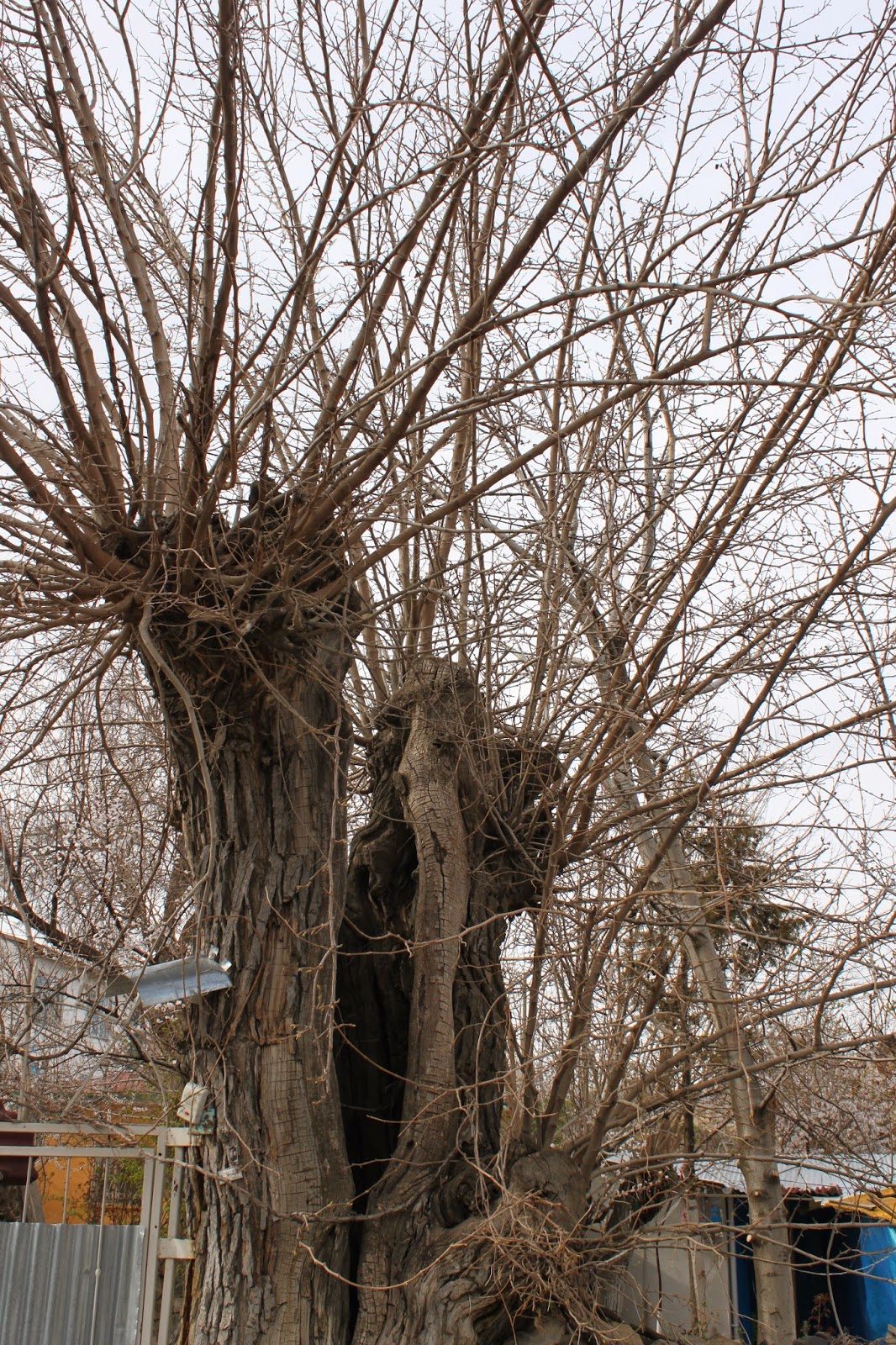
An old sycamore that I thought looked like an elephant (the right one)

A flowering almond in front of an old Harput house
The praying sycamore at the Ulu Camii (Great Mosque)
Across the square from the mosque, commanding a view of Elazığ on the plains below are the dramatic ruins of what was once an Urartu Fortress, dating back some 3000 years ago. You can still wander around its battlements and if you are willing to climb over a gate—as some teenagers and I did, you can plunge down a flight of stairs cut into the rock and explore the pitch black dungeons below.  
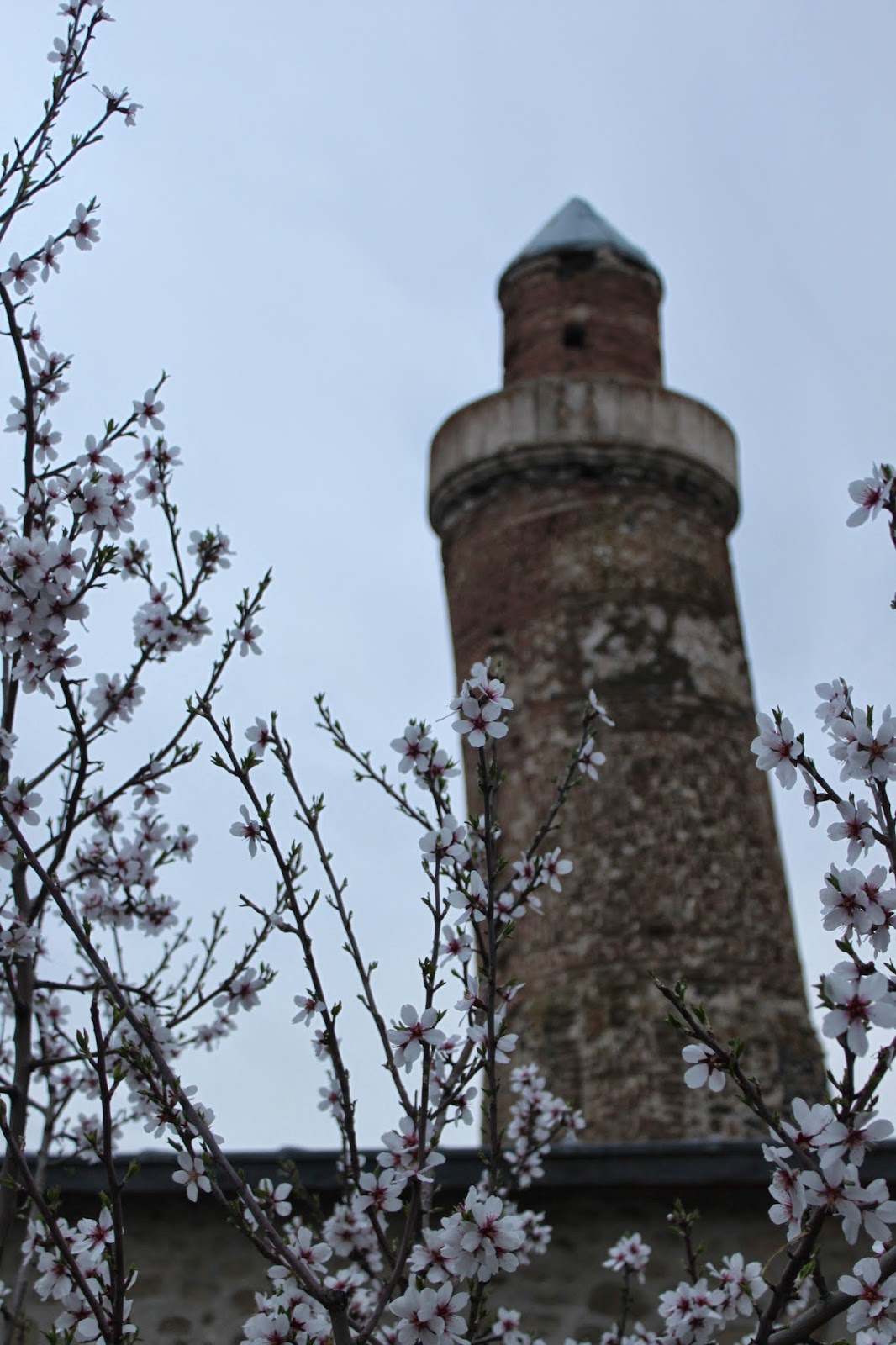
The leaning minaret of the Ulu Camii (Great Mosque)
 Harput also is the site of the Syriac Church of Ancient Mary (Kadim Meryem Kilisesi) which sits on a cliff just below the fortress. The church is a rock-walled cube completely sealed off from the world with only a few irregularly shaped windows placed high in the North wall. I climbed all over it and even skirted the walls that overlook a rocky ravine, but I could find no entrance. Upon reading some of Pat Yale’s articles, I found out it had been sealed up for a while now. According to the church’s Facebook site, it dates back to 179 AD—and is thus one of the oldest Christian churches in the world. In fact, a quick, unacademic seach on the internet turned up none older. The Santa Maria in Trestevere located in Rome is, according to Ask.com, the oldest, but it was built in 220 AD. The Duro-Europos Church in Syria is the oldest according to several websites and dates back only to 235 AD.  So if the claim of local Assyrians is true—this is easily the most ancient church in the world, and still in use on special occasions if their Facebook pictures can be believed.

The mosaic of dolphins at the church--no explanation


But I knew none of this when I was scaling the walls looking for a way in. There was a church. It was in the tour books. There had to be a way in. Two Kurdish guys joined me in my quest and, as we scrambled over rocks together (maybe there’s a door on the wall of this sheer drop) I heard them mumbling about what a shame it was that there was nothing here to explain anything—not even a historical marker. “History is always hidden here in the East,” one of them said. And it was at that point that I looked down into the ravine and and noticed the ruins of another building at the bottom. Wondering if I had somehow misunderstood and this new building was the church I was hunting for, I started down the goat paths to explore. I have a picture from the bottom of the ravine showing a collapsed wall and a vast slope of stone and bramble. When I Googled a picture of ancient Harput I turned up a photograph that showed this same slope, only crowded with buildings. The church and the ruins I had hiked to were all that was left of the old Christian Quarter of Harput—called Kharpert by the Armenians.
The view up the now empty hill toward the church and fortress

 
I got a shiver when I saw the picture. It reminded me that Harput had been at the center of the Armenian (and Syriac) Genocide every bit as much as Auschwitz had been part of the Jewish one. Many of the pictures of the famous photographer of the Genocide, Armin Wegner, are from Harput. I won’t reprint them here—it takes a strong constitution to look at them, but here and here is a link. On the very stones I had scrambled over starving Armenian children had laid down to die.
 

Subsequent research made me rather unsure about the church—after history was so thoroughly obliterated in 1915 (and then again so many times it’s hard to count, 1938 and then from the 80s onward there was another memory black out as the government waged its war against the PKK) the real story of the church could easily have gotten lost in the chaos. I found this picture on a sight of old Harput photographs showing the church of Church of Surp Asdvadzadzin (the Holy Mother of God)in the Assyrian district of Kharpert (Harput). But another website detailing the travels of some descendants of Armenian survivors of the Harput massacres say this name belonged to a huge monastery and that it has been reduced to rubble, but that the churches of St. Paul and St. Peter were still standing but used for storage by the municipality. Or this young Armenian woman who visited Harput--one of the comments says the church was Armenian and bought by the Assyrians.

As usual—there is no straightforward reliable historical account as no one is really interested in letting all those skeletons out of the closet. And so, as in Conag itself, there is all this unexplained past, deliberately erased and forcibly expunged from memory.

Edwin Bliss wrote a book called Turkey and the Armenian Atrocities that describe the sack Harput. A mob of Kurdish bandits appear from the North and East to attack the city—which the Ottoman government claims, of course, to have absolutely no control over. They are spontaneously enraged locals who are taking the law into their own hands due to rumors of Armenian insurrection. One eye witness says the approaching Kurds seemed to be ‘bent on destroying every last building.’ (Is that why this hill along the ravine has been completely denuded?) The eye-witness goes on to say

“The next morning after the attack, the Turkish military commander advised and urged leaving the college building, saying: ‘I can’t protect you here.’ Mr. Barnum (an American doctor) replied: ‘ The time has come for plain talk. I saw you standing on the hill there yesterday when our houses were plundered and burned, and you did nothing to prevent it.’ He also speaks of the ‘redifs’ who were Turkish soldiers disguised as Kurds. In other words, official members of the military pretending to be enraged members of a mob.
Elazığ (once called Mezire) on the planes below

The view of the Keban Dam Lake from the Fortress
There is a great continuity in all this—how is the mentality actually changed since the destruction of Harput in 1915? How many Kurdish villagers have I met or read about who tell about Turkish soldiers visiting them during the day and then returning to sack the village at night, but this time dressed as PKK guerillas? Or how about the undercover cops we’ve seen dressed as protesters who either lead or set off violence?
When I think of the Kurds now in prison—being released bit by bit but nevertheless being tried for made-up crimes by a government that in the press pretends to be defending them (like the soldier in Harput pretending to defend Dr. Barnum or the Government in Istanbul denouncing the very atrocities it was instigating with secret telegrams). It outwardly pushes for a peace process by word but not by deed, and this after decades upon decades of secret assassinations, mass graves ,burned villages and forced exile all under the justification of cleaning up ‘baby-killers and terrorists bent on splitting an independent homeland from the Turkish motherland’. I think of the Armenians in the early 20th century who were accused of terrorism for petitioning the government for the right to testify against a Muslim in court. In Kiğı, for instance, ağas could use all sorts of duplicity to steal land (both Kurdish and Armenian) and the Armenian could not sue--if they tried, they were labeled 'instigators of insurrection.' The eye witness I cited above spends the first few paragraphs of his account begging the reader to understand that the Armenians of Harput were not rebellious, were not terrorists, were not revolting against the goverment, because those same excuses were being used to burn their villages and drive them into exile and justify mass execution.
Or consider the ‘spontaneous’ mob attacks on all the buildings these past few weeks of the Kurdish affiliated HDP Party (or the ‘spontaneous mobs’ that drove out the Greeks in 1955) and all the rumors that the government orchestrated the whole thing—I think again of those soldiers who had orchestrated the Armenian massacres and pretended to be helpless against them. And all of these atrocities are covered up at the government’s command using the official news media (which I think now everyone understands is completely untrustworthy) the official government reports (ditto) and finger pointing. They were actually attacking us, you see? Poor us. The Dersimlis are savages. The Greeks are trying to overthrow the government. The Kurds are trying to split the motherland. The Armenians were trying to destroy the Empire. And anyone, like me, who doesn’t agree or at least wants to look at it more complexly and honestly is a foreigner who simply can’t understand the truth, or is lying, or is a propagandist for the enemy or trying to divide Turkey.

So on to Conag.

I woke up early to catch the first dolmuş from Elazığ to Karakoçan and from there, to Conag. On a whim, as I rode out I scribbled down the names of the roadside villages to look up later. My whim turns out to be prescient. In another passage from Bliss’s book, he quotes the same eye-witness:

We were surrounded for a week or ten days by a cordon of burning villages on the plain. Gradually the cordon of fire and fiendish savages drew nearer the city. The attack in the city was planned for Sunday.’

As I traveled by minibus toward Karakoçan on the Elazığ, Bingöl road I passed by several villages on the roadside that had all once been Armenian. Were these then that ‘cordon of burning villages’? Along the edge of the lake you pass Yukarıbağ with its little rest stop and market, once the village of Şeyhhacı with a population of over 600 Armenians and 258 Turks.  After the bridge over the dam lake you pass Muratbağ, once Gülişger.  There’s also Elmapınarı (once Verin Ağntsig), Güntaşı (once Köğvenk) and İçme, of which Bliss writes ‘Survivors are considered Moslems. Males are assembled in church, led out, and made to choose Islam or death. Protestant pastor killed. ‘ A picture of the church and congregation of the now long dead and gone İçme Armenians can be found here. These villages all little clusters of concrete houses and nondescript fields against the background of the lake. These were the villages whose fiery destruction lit the planes and splled the doom for the Armenians in Harput.
Election flags for the BDP against the snowy Mt. Taru (Mt. Silbus is lost in the mist)


I had never been to Conag outside of the summer and so I was thrilled to see these mountains in the Spring. In Karakoçan, I was picked up by the village driver, Şerafettin Abi, and as we pulled out of Karakoçan and started winding up into the mountains along the Peri River, I caught a vision of the famed Mount Silbus covered in snow.  The rocky canyons and ravines which in the summer were all earthy browns were now covered in green lichens and moss. Most of the trees, however, still had no leaves and so the usual splash of green from the poplars and pines and mulberries was absent—it was all wet earth colors, clay reds and deep maroons and orange-browns.

                Dede’s house was cold and we kept it heated with a wood stove. On the morning of the election we woke up to a blizzard. The winds howled down off of the mountains so loud that it sounded like a train barrelling down on us, and snow had piled up on the balcony outside. The valley below was invisible in the white winds. Dede and I sat around the stove during breakfast as he ran through all the local snow stories he knew.
Dede's house in the snow
 

                On March 15th back in the 40s (and this one I’d heard), two teachers from Trakya were busily getting the newly built village school ready for classes when an avanlanche swept down off the mountain and carried away part of the building. ‘We found one of the teachers down by the fountain below the village,’ Dede explained. ‘The other we’d given up for dead, but we went up to the school anyway and started digging in the snow. When the avalanche hit he had been writing on a paper pressed to the wall ‘March 15th, Snow Storm Hits’. And that’s exactly how we found him, nearly frozen to death with that paper still against the wall and his hand frozen to the pen! But alive!’

The hill above the spring and the wind screaming down the slope
                Or the story of the ‘Caravan Breaker’ (Kevrankıran in Dede’s words, though it probably should be Kervankıran) which is what he says the old ones called the Milky Way. ‘You see,’ he explained, ‘In the winter, the caravans would start off at the light of the morning star (Venus) because they knew that dawn was coming, but one night, they woke up to a great light in the sky, and thinking it the sign of morning, they set out. But morning was still far off and the caravan was caught in a terrible snow storm and utterly destroyed. The light in the sky was the Milky Way. They had mistaken it for the morning star.’

The snow off the balcony
                And he ended with the story of Aunt Suzan who came back to the village for her mother’s (and Dede’s wife’s) funeral. The day before she was going to leave, a blizzard hit, and she and her entire family were stuck for two weeks in Conag. ‘There were twenty of us!’ Dede says, ‘All closed up behind the snows in this house! But those were back in the days when the house was alive. My wife had dried food everywhere—kavurma and dried vegetables and honey and dried fruits.’

The view down toward the village center

A dog by the road winding up the mountain
                He ended with this story, I think, because he was thinking the same thing might be about to happen. I watched worriedly as the snow piled up outside.


                I spent the afternoon in Yayladere (Xolxol) the town up above Conag. The voting precincts were located here. Delal was an election monitor in the Yayladere high school (boasting 20 students) which housed 7 ballot boxes. We learned alot about Yayladere. First of all, there were a little over 500 registered voters, and half of those were soldiers and police, none of whom were from the town. As a result, the military has control not only of security but of the politics. And their influence extends far. Some of the BDP election workers we talked to said many of the people said they wanted to vote for the Kurdish party (the BDP) but were afraid to. There's a 3 decade long military presence here, complete with harassment and assimilation policies, and that isn't going to go away overnight. And despite government assurances, the pressure seems to be increasing out. Security cameras (called Mobese) have been set up on the road to the village since last year—God knows why, we waved at them every time we rode by—and several new military bases (karakols) have been built in the area despite government denials.

                We saw all sorts of trickery and deception that day. There were bribes of course. One of the ballot box chairmans told everyone who came in to vote for the AKP before he was told to stop (by Delal). One woman took it upon herself to guide in all the elderly, and was caught going into the ballot box with a man from our village, pushing his hand toward the CHP box despite his repeated requests for the BDP (The CHP was the overwhelming choice of the soldiers out here). Later into the evening, after polls had closed and counting was underway in larger cities, the electricity suddenly went off in both the village and in town, and it didn’t come back on till the next day. There were power outages at ballot-counting time in 22 different provinces of Turkey that night (all blamed by the Minister of Energy on a cat in Ankara). From Bingöl we got reports of stolen ballot boxes and in the days since the election, piles of burnt ballots have been found all over the country. In Istanbul, in Bakırköy, an empty apartment was listed as having 40 registered voters. A man in Zonguldak found out that there 2 imaginary roommates living with him who had somehow voted that day. I am sure the AKP would have made a killing without all the election fixing, but there were some close races in which it probably made a difference.

                So there is the update on my life which seems to be a Social Studies lesson eternally out in the field. And as both Twitter and You Tube are banned (wait, I just found out Twitter is back up!), as more and more meddling is revealed in the recent elections, as the sneaky military influence increases back in Conag—I wonder how many more lessons I have to learn.  

Saturday, September 24, 2011

Another Conag blog--Be back soon, Gone Villageing!


Kurdistani Entertainment

Out East, there is a past time I like to refer to as ‘going villageing’. Basically one starts by waking up slightly earlier in the morning than usual and has a breakfast of dorak, bread, and salad out on the balcony.  If you are in the elderly set (Dede), you start this process around six. If you are slightly younger than 83 (like the rest of us), then you get up when the elderly set knocks on your door and repeatedly calls your name—say 6:10.

Delal! Hun hişar bun!? You awake?

(I keep mentioning dorak by the way. That’s Kurmanci Kurdish.  I forget the Turkish word, and have never eaten it in the presence of a Turk anyway, but basically it is a dairy product, a kind of sour, cheesy sort of grainy mixture that is creamed with butter and eaten on toast, sometimes cooked with eggs.  I like it, though my mother did not find it so palatable when she was here.  I believe the word she employed was, ‘YUCK!’)

After breakfast you hop in your car--if you have rented one, like we have--and drive to a village where you hopefully know someone or know someone who knows someone. If you are from the Mala Memli  (remember? The House of Memli), this is never a problem. It should be a nice village—and there are many around Conag with reputations for having lots of trees and brooks and friendly non-fanatical folk.

We went villageing several times. On one such adventure, I set out with Dede, Uncle Celal, Delal, and Zelal early one sunny morning. Our first stop was the village of Hopık, about fifteen kilometers and two hours from Conag. No, I didn’t miswrite that. You head down a dirt road, round a small lake and then dive left into the brush, fording small streams and washes until you park at the foot of a very steep and very green hill. The village sits on the summit. The climb up takes you past a lush orchard with a tall wooden fence. A gate in the fence reveals a shadowy trail vanishing into a crowd of mulberry trees—the woods lush with vines and clusters of plants. At the first row of houses Uncle Celal shouts out to the first person he sees—a man working on his roof. The man stops working, and wipes his brow. They launch into small talk hollered across great distance. Çerre? Rindin? Hi? How are you? Where you coming from? How are things over there? Oh things here are fine, fine. Lots of visitors for the summer. Conag? How’s the water situation? By the way, is so and so about? We know a friend of his….

It’s odd to think about here in Northern Mesopotamia, but as we labor up the hill and Celal stops to chat with random strangers standing in their doorways, it strikes me that villaging was an activity my father was good at. Born in a town back in rural Georgia Conagians may have found small, he was the last of an old fashioned breed of Southern gentleman. He liked to ‘pay calls’. When I was a kid, we would hit small towns in Georgia and Florida and, starting out with an acquaintance of a relative of a friend, slowly work our way around. His method was similar—stomp up in the yard and holler a name. If there was trouble or doubt, invoke the name of the famous family head. In his case Grandma Hattie (famous from Valdosta to Tifton). The results? Tea and sweets and tongue wagging. He would have loved Conag.

The house we are seeking belongs to the parents of the husband of one of Delal’s mom’s cousins. (Figure that one out.) They welcome us warmly with plates of cookies and nuts and of course cup after cup of fresh tea. Kaçak (bootleg) tea from Sri Lanka—the preferred kind. The wife boils it on the wood burning stove in her kitchen, and we sip with her for an hour or so out on the shady front patio, sharing Istanbul gossip and news, learning about the gossip and news of Hopık. They stop to inquire after the foreign zava for a bit. (That’s me!) The usual questions, how am I holding up in such an out of the way place? Can I take village life? They’re picturing me in New York cruising down 5th Avenue in my Benz. I’m remembering scratching chigger bites in the trailer in the swamp where my father lived my 3rd grade year—we paid lots of calls that summer.

We didn’t just choose this village for the company. It commands a pretty spot in the hills. There are lots of walnut, plum, and mulberry trees giving shade and endless green meadows. Many of the houses have plums drying in their guardians and one family we visit give me a free taste of some of their homemade prunes—they’re dark gold and sour and incredibly fun to eat. We pop them in our mouth as we descend back down toward the car, squeezing our faces up into a grimace as we chew.
Our hostess in Hopık

The dried plums!

A view from a stable in Hopık


Our next stop (after several police checkpoints) is Zenan. Zenan is where Delal’s mother hails from. It’s a Sunni village and so they are hard core Ramadan fasters—no water, no food, no nothing till the evening ezan—the Conag Alevis are a bit wary of all this faithyness. To wit, the whole place is empty when we arrive. We have come to see the mother of another second cousin—whom we call Amoj (Auntie). Amoj, being one of the elderly set, doesn’t have to bother with fasting, and she welcomes us in with open arms and lots of kisses and begins preparing a meal of boiled lamb and rice—her specialty which we eat out on her front patio, probably to the envy of many invisible eyes. After tea, we have a look around her house, a small but spotless earthen walled home with a picture of the Last Supper mysteriously hanging in the bedroom.

I feel a bit sorry for her—at one point, Celal, Dede, and I get embroiled in a political discussion and Amoj is kind of relegated to smiling and nodding in the background as the menfolk prattle. She remains gracious by keeping our tea glasses filled, but seems bored.  

The streets of Zenan are cobblestone and narrow. Many of the lanes are barely wide enough to fit one large man walking. On the largest streets a small dike runs down the side so that the sound of trickling water fills the whole village. Chickens and donkeys wander about, more plentiful than the humans during the day.

We visit a few different houses—relatives of relatives of cousins—again catching up on news great and small between Istanbul and Bingöl. I see the house where the Armenian sister Magrik first knocked on the door to find the man who would save her (the story is here). There is a large field in the back, all empty green grass now but which, in the old days, sported the most fertile, lushest garden in all of Bingöl. A party of women is just breaking up and as they burst laughing out of the gate, they blink wide eyed in surprise and then shower us with hugs and kisses on the cheeks.

Xer hatin! Xer hatin!  Welcome! Welcome!

More friends and relatives of Delal and Dede.

Pulling out of Zenan in the late afternoon, we pass the cemetery where Amoj’s husband is buried. As soon as we are even with his head stone, a magnificent woodpecker with a black and white spotted crest lands in the middle of the road.  I honk the horn and he flies up only to land a few feet ahead of us to land again.

‘How strange,’ Delal says. ‘He appeared right next to that grave! It’s like he’s trying to tell us something.’

The bird’s name in Turkish is Dik Suleyman—Spiky Suleyman, and Spiky keeps appearing for the next thirty miles, hopping in the middle of the road and flying away only after I have stopped and blasted the horn to drive him away. It was just the beginning of our wild life encounters for the evening.

From Zenan, we drove North to the small town of Kiğı. The dirt road winds for thirty miles along the Peri River Canyon past several dam lakes. To the right are dramatic drops to the bue-green water.  To the left red towers of rock and cliff. After the woodpeckers stop pursuing us, there comes a new kind of bird—as big as a Western Bluebird with bright blue and green wings—I mean tropical bright—and a fanned tail. The bird is magnificent, and when we first sight it, it hops into a bit of brush on the side of the road and when I stop to get a better look, even Dede leans out the window for an eager peek.

We round a corner with a glorious view of a valley streaked with silver lakes. It’s sunset, and the water is starting to blush a deep wine red at the edges. The sky is purpling.  And there, in a cluster of green hills at the foot of a tall mountain is a patch of lights, like a constellation fallen to the ground. This is the town of Kiğı, where Delal was born. Our last ‘village’ on our villageing tour that day.
A view on the road to Kiğı


If Bingöl reminds me of Arizona, then Kiğı is its Flagstaff. It’s much cooler and greener here than in the valley below. There’s a waterfall to the side of the road as we pull into town. The minaret of a mosque older than either the Ottomans and Columbus sticks up out of the shadowing dusk. Somehow, though we are two hours away from Conag, Dede manages to locate a friend within five minutes of leaving the car and we are invited to dinner at the local lokanta where we have moussaka and tea and warm bread.

This area has a long history—at least five thousand years. The Hittites were here (more Biblical folks). The Persians were here. It was part of the Urarturan Empire for a bit, and a castle looms crumbling from the mountains behind to prove it.  Then came the Byzantines (as always) and more ruins. Later it was controlled by the Ak Koyunlar Turks (White Sheeped Turks?) who had their capital several hundred miles South in Diyarbakır. They were founded by Tamerlane the Great, and built a mosque in Kiğı with an odd attached square minaret that still stands today. The Armenians were prominent here as well, and during the genocide, this was one of the smaller centers of killing. Then came the Russians with a brief invasion, followed by Republican Turks.  And now, well, us. It was the usual layer-cake of people and civilizations but with ruins scattered everywhere—unexplored, unsurveyed, and fast dissolving into dust.

There are other things that remind me of Flagstaff—the whish of trees after a desert, the Old West atmosphere of the old town with its shut up wooden shops and saloons and the posters advertising concert festivals with folk singers and barbecues. Of course, the big history here is astounding if largely undocumented, but it’s really the smaller history that I’ve come for--this is also the town my wife’s first memories take place in.

She remembers the one-story red building where she first went to school. She remembers the pharmacist we visit on the way back from dinner—her father’s friend who at first think I might be big brother Heval. She remembers the teacher dorm where her family lived when she was born.

‘Is this the house you nearly plunged to your doom?’ I ask.

‘Yep.’

One day, when she not yet two, Delal was playing on the balcony while her mother, Safiye, was working. Suddenly, she fell over the edge. When her mother looked up, the spot on the balcony was empty. ‘My heart was in my throat,’ Safiye tells me. ‘I knew that if Delal had fallen…’ Holding her breath, she peeked over the railing only to find Delal sitting up as if nothing had happened.

‘I think it was because she landed on her butt,’ Safiye says. ‘That cushioned her fall.  But I couldn’t tell her father what had happened. He would be furious with me! So I just waited around to make sure she was okay. One of the neighbors said I should keep watch for signs of anything strange. If nothing happened in twenty four hours or so, she’d be fine. I watched, and well, she just sat around smiling and playing and everything seemed fine. I still think her butt saved her.’

This wait-and-see-if-something-weird-happens is a far more hands-off approach to parenting than most people I know here. In other hands, Delal might have been in ICU for a month—just as a precaution.

Safiye follows this up with another story.

‘And do you know when she was one year old, she was already singing? I was singing a turku and I heard someone humming it after me. I looked around, wondering who had snuck in the house, only to see Delal smiling up at me and humming away, just as pretty as can be.’

Other stories of a less funny nature, but still a bit comic in a way darkly…

Delal remembers at age five or six, her father was arrested. Being a somewhat apolitical kindergartener, she can’t quite remember the reason, but in those days in the mid eighties, it was just after the coup (the Turkish word is darbe-as in a blow from a beating) and you didn’t need much reason to arrest a socialist, Alevi Kurd. ‘It was like a funeral at home,’ Delal said, ‘And somehow my mother sent me with our neighbor, whose name was Fate (Kader), to pick up my Dad. When the soldier saw a five year old approach the prison gates, he must have thought he was dreaming. I told him why I was there, my dad had been arrested and was in prison and I had come to pick up.’

If you knew Delal, you’d be able to picture this scene perfectly—the saucy five year old telling the prison guard to cough up her father. But he didn’t, ‘Get out of here! They’ve taken your father to Bingöl City,’ he said.

Everyone calls my father-in-law hoca, a rather old fashioned word for teacher—more akin to ‘school master’ I would say. I do, too but I find it puts such an odd distance between us, at least in my own thinking. It’s hard thinking of him as human. He’s not a man with flaws, he’s hoca. But there’s one story from the Kiğı days that really struck me.

‘I used to write, too,’ he told me once. ‘Around the time of the coup, I kept lots of journals. It seemed like an important time in history and I wanted to record what was happening for posterity. I was hoping for a book one day. I had researched. I had collected books for years and written hundreds and hundreds of pages, and then, one day, the gendarmes came to my house. They dragged all of my books and journals outside and piled them into a huge mound and then made me burn them.’ He paused. ‘I have not had the heart to write since.’

One final Kiğı story. One of Hoca’s friends, a fellow Conagian and leftist, had dodged the draft. He was operating under a fake id and trying to leave the country.  Now, in Turkey, the army is somewhat sacred. Questioning the military service ever, anywhere is like burning a flag in front of Daughters of the Revolution meeting hall back in the states. In any case, he was found out—a slip up by his wife-- and the police were in hot pursuit. He ran to Hoca’s house and asked for help. The cops weren’t far behind. There was a door between Hoca’s house and a neighbors and Hoca quickly shoved him through. ‘A neighbor woman lives here,’ Hoca explained. ‘A friend of ours. Oh yeah, by the way, her husband just got back from jail though. He killed a man because he thought he was having an affair with his wife, so take care.’ And then he shut the door.

I was lucky to meet the fugitive a while later.

‘Hell, I didn’t know what to think. Either I threw myself on the mercy of the police or I waited for this guy to come shoot me! Thanks hoca!’

It’s night when we pull out of Kiğı and start on the road back home. There’s not another car on the road, just a spill of stars in the sky and these odd little birds perched in the middle of the right (our!) lane. I stop the car and let the headlights flood over them—miniature white owls.  They don’t move until I turn off the headlights. We see the first one when we cross the river and then they start to turn up every five minutes or so. It’s slow going.

Sometimes there’s another bird—usually in the left lane--that bears a striking resemblance to the chuck-wills-widow back home. Both are ground nesters and both look like a pile of dried leaves. I think it’s an Anatolian species of nightjar—which in Turkish is called a çobanaldatan—The Shepherd Tricker. This guess sparks some lively debate in the car. Maybe it’s a bapuk (Kurdish word)? No, no, impossible, not the season. There’s a night bird we hear in Conag that has a similar melancholy cry to the Chuck Will’s—a soft rising coo calling from tree to tree. I think the little bird in the road is probably one and the same.

And then come the foxes. We have counted twelve before we finally pull into the rocky  lane that descends into Conag only to have a pair of them pop up and dash into the brush. And it is also this night that I start to notice the little glow-in-the-dark bugs that gleam a pretty yellow-green from the weeds along the road.

If there are so many unexplored ruins here, I wonder how many of these animals and plants are unexplored? I can find nothing on the area on the internet or in the library. One of the cousins said a German botanists had come through last year researching one of the plants on Mt. Silbüs which was supposed to be a possible treatment for arthritis.

Another morning, we go villageing down below Conag to Xasköy—where a hot springs resort entertains the locals. We take Şerafettin’s van which means leaving at 6 and picking up everyone else along the way. At one stop, there is a view of a wide rolling valley. Near the lowest point is what looks like a herd of cows, and then someone whispers, ‘Boars!’ The bus erupts into a chorus of hisses and tuts and curses. ‘Pis domuz!’ Filthy pigs!’ and the whole herd dashes into the forest as if in shame. They’re huge animals and one of the men on the bus, wide-eyed, tells a story he heard about a man being gored to death by one. ‘It attacked him out of nowhere!’ he says. ‘They’re deadly!’  The rest of the drive is filled with rabbits and hares (one small and black and white, the other long legged and dun colored). We unload at the spring and immediately embark on breakfast. Cousin Husein and I mosey down to the water when the men’s turn comes, harassed the whole way by fat horse flies. (Another similarity to home!) Just like at Lake Geneva back in Florida, I spend the next half hour ducking under the water and splashing the pursuing fly above the surface. There’s a trinity of old men commanding the coveted spring mouth where warm water gushes out like a Jacuzzi. They never yield up their position and spend the entire two hours of the men’s turn complaining about how fanatically religious the surrounding country side is—Alevis looking down on their Sunni neighbors, also Kurds.

But to be fair, there’s some history to it. First of all, the Alevis here have a reputation for tolerance that Sunni Kurds do not. They hid the Armenians when they fled from the genocide for instance, while the Ottomans used Sunni Kurds to do the killing. And of course, the mountains here sheltered the Alevis themselves when they fled the pogroms of Sultan Selim the Grim who enlisted the aid of Sunni Kurds to help with the massacres. After this, there was such intense pressure to conform to the mainstream Sunni religion that Alevis in general became fiercely opposed to all forms of external worship—at least according to a book on Alevism I read, although its backed up by personal observation. My ex-ney teacher, for example, always stressed the inner self and dismissed any kind of external worship, and while mainly taken up with Sufi and Bektaşi philosophy, he also reads Buddhist, Christian Mystic, and Hindu literature.

There is a footpath that connects to the road to Hasköy with the Conag cemetery. If you follow it, you find a small spring spilling water out of the rock. This is the fountain of Xıdırilyas—Kurmanci Kurdish for the saint Khidr or Hidrellez who is also supposed to roam Mt. Silbüs. It’s an Alevi shrine where we stop to drink the water, whisper a prayer, and wash with the sacred water.  It’s cold and bright clean. Down below the stream skips past a row of shady poplars, where we sit on the grass, have a cup of tea and cookies, and talk. It’s the late afternoon. The sun is honey gold, the trees rustle in the wind. A fire on the hill across from us sends black smoke up into the blue and Mounts Silbüs and Taru tower in the distance. It’s a glorious, sleepy place for a picnic.
Our picnic spot down from the spring

On the road to Hasköy

Hasköy was rather unremarkable to me, save for the speedbump that nearly tore out the undercarriage of our car. It has a friendly father dog, who plays with his puppy rather than chase strangers. And it has a little girl named Hivda who seemed a little surprised at the foreign zava.

‘I don’t think you’re really American,’ she says.

‘Why not?’ I ask.

‘You’re not black!’

‘How’s that?’

‘I know Obama. He’s American and he’s black. So is Michael Jordan.  But what are you?’

After centuries of civil rights struggle on the part of our black people.  After my own travels in Asia where somehow the word American always equaled ‘White’. After lynching and slavery and profiling and whatever else you want to throw out there, we have come to a point where this Kurdish girl doesn’t believe I am American because I am white. I laugh out loud, and show her my driver’s license. See? She looks unconvinced, and repeats, ‘You don’t look anything like Obama!’

Her mother lays out a huge tray on the table and we gather around for dinner. It’s dusk. The call to prayer is signaling the end to the fast. There’s soup, lamb, lavash, and as always tons of questions and hospitality.

Before I close here, I want to mention a few of Conag’s own locals, who seem very important to this whole experience. For going villageing could often involve simply visiting several people in Conag itself, walking around randomly and popping into houses as you go to partake in conversation and whatever refreshment they brought out (usually tea). I couldn’t learn all the names, but let’s run through a few.

There’s Remziye Abla—Big Sister Remziye, whose legs were broken when she was young by the collapse of an power line. She uses two homemade crutches to walk, but is always smiling and when Husein and I pass her one day on a tour of the village, she grabs our arms and leads us to a hidden little plum tree loaded down with fat purple fruit. ‘These are the best in the whole village! I’ve kept them a secret until now!’ They taste like grapes—incredibly sweet. She then leads us to a huge mulberry tree in her yard. The west side of the tree, toward the bottom, bear white mulberries, the rest of the tree fat black ones. She laughs as we climb up and start to gather fruit, raining berries down on her head. ‘Take all you want!’

Then there’s Cengiz Abi (Big Brother Cengiz) with his honey—he’s a beekeeper and diplomat who keeps trying to negotiate the water crisis in the village. He has a soft, deep voice, a world-weary grin and always stops when he passes by to bid me a normal hello—without any of the marveling at the foreigner. Somehow, I just automatically feel at ease around him—right from the first handshake. I don’t know what it is.

Hediye Abla (Big Sister ‘Gift’) is a plump woman who talks in a boisterous voice and is always laughing. She also greets me normally, like I have lived next door all my life. She is one of the few who stays in the village all year round and is the manager of the calves that I let into Dede’s house the first day. We often pass her in the heat of the day shooing the little cows up or down the hill. Sometimes they wander ahead of her and you can hear her voice far away bellowing after them.
Hediye Abla's employees and my gate crashers

Mehmet Abi and his elegant Armenian wife who spend their winters in Germany—he’s a television produce there. It is there you go when you want to discuss history or music over rakı and beer.

Then there’s Celal’s wife Fatma, who invites us over one night for a dinner of zirvet—this was amazing, a hot fresh tray of soft bread drowned in ayran, garlic, and butter. She adds her own little flourish with a bit of honey.  We dined out on her porch after the ezan (she was fasting) and watched the twilight sky over the Peri Canyon turn from purple to star strung. Her grandson, Yağız was visiting, a little two year old with a big belly who somehow never ever ate—not even junk food, but who also never stopped smiling. His vocabulary consisted of bak and burda (Look! and Here it is!) which he used to mean just about everything. He used bak to ask for help tying his shoes, to say welcome, to point out a dog barking, and to say goodbye

So let me use it here to close. Interpret it as you will.

Bak!


Monday, September 19, 2011

Conag, Part 10000. Mt. Silbüs--Lord of Light


                                                                The Holy Light—Mt. Silbüs                          

If the natural world holds any interest for you. If you’re the type to literally stop breathing when you see the full red moon clear the horizon, or when you  drive over a hill to find yourself looking over an empty canyon, or if you kind of get a high from a field of wild flowers, or from the sight of a turquoise blue river snaking far far down a mountainside through a sand colored valley—then there is no better place than Conag’s little spot on the border of Bingöl, Tunceli, and Elazığ provinces.


But what if nature is your arch enemy?

You see, I am working on developing a new stereotype. It may even advance to the level of prejudice one day. In any case, I would like to present it here so that others may share in my bigoted beliefs. Won’t that be nice?

Ready?

People in Turkey hate and fear the natural world.

Never mind the government’s decision  to dam all the rivers and turn over Turkey’s national parks to ‘entrepreneural initiatives’—that’s just good old fashioned greed. I’m talking about the fear of outside air for one. This is why so many people keep their houses shut up tightly even in the summer. Why, when its over 90 degrees outside, your service bus driver and his Turkey born passengers will not open a window.

As a corollary, they fear wind and breezes—those stalwarts of poetry the world over that most cultures describe with pleasant adjectives like ‘cool’, ‘warm’, ‘gentle’, ‘refreshing’, are here agents of Satan blamed for all sorts of illnesses from hernias to the flu.

And swimming in natural fresh water is deadly. It pulls you under and drowns you. When we went swimming at the Özlüce dam I had a very difficult time understanding what all the panic was about. ‘Please don’t swim!’ our host’s mother begged. ‘Please don’t even touch the lake! Fresh water pulls you!’ Tatlı su insani çekecek. Pulls me?  Like on a ski rope?  That sounds fun! But then I use my trusty language skills and figure out from context that she means ‘sucks you under.’ I suppose that when you compare it to the buoyancy of the salty Mediterranean or Aegean, it might feel like being pulled to someone who didn’t know any better.

Also, in the summer you can’t go outside because of the deadly African ticks. The media floods the airwaves with warnings, and Istanbul friends won’t even go in grassy parks for fear of them.  This year bears were added to the mix. There was a bear attack in the East and now everyone’s on the look out for roaming packs of killer bears.  Articles appear in the papers. Are we safe?  Can we coexist? What must be done? As if the whole nation were on the verge of invasion by armies of grizzlies.

And so when we decide to climb the majestic Mt. Silbüs, we are met with the same dismayed response by almost everyone. ‘Oh, you can’t! It’s too hard, and very dangerous.’

The drive to Mt. Silbüs was a hair raiser, I’ll give them that.  After the town of Xolxol, the road turns straight up and changes quickly from pavement to sand with bits of it washed away down the cliffs on either side. At one point, our trusty little Chevy already in first gear, starts to slide backwards down the mountain and it takes a few tries before she is able to clear the hill. The road is barely wide enough to accomodate us. If something happens, there’s no turning around, no getting out of the driver’s side even.

‘In the old days,’ says Delal. ‘You had to park down hill and walk for about twenty minutes, but the road is decent now.’

Decent?
Flowers of Silbüs


By some miracle, we arrive at the base of the mountain. From Conag, Silbüs looks like a smoothe rounded hill, but from here, it’s gigantic—three successive peaks towering ever higher into the turquoise sky. We are nearly above the tree line. Everywhere is desert brush and alpine flowers, splashes of bright pink, white, purple and yellow scattered among the rocks.  The patches of purple are so profuse it looks like lavender cloud shadows have frozen as they race cover the rock. The real cloud shadows pass quickly, darkening the tones to dark violet. Along the road, century plants stand like centinels, as tall as men. The sky is pristine. Across a small valley filled with bright green lichens is Taru, Silbüs’s mountain mate, a fortress of red rock and stone jutting up out of the earth, and behind Taru, a rolling stretch of smaller hills and canyons as far as the eye can see. Which is far—almost fifty miles even on a hazy summer day like this.

We breakfast at a picnic table overlooking Taru, and as we dig into our olives and cheese, Şerafettin’s minivan pulls in behind us. A troop from the village has come—more than should safely be jammed into a bus. A goat steps out of the back, destined to become a pot of Shepherd’s Stew by the early afternoon. Silbüs, like the shrine of Nur Dede, is a sacred place where sacrificing an animal and distributing the meat to others can win you merit. It is so sacred that it is the solemnist swear one can make.
Serê Silbûse wî! ‘By the Peak Mt. Silbüs!’


I hinted at the story before, but the full legend goes like this.

In the old days, there was a shepherd boy named Siibüs. He grazed his animals on these slopes and back then, the land was a paradise of fresh springs and green meadows. A girl from a neighboring village fell in love with him.  Her name was Star. They met together on the mountain slopes and eventually decided to marry.  But there was a very unhappy witch who saw them from her hut and decided that if she herself were miserable, then everyone around her would be miserable as well. She spread rumors about the couple, (in this culture—what people say about you is paramount) and the girl’s family locked her away and forbade her to see Silbüs. Silbüs was devastated. He wandered the slopes in his grief and finally, lost to despair, lay down weeping in some rocks near the mountain peak and died. Star finally managed to elude her family and ran up the mountain to meet her lover only to find his dead body among the stones. She fell down weeping and died herself from sorrow. The witch, unwilling to let them be together even in death, transformed herself into a thicket of briars that grows to this day between their unmarked graves. In the spring, the two lovers’ ghosts struggle to be together, and their fight against the witch’s magic results in great black storms that engulf the peak.

But then, this is just one version. The mountain harbors layers upon layers of different stories.

In the version I first heard, the two mountains of Silbüs and Taru were the two lovers and the valley between them where the witch transformed herself into a bramble.

It was also apparently a mountain sacred to the Armenians who once lived at its feet.  The name Silbüs is probably a Turkification of Surp Luys (Holy Light). Some say the boy and girl in question were Kurdish and Armenian and that Silbüs means light in Armenian (a la Lucifer) while Taru meant ‘dark’ in Kurdish. So it was a myth for day and night, and for the folly of fighting between two peoples or religion. In other stories, the two mountains are brothers. Silbüs goes off to stop an invasion but his brother Taru doesn’t join him. Silbüs curses his brother, who becomes a mountain of rough and sharp stone with no smoothe meadows.

The Alevi Kurds come here now when they want a blessing. They sacrifice an animal at the summit or else go behind the spring that gushes ice cold water to find a boulder blackened with soot. There they light a candle and pray—for themselves or a loved one, especially for women who can’t conceive, people wanting to meet a mate, or people separated from their lovers. This is the mountain of the Kurdish Romeo and Juliet after all. Some say its the mountain of St. Hizir, a kind of trickster saint beloved by the Alevis and Muslims alike—he’s the saint of misfits. He helps the poor and down-trodden and gallops to the aid of anyone truly in need on a magnificent white horse.

We get in line to light our candles, but the wind keeps snuffing them out. I finally manage to get three burning behind a small crack in the stone and say a quick prayer for my family back in the states.

There’s a lot of action going on. The villagers are setting up the barbecue grills, the goat is being led down to an outcropping below the picnic table, and we (Delal,Zelal, and I) decide to make our climb.

It takes only two hours from start to finish, and though there are points where the slope is steep and the air is thin (burning the back of the throad), it’s a relatively easy climb, but just absolutely awe-inspiring. Christ, I am running out of words to describe nature here. The last of the three peaks is up a field of red stones that people have piled into cairns. The sight of these standing stones is eerie. They are scattered with bright purple and lemon yellow flowers that Zelal picks—she says that when they are dried they give off a perfume that lasts for years. Dede still has a bunch in his house picked decades ago.  Delal is far ahead of us snapping pictures, her purple scarf flying out from her neck and snapping in the wind. It looks dramatic against the deep blue. Kites (the bird) soar in the air above us, riding the fierce air currents that whip up over the blade of the ridge.


When we reach the peak we find  boulders covered by hundreds of lady bugs—some orange and some yellow. A stone wall surrounds another black rock filled with tiny multi-colored candles. We light the ones we’ve brought and look out at the expanse of canyon and mountain, rivers and lakes—it stretches far toward the edge of sky where it desolves in a whitish mist of sunlight and distance. The wind is howling over the rocks, jumping past us and plunging into the void with a pained whistle. We can make out the Peri River and the castle of Xolxol far below. We can see the province of Dersim and the old Armenian village of Herdif amid a green wood.  Towers of thunderheads sail in from the north. Two hawks fly in circles next to a mountain peak far below ours and the sight of them, the realization of how high we are gives me vertigo.

‘I think I will always be the daughter of mountains,’ Delal says. ‘The sea just doesn’t call me like this.’

Zelal agrees.
Words don't even touch it


Some Conagians at the celebration--I just like this picture
More of them celebrating Conagians--one the famous Memli Dede
When we climb down, we find the villagers ready to eat. There’s a group of women singing a Kurdish folk song, and some are dancing the halay. Watermelons float in a pool just below the spring and I am reminded of how we used to chill our watermelons in the spring water back in Florida. What follows is hours of feasting and dancing. The goat is served in huge black skillets with flat loaves of lavash bread and salad.

Before the Armenians were driven out, they would have joined in these festivities. Armenians and Kurds, according to all the stories I’ve been told, celebrated each other’s holidays here. At the spring where the water melons chill, Armenian priests used to conduct baptisms for children born on the holiday of Vartavar--the biggest celebration of the year. It dates back to pagan times perhaps, and is thus loads of fun.  People throw water on each other, old and young alike, much like the Thai festival of Songkhran. They also sacrificed animals, ate lots of food, played music, and danced themselves silly right where we are doing the same things (minus the water throwing).

I try to imagine how the mountain would have looked then. 

Dark. The mountain is black, the sky a spray of icy stars.

The Armenians would have prepared for days, buying new clothes, cleaning everything in sight, baking loaves and loaves of lavash. Animals would be ready for sacrifice on the mountain (and all feuds ended, to sacrifice while angry at someone was a sin)

The first hint of sunlight would gleam pink-orange over the village of Xolxol and her castle down below, the mountain ridges lined with a pale light, and the Armenian women—perhaps with Kurdish neighbors—would labor up the slope in barefeet with loads of food, their men behind them.  They would reach the fountain where we now feasted—the whole sky perhaps a deep orange at this point and have breakfast.  The first to reach the water had the right to throw some on the others. I can imagine squeals and shrieks as the icy water made contact.  Then they set out for the summit—files of them trudging ever upward, a priest in front leading the way.  Once at the top, religion and race and creed were forgotten. All worshipped together, touching their heads to the rocks and kissing the stones like people are doing even now at the black rocks above the spring.

There are caves all over the mountain slopes. They supposedly sport piles of snow all year round. In fact, as we get down to the trailhead, everyone asks, ‘Did you eat the snow?’ When we say there wasn’t any, they look at us as if we are lying. Hundreds of people can fit in these caves (though we don’t see them, many people talk about caverns being up there, somewhere among all those crags). In one of these caves, an Armenian priest would feed sacred salt to an animal—only once made holy could it be cut.

They’re all gone now, these Armenians. Or maybe not. There’s a lot of mixing here, and a lot of hidden blood. Still, this whole mountain seems haunted with ghosts and memory.
After climbing it, it never quite looks the same. It is visible from every point important to a Conagian. It is a center, a compass, the great axel around which the world turns.