 |
| A flowering almond (?) tree in Harput |
WINTER CONAG, HARPUT, AND THE GREAT ELECTION FIASCO OF 2014
 |
| Restored House in Harput--The Şefik Gül Kültür Evi |
A
lifetime of Social Studies lessons with my old history teacher Mrs. Gibble
could not teach me as much as just one week of living in Turkey. I’d intended
this rather naively to be a simple travelogue of my recent travels to Harput,
an ancient city outside Elazığ, and then on to Delal’s village of Conag for the
elections, but one cannot avoid some sort of tragedy or atrocity or the memory
thereof once you go East. So I apologize ahead of time—for all the heavy stuff
to follow.
It’s been a whirlwind week—last Wednesday,
Delal’s phone started getting a storm of messages at around 3:30 in the
morning. 37 people in the KCK trial her father, Kemal Seven, is enmired in were released! We
were quick to learn that her father was not one of them, but rather one of the
34 the court deemed likely to ‘run way’ if they were let out. There was no
explanation for why it happened. Apparently the lucky ones were simply
approached by the guards, told they would be let out that day “and very soon at
that, so get your stuff packed.” They were kicked out (don’t let the door hit
you as you go out) into the pouring rain with no reporters, no supporters, and
more importantly, no car waiting for them to carry them from the prison’s
remote location in Silivri’s farmland to home or at least to Istanbul—over an
hour’s drive away—or anywhere not dark and wet and cold. After some phone calls
begged from the guard at the gate, they arranged a ride and showed up on their
families’ doorstep just as they had been taken away—in the middle of the night
and unannounced. And why? Who knows? This is Erdoğan and Fethullah’s
(increasingly more Erdoğan’s) Turkey and
like Cartman or that nasty little toddler in the Tylenol commercial, they can
do whatever they want, however they want, whenever they want. And they’ll cover their asses with news
blackouts, misinformation, finger pointing (they’re too dangerous to let go)
like they have for centuries.
Local elections
were also this week—when all of Turkey would be selecting its mayors,
governors, city council members and village headmen (muhtar). It was considered a vote of confidence on the increasingly
authoritarian AKP government and saw a record campaign effort, a record turn
out, and a record level of tension. This was after Gezi, after the mob attacks
on the Kurdish affiliated HDP party, after the corruption scandals and mass
arrests and mass releases of convicted murderers. So Delal and I went to the
village, where she is registered, so that she could vote. Because of work, I
couldn’t leave on the same day as her, so I flew out on Friday and spent a day
wandering around the old city of Harput before catching a bus to Conag.
 |
| The famed Urartu fortress of Harput |
 |
| The lampposts of Harput--in front of an abandoned house |
Harput was a nice breather—it’s a
centuries, if not millenia-old town on top of a hill just outside the newer
concrete city of Elazığ. It commands a sweeping view of the lake ofthe Keban Dam and the snow-peaked mountains to
the East and North—where Dersim lies. The town is like a nostalgiac illusion
from a photograph taken centuries ago, with traditional stone houses, a
thousand year old mosque, tombs of Muslim saints, flowering almond and apple
trees and huge sycamores centuries old. The Great Mosque is a graceful little
building from a different age, with a leaning minaret and a courtyard open to
the sky—totally unlike any mosque I have ever seen, with no minbar and a design
not focused on the kible. It’s surrounded by pink-flowering almond trees and on
the East side has a gigantic sycamore erupting through the cement—it’s trunk
split in two and bent, like two elbows, as if the tree itself were performing
the namaz.
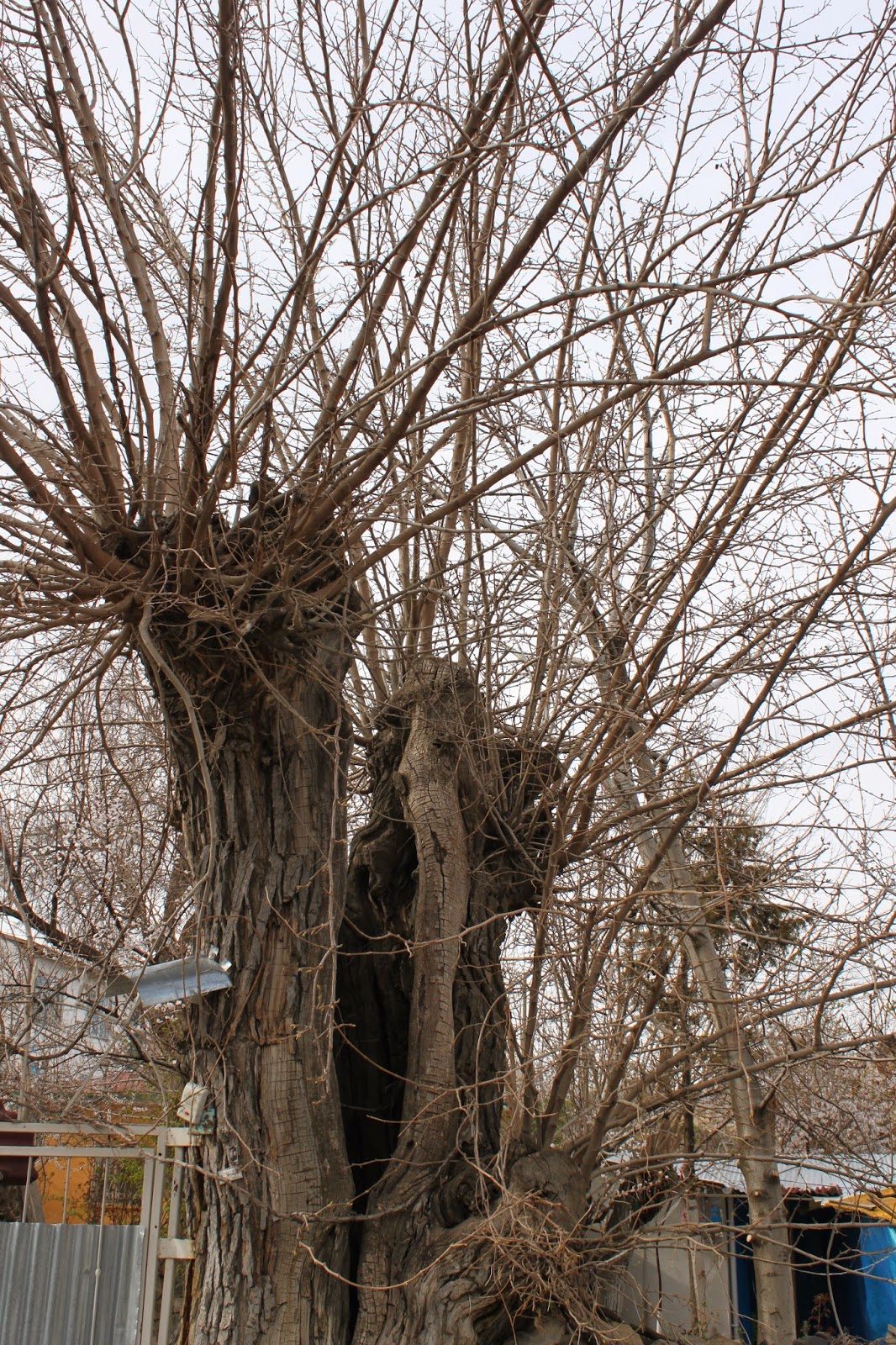 |
| An old sycamore that I thought looked like an elephant (the right one) |
 |
| A flowering almond in front of an old Harput house |
 |
| The praying sycamore at the Ulu Camii (Great Mosque) |
Across the square from the
mosque, commanding a view of Elazığ on the plains below are the dramatic ruins
of what was once an Urartu Fortress, dating back some 3000 years ago. You can
still wander around its battlements and if you are willing to climb over a gate—as
some teenagers and I did, you can plunge down a flight of stairs cut into the
rock and explore the pitch black dungeons below.
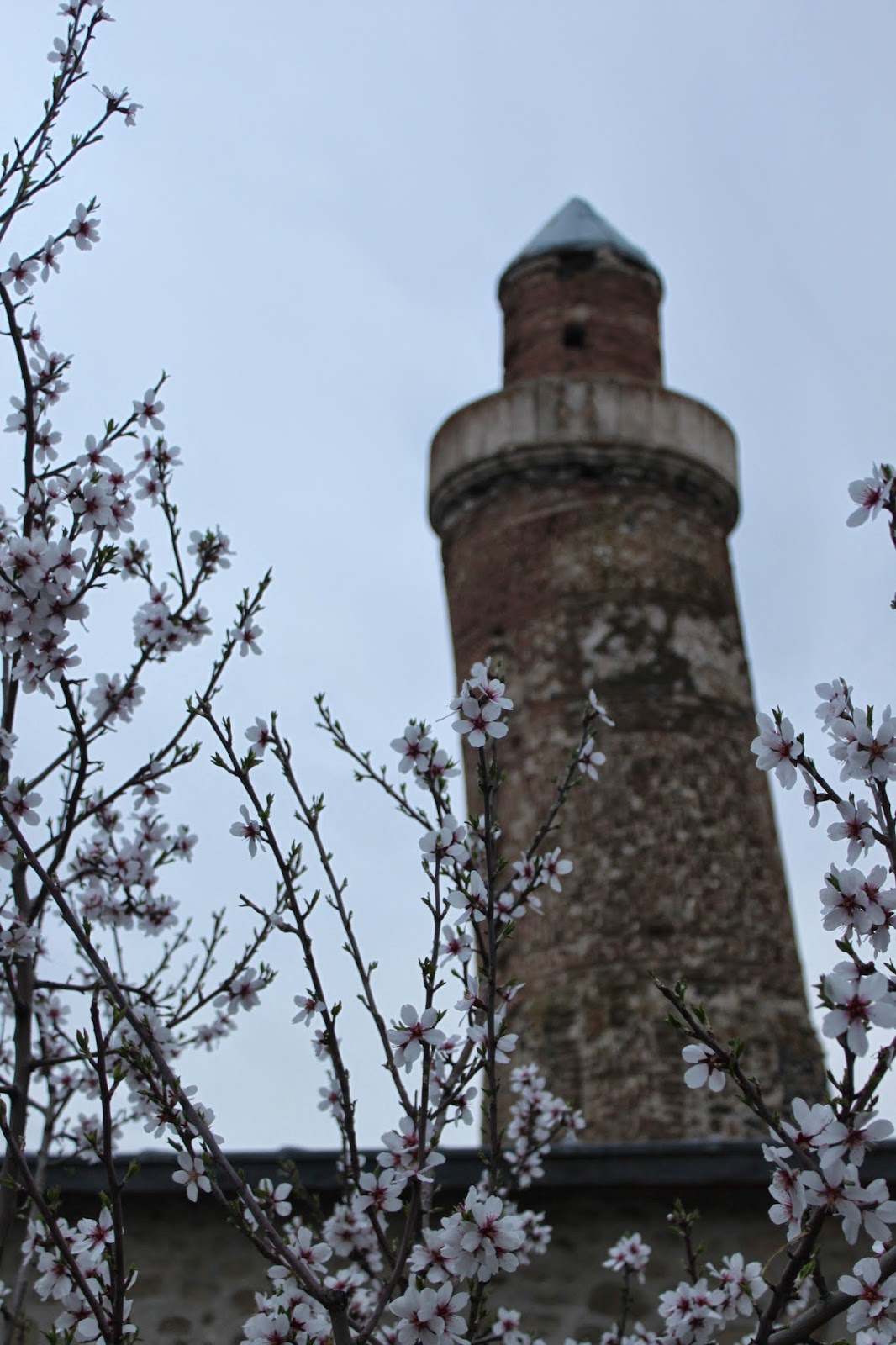 |
| The leaning minaret of the Ulu Camii (Great Mosque) |
Harput also is the site of the Syriac Church
of Ancient Mary (Kadim Meryem Kilisesi) which sits on a cliff just below the fortress.
The church is a rock-walled cube completely sealed off from the world with only
a few irregularly shaped windows placed high in the North wall. I climbed all
over it and even skirted the walls that overlook a rocky ravine, but I could
find no entrance. Upon reading some of Pat Yale’s articles, I found out it had
been sealed up for a while now. According to the church’s Facebook site, it
dates back to 179 AD—and is thus one of the oldest Christian churches in the
world. In fact, a quick, unacademic seach on the internet turned up none older.
The Santa Maria in Trestevere located in Rome is, according to Ask.com, the
oldest, but it was built in 220 AD. The Duro-Europos Church in Syria is the
oldest according to several websites and dates back only to 235 AD. So if the claim of local Assyrians is
true—this is easily the most ancient church in the world, and still in use on
special occasions if their Facebook pictures can be believed.
 |
| The mosaic of dolphins at the church--no explanation |
But I knew none of this when I
was scaling the walls looking for a way in. There was a church. It was in the
tour books. There had to be a way in. Two Kurdish guys joined me in my quest
and, as we scrambled over rocks together (maybe there’s a door on the wall of
this sheer drop) I heard them mumbling about what a shame it was that there was
nothing here to explain anything—not even a historical marker. “History is
always hidden here in the East,” one of them said. And it was at that point
that I looked down into the ravine and and noticed the ruins of another
building at the bottom. Wondering if I had somehow misunderstood and this new
building was the church I was hunting for, I started down the goat paths to
explore. I have a picture from the bottom of the ravine showing a collapsed
wall and a vast slope of stone and bramble. When I Googled a picture of ancient
Harput I turned up a photograph that showed this same slope, only crowded with
buildings. The church and the ruins I had hiked to were all that was left of
the old Christian Quarter of Harput—called Kharpert by the Armenians.
 |
| The view up the now empty hill toward the church and fortress |
I got a shiver when I saw the
picture. It reminded me that Harput had been at the center of the Armenian (and
Syriac) Genocide every bit as much as Auschwitz had been part of the Jewish
one. Many of the pictures of the famous photographer of the Genocide, Armin
Wegner, are from Harput. I won’t reprint them here—it takes a strong
constitution to look at them, but here and here is a link. On the very stones I had scrambled over
starving Armenian children had laid down to die.
Subsequent research made me
rather unsure about the church—after history was so thoroughly obliterated in
1915 (and then again so many times it’s hard to count, 1938 and then from the
80s onward there was another memory black out as the government waged its war
against the PKK) the real story of the church could easily have gotten lost in
the chaos. I found this picture on a sight of old Harput photographs showing
the church of Church of Surp Asdvadzadzin (the Holy Mother of God)in the Assyrian district of Kharpert (Harput).
But another website detailing the travels of some descendants of Armenian
survivors of the Harput massacres say this name belonged to a huge monastery
and that it has been reduced to rubble, but that the churches of St. Paul and
St. Peter were still standing but used for storage by the municipality. Or this young Armenian woman who visited Harput--one of the comments says the church was Armenian and bought by the Assyrians.
As usual—there is no
straightforward reliable historical account as no one is really interested in
letting all those skeletons out of the closet. And so, as in Conag itself,
there is all this unexplained past, deliberately erased and forcibly expunged
from memory.
Edwin Bliss wrote a book called
Turkey and the Armenian Atrocities
that describe the sack Harput. A mob of Kurdish bandits appear from the North
and East to attack the city—which the Ottoman government claims, of course, to
have absolutely no control over. They are spontaneously enraged locals who are
taking the law into their own hands due to rumors of Armenian insurrection. One
eye witness says the approaching Kurds seemed to be ‘bent on destroying every
last building.’ (Is that why this hill along the ravine has been completely
denuded?) The eye-witness goes on to say
“The
next morning after the attack, the Turkish military commander advised and urged
leaving the college building, saying: ‘I can’t protect you here.’ Mr. Barnum (an
American doctor) replied: ‘ The time has come for plain talk. I saw you
standing on the hill there yesterday when our houses were plundered and burned,
and you did nothing to prevent it.’ He also speaks of the ‘redifs’ who were
Turkish soldiers disguised as Kurds. In other words, official members of the
military pretending to be enraged members of a mob.
 |
| Elazığ (once called Mezire) on the planes below |
 |
| The view of the Keban Dam Lake from the Fortress |
There
is a great continuity in all this—how is the mentality actually changed since
the destruction of Harput in 1915? How many Kurdish villagers have I met or read about
who tell about Turkish soldiers visiting them during the day and then returning
to sack the village at night, but this time dressed as PKK guerillas? Or how
about the undercover cops we’ve seen dressed as protesters who either lead or
set off violence?
When I think of the Kurds now in prison—being released bit by
bit but nevertheless being tried for made-up crimes by a government that in the
press pretends to be defending them (like the soldier in Harput pretending to
defend Dr. Barnum or the Government in Istanbul denouncing the very atrocities it was instigating with secret telegrams). It outwardly pushes for a peace process by word but not by
deed, and this after decades upon decades of secret assassinations, mass graves ,burned
villages and forced exile all under the justification of cleaning up
‘baby-killers and terrorists bent on splitting an independent homeland from the
Turkish motherland’. I think of the Armenians in the early 20th century who
were accused of terrorism for petitioning the government for the right to
testify against a Muslim in court. In Kiğı, for instance, ağas could use all sorts of duplicity to steal land (both Kurdish and Armenian) and the Armenian could not sue--if they tried, they were labeled 'instigators of insurrection.' The eye witness I cited above spends the
first few paragraphs of his account begging the reader to understand that the
Armenians of Harput were not rebellious, were not terrorists, were not
revolting against the goverment, because those same excuses were being used to
burn their villages and drive them into exile and justify mass execution.
Or
consider the ‘spontaneous’ mob attacks on all the buildings these past few
weeks of the Kurdish affiliated HDP Party (or the ‘spontaneous mobs’ that drove
out the Greeks in 1955) and all the rumors that the government orchestrated the
whole thing—I think again of those soldiers who had orchestrated the Armenian massacres
and pretended to be helpless against them. And all of these atrocities are
covered up at the government’s command using the official news media (which I
think now everyone understands is completely untrustworthy) the official
government reports (ditto) and finger pointing. They were actually attacking
us, you see? Poor us. The Dersimlis are savages. The Greeks are trying to
overthrow the government. The Kurds are trying to split the motherland. The Armenians were trying to destroy the Empire. And
anyone, like me, who doesn’t agree or at least wants to look at it more complexly and honestly is a foreigner who simply can’t understand
the truth, or is lying, or is a propagandist for the enemy or trying to divide
Turkey.
So on to Conag.
I woke up early to catch the
first dolmuş from Elazığ to Karakoçan and from there, to Conag. On a whim, as I
rode out I scribbled down the names of the roadside villages to look up later.
My whim turns out to be prescient. In another passage from Bliss’s book, he
quotes the same eye-witness:
We
were surrounded for a week or ten days by a cordon of burning villages on the
plain. Gradually the cordon of fire and fiendish savages drew nearer the city.
The attack in the city was planned for Sunday.’
As I traveled by minibus toward
Karakoçan on the Elazığ, Bingöl road I passed by several villages on the
roadside that had all once been Armenian. Were these then that ‘cordon of
burning villages’? Along the edge of the lake you pass Yukarıbağ with its
little rest stop and market, once the village of Şeyhhacı with a population of
over 600 Armenians and 258 Turks. After
the bridge over the dam lake you pass Muratbağ, once Gülişger. There’s also Elmapınarı (once Verin Ağntsig), Güntaşı
(once Köğvenk) and İçme, of which Bliss writes ‘Survivors
are considered Moslems. Males are assembled in church, led out, and made to
choose Islam or death. Protestant pastor killed. ‘ A picture of the
church and congregation of the now long dead and gone İçme Armenians can be
found here. These villages all little clusters of concrete houses and
nondescript fields against the background of the lake. These were the villages
whose fiery destruction lit the planes and splled the doom for the Armenians in
Harput.
 |
| Election flags for the BDP against the snowy Mt. Taru (Mt. Silbus is lost in the mist) |
I had
never been to Conag outside of the summer and so I was thrilled to see these
mountains in the Spring. In Karakoçan, I was picked up by the village driver, Şerafettin Abi,
and as we pulled out of Karakoçan and started winding up into the mountains
along the Peri River, I caught a vision of the famed Mount Silbus covered in
snow. The rocky canyons and ravines
which in the summer were all earthy browns were now covered in green
lichens and moss. Most of the trees, however, still had no leaves and so the
usual splash of green from the poplars and pines and mulberries was absent—it was
all wet earth colors, clay reds and deep maroons and orange-browns.
Dede’s
house was cold and we kept it heated with a wood stove. On the morning of the
election we woke up to a blizzard. The winds howled down off of the mountains
so loud that it sounded like a train barrelling down on us, and snow had piled
up on the balcony outside. The valley below was invisible in the white winds. Dede
and I sat around the stove during breakfast as he ran through all the local snow
stories he knew.
 |
| Dede's house in the snow |
On
March 15th back in the 40s (and this one I’d heard), two teachers from Trakya were busily
getting the newly built village school ready for classes when an avanlanche swept down off
the mountain and carried away part of the building. ‘We found one of the teachers
down by the fountain below the village,’ Dede explained. ‘The other we’d given
up for dead, but we went up to the school anyway and started digging in the
snow. When the avalanche hit he had been writing on a paper pressed to the wall
‘March 15th, Snow Storm Hits’. And that’s exactly how we found him, nearly
frozen to death with that paper still against the wall and his hand frozen
to the pen! But alive!’
 |
| The hill above the spring and the wind screaming down the slope |
Or the
story of the ‘Caravan Breaker’ (Kevrankıran in Dede’s words, though it
probably should be Kervankıran) which is what he says the old ones called the
Milky Way. ‘You see,’ he explained, ‘In the winter, the caravans would start
off at the light of the morning star (Venus) because they knew that dawn was coming,
but one night, they woke up to a great light in the sky, and thinking it the
sign of morning, they set out. But morning was still far off and the caravan
was caught in a terrible snow storm and utterly destroyed. The light in the sky
was the Milky Way. They had mistaken it for the morning star.’
 |
| The snow off the balcony |
And he
ended with the story of Aunt Suzan who came back to the village for her mother’s
(and Dede’s wife’s) funeral. The day before she was going to leave, a blizzard
hit, and she and her entire family were stuck for two weeks in Conag. ‘There
were twenty of us!’ Dede says, ‘All closed up behind the snows in this house!
But those were back in the days when the house was alive. My wife had dried
food everywhere—kavurma and dried vegetables and honey and dried fruits.’
 |
| The view down toward the village center |
 |
| A dog by the road winding up the mountain |
He
ended with this story, I think, because he was thinking the same thing might be
about to happen. I watched worriedly as the snow piled up outside.

I spent
the afternoon in Yayladere (Xolxol) the town up above Conag. The voting
precincts were located here. Delal was an election monitor in the Yayladere high school (boasting 20 students)
which housed 7 ballot boxes. We learned alot about Yayladere. First of all,
there were a little over 500 registered voters, and half of those were soldiers
and police, none of whom were from the town. As a result, the military has control
not only of security but of the politics. And their influence extends far. Some
of the BDP election workers we talked to said many of the people said they wanted
to vote for the Kurdish party (the BDP) but were afraid to. There's a 3 decade long military presence here, complete with harassment and assimilation policies, and that isn't going to go away overnight. And despite government
assurances, the pressure seems to be increasing out. Security cameras
(called Mobese) have been set up on the road to the village since last year—God
knows why, we waved at them every time we rode by—and several new military bases (karakols) have been built in the area
despite government denials.
We saw
all sorts of trickery and deception that day. There were bribes of course. One
of the ballot box chairmans told everyone who came in to vote for the AKP
before he was told to stop (by Delal). One woman took it upon herself to guide in all the
elderly, and was caught going into the ballot box with a man from our village, pushing his hand
toward the CHP box despite his repeated requests for the BDP (The CHP was the
overwhelming choice of the soldiers out here). Later into the evening, after
polls had closed and counting was underway in larger cities, the electricity
suddenly went off in both the village and in town, and it didn’t come back on till the next day. There were power
outages at ballot-counting time in 22 different provinces of Turkey that night (all blamed by the Minister of Energy on a cat in Ankara).
From Bingöl we got reports of stolen ballot boxes and in the days since the
election, piles of burnt ballots have been found all over the country. In
Istanbul, in Bakırköy, an empty apartment was listed as having 40 registered
voters. A man in Zonguldak found out that there 2 imaginary roommates living
with him who had somehow voted that day. I am sure the AKP would have made a killing without all the election fixing, but there were some close races in which it probably made a difference.
So
there is the update on my life which seems to be a Social Studies lesson eternally out in
the field. And as both Twitter and You Tube are banned (wait, I just found out Twitter is back up!), as more and more
meddling is revealed in the recent elections, as the sneaky military influence
increases back in Conag—I wonder how many more lessons I have to learn.


