Wednesday, November 25, 2015

Diyarbekir Diaries – Rojnivîska Amedê Day 4


Diyarbekir Diaries – Rojnivîska Amedê  4


The Kurdish Pantheon


Today we woke up with no new world crisis and a simple breakfast on the balcony overlooking the park. I spent a long time watching a little girl empty a trash can, piece by piece (all shiny potato chip bags) until she was noticed by her older sister who, hitherto, had been playing with a friend on the swings. The older one grabbed the trash digger and sat her rather sternly on a bench, but as soon as her back was turned, the little one ran back and put everything she had thrown out back in, piece by piece. Then her sister noticed, and dragged her once more to the bench. When the older one was safely on the swings with her friend, the little one again ran back to the trash and proceeded to empty it out all over. I remember her pink sweat shirt, whose long sleeves she had pulled down to cover her hands.

Man in a cafe


Mesopotamia from the battlements at Goat's Point


We took a minibus to the ancient city walls—reportedly dating back, in places, some 3000 years when the whole area was a capital of an Aramaic kingdom that at one point had a scuffle with King David of the Old Testament. Near the Mardin Gate is a tower built into the walls called “Keçi Burnu” or “The Goat’s Point”—the oldest and largest of all the towers along the walls. Inside is a dungeon, now a café. At the back, a small slit in the black walls sends a sliver of silver light beaming onto the floor—once, according to the owner of the café, a temple to the sun for the ancient Hurrians who built this place. If this is true, then their sun god would have been Shimegi or possibly Teshub whose Hittite name, Taru, was given to one of the mountains in Delal’s village.

The Temple of the Sun

The colors of the fields around the walls were bright yellow gold and green—each black square of plowed earth lined with poplars and sycamores and acacias. Among the trees, a man was calling his doves back to their roost with sharp, musical whistles. The birds swirled and swirled around the ramparts, dipping further and further toward the whistler. The pretty little scene was broken by the appearance of a bomber moving heavily south toward the Syrian border, followed soon by three fighter jets cutting an angle across the sky.

Cafe on the Walls


Doves returning to their dovecote

After the walls, we took a taxi down to the “Ten Arch Bridge” on the Tigris. Made from the same black stone as the city walls, the bridge was originally built by the Romans in the 6th century. The sun was setting, the banks of the river were deserted. A haunted autumn evening seemed to rise out of the water like lost spirits and snake up the banks and into the poplars. You could look out south toward the empty Mesopotamian plain and feel the history, the weight of tens of thousands of years and all the armies and civilizations and forgotten souls. Here human civilization began. History began. And what came before was mystery.

Waters of the Tigris


The Markets

The markets of the city are like a series of small theaters. Each stall is piled high with merchandise—whatever it may be--so that only a small lighted proscenium reveals what’s happening on the inside. As you walk, they unveil themselves scene after scene. It’s like strolling through a carnival and peeking at private little plays—a group of young men chatting over tea, a small fat boy watching TV and dozing, a man grinning into his iPhone, a sad looking old man in a fedora staring mournfully at a clock.

The name of the market means "Burnt Market" in Kurdish and comes from a fire that apparently razed the place once


One of the prosceniums, curtain off by jeans and shirts, waiting for the entrance of the actor (whom I did not wait for because I would have to buy something)

Theater scenes from the Cheese Market


When we finished, the streets of the old city were dark. The street lamps had not yet been lit. The only light spilled out from closing store fronts. I watched my wife dip in and out of this light as she walked in front of me down the sidewalk, vanishing again into shadow with the rhythm of a lighthouse beam.


Tuesday, November 24, 2015

Diyarbekir Diaries – Rojnivîska Amedê Day 3

Diyarbekir Diaries – Rojnivîska Amedê  Day 3


My mother-in-law and her sister arrived last night--making us a party of five.


From about 10 PM on, the roar F16s filled the air and almost managed to drown out the voices of my in-laws who stayed up late debating various topics, ranging from the character of the various brothers-in-laws in the family to what in human nature pushes large groups toward extremism. I woke up to only the sound of F16s, which have been flying back and forth non stop all day. More insane news greeted us this morning—the Turks shot down a Russian plane.

This entry is going to be mostly pictures and will be devoted to two things--the food and the architecture of the old city. 

The park we pass through every morning in all its autumn glory

Students from a nearby middle school playing football on lunch break

The Food 

People in Turkey always wax romantic about the cuisine of Antep. I never found anything there but the usual Turkish fair and none of it all that special. To me, Diyarbakir is the premier city for food in the east. I have never eaten anything bad here, never. 

Here is a brief glance into our culinary adventures today.

We started with a breakfast at Hasan Paşa Han--a 16th century caravansaray in the middle of the old city. Breakfast came with 24 different plates of food. I counted 8 types of cheese, a dish of cured lamb and eggs, a spiced eggplant and tomato salsa, cream and honey, yogurt with strawberry sauce, fresh butter, potatoes, roasted peppers, a roasted flour concoction good for eating with bread, a kind of peppery paste (also for bread), orange preserves, honey on the comb, bananas with pomengranate sauce, cucumbers and tomatoes, an arugula salad and more. Breakfast here is a Diyarbekir ritual for us and a must for anyone visiting the city.  

The 24 plate breakfast at Hasan Pasha


The cured lamb and eggs

The entrance to the Han
Our view from the table


The sundried vegetables
Around the han are all sorts of markets. Dried fruits and vegetables are everywhere (the climate here makes it ideal). I recommend cooking with sun-dried okra. Amazing. There is also a spice market which sells different degrees of roasted Urfa peppers and a staggering variety of pepper and tomato pastes. 

I ran into a strange man while perusing some of the unusual soaps sold here. He came down the sidewalk wearing a beret and sunglasses. He had bright white hair and a brown, creased face, and walked with a cane. Under one arm pit, he had a stuffed fox whose body seemed abnormally long--nearly two thirds of the man's height. Under the other pit, he carried a stuffed weasel, equally long. Each animal's mouth was open, showing its fangs. I would have snapped a picture but something told me that words were a better description of this--your imagination at this point has a better impact than whatever photo I could have come up with.


The different grades of Urfa Pepper


It gets dark rather early here these days--around 4:30, and as the sun was setting we went back to Sülüklü Han from yesterday for some coffee and then, a cup of their house wine, a red that was amazing. Being dark, I could only get a decent picture in black and white. The proprietor went on and on about how organic it was. In any case, it was light, somewhat fruity yet with a nice body.


Dinner was at one of my favorite restaurants in Diyarbekir--Tabier, a lahmacun restaurant that has the best "Arab pizza" I have ever tasted. The crust is thin and crispy on the outside, soft on the inside and the meat topping full of spices, with a nice dose of the Urfa pepper. It comes with a table load of mezes and vegetables, all on the house. This is a typical feature of eating out in Diyarbekir--no matter what you order it comes with a table full of side dishes, which is why I feel absolutely stuffed wherever I go.


The Old City--the Architecture

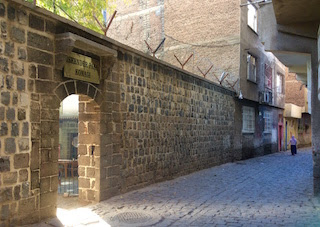
I could wander around the inner city for days--a maze of tall black basalt walls, ancient churches (of Armenians, Chaldeans, and Assyrians) and crumbling houses. The height of the walls in the streets are a defense against the intense heat of the summers. With the air so dry, anywhere you find shade is cool, and these tall walls provide long winding avenues of cool shadow. 


The knockers we saw all around the old city


Before I go any further, I would like to say that as we toured the old city today, we passed through one of the areas that have been barricaded and declared independent of the state. (It was near one of the historic Armenian churches). Paving stones have been used to build walls, trenches dug, and sandbags piled up as barriers. White plastic tarps cover the streets as protection against snipers. It's perfectly safe during the day and people carry on about their business as usual. I saw some of the youth responsible for the blockades--a few masked but most not. They were mostly boys in their early teens though there were lots of smaller kids, too, as young as five or so. They had built a fire in a ratty trash barrel and set up couches and arm chairs around it in the street. There were also girls here and there--they seemed to command a post of their own down a different street. An older man played a bağlama from one of the sofa. A group of middle aged to elderly women in head scarves sang Kurdish songs and stood around the fire with the boys. A blond woman in a pants suit leaned against the all and though she did not sing, watched the whole performance thoughtfully. A couple of toddlers came out of an apartment building to watch, fingers in their mouths. In other words, ordinary people from all sections of Diyarbakir's poor defending this dilapidated street. How many of these people singing would survive the week, I wondered? Who would be shot? The little boy eating cookies? The old covered lady sitting on the oil can and warming her fingers? The teen girl with the bright colored scarf covering her face? Who would become the next "martyr" and who would go about their lives?


Through the maze of black walls you stumble occasionally on a sudden burst of green, an opening into the garden of one of the old hans. We went to Iskender Pasha Han for menengiç coffee. The courtyard was gorgeous, full of golden leaved mulberry and sycamore trees. Magic.


Many of the houses of the old aristocracy have been turned into museums. Here is the courtyard of the poet Ahmet Arif. Diyarbakir social life was once completely centered around these courtyards.
The poem on the wall is from his famous anthology, "The Manacles Were Worn Away by Longing"

Your love never left me.
I hungered, I thirsted, 
The traitor nights were dark
My spirit is weird, my spirit is silent
My spirit is in pieces
And my hands in chains
I was without sleep or cigarettes
Your love never left me


Monday, November 23, 2015

Diyarbekir Diaries – Rojnivîska Amedê Day Two

Diyarbekir Diaries – Rojnivîska Amedê

We awoke early this morning--around nine or so, to full on summer level sunlight. It poured in from all directions and was warm enough for me to walk around in a T-shirt. All three of us, still in pijamas, immediately dove into the news. Last night, after I finished this blog, just a few kilometers away, someone had apparently attempted to assassinate Selahattin Demirtaş, the co-chairman of the opposition HDP party. A bullet hole was found in the rear window of his car. If they had succeeded, the whole country could have been plunged into a civil war. The governor of Diyarbekir province (an AKP appointee) denied that it was a bullet hole, of course. 

After news and politics, we had our breakfast on the balcony overlooking the park. As we ate, two F16s passed overhead--on their way to God-knows-where from the Diyarbakir military airport, to bomb Kurds in Iraq (most likely) or perhaps somebody else in Syria. Hilal made a kind of herbed French toast, and as we ate, I watched the goings on in the park below. One jogger, a kid spinning an trashcan and startling a cat, two old men chatting on a bench, a pair of speed walking girls, a group of student boys in uniform walking and chatting, one of them in front of the others, walking backward to face his friends and gesturing excitedly.


Delal and I decided to stroll around the new city, not the touristy part, just to see what we ran into in terms of ordinary life. We took a road behind the apartment complex and passed onto a wide sidewalk lined with Acacia trees. The fall weather was pitch-perfect--sunny, slightly cool, crisp air. Pairs of students strolled to school arm in arm.

We passed by a high school in the neighborhood of Bağlar. Back in 2012, at a protest during the height of the Kurdish hunger strikes, I had met a boy from here who told me that this was the poorest neighborhood in the city. He said that the police loved to target Bağlar and once, during a protest when he was twelve, he'd watched them chase down and kill one of his friends. I wondered if this was the school? The graffiti on the walls around here, I think, explains a lot about the place somehow. The usual names of lovers separated by hearts, lists of school friends names, and political slogans praising Rojava, the HPG, the PKK, and Demirtaş (nicknamed Selo). On one wall a name has been painted over and the rest of the sentence, "is a novel that has not yet reached its end," now lies subjectless and seems to apply to everyone here. Just down the road is an advertisement for Salsa classes with the slogan "And our souls remained free..." 


We stopped in the chic neighborhood known as Ofis (Office) for a cup of menengiç coffee. Menengiç is something you find all over Eastern Turkey. It is a creamy kind of coffee made from the roasted terebinth berry, a bitter relative of the pistachio. The cafe was called "Ares", the god of war. Out front along a stone wall, someone had lined up three nargile pipes--red, green, and yellow. When I took a picture, the waiter told me to hold up.

"It's not in the right order," he said. "Let me fix it."

He rearranged the pipes so that they went in the proper Kurdish order according to the slogan, kesk sor û zer (green, red and yellow)--the colors of the Kurdish flag. When he'd finished, he put his hand on his hips and smiled. "Now you can take a picture." 

kesk sor û zer
Menengiç--with a side of chocolate pebbles and Turkish delight at the Ares Cafe


A few months ago, I got in an argument on Twitter with a well known journalist who had written an article where she'd insisted that Diyarbekir had become like a foreign country--with everything having become so Kurdish and so other that when you ran across a Turkish restaurant you found yourself as surprised as when you saw a kebab shop in Paris. Given the Turks paranoia about the Kurds always trying to divide their country, I thought this was an exaggerated and irresponsible thing to write, knowing how it could easily provoke and mislead a people already quite confused and deluded about what was really going on here. She countered by asking if I had reported on this place for over ten years, if I had been there in the 90s, if I was as experienced and as big an expert as her. Well, as I said then, no, but with a few pictures from our wanderings on the street, I think you can see there isn't much all that foreign for a Turkish street (sadly). One need not be an expert to look around and see what's right in front of your face--the same Ceylan Kuafors, Mehmet Avukats and Tarihi Cafes as in Istanbul.

The ubiquitous restaurant in Turkish that is supposedly so surprising to see--I love that the meat is cooked on a wood fire. The man feeds logs into the flame.

Bank Street in Ofis--with tons of Döner, Lahmacun, and Çiğ Köfte restaurants that you find all over the country.

But there is definitely a different vibe in Diyarbakır--something more relaxed, friendlier than Istanbul or any city in the west of Turkey. Paying always seems to an option--if you have the money, and the sums are negotionable. 25 lira--oh you only have two twenties? Give me one then. Behind the wall of buildings on Bank Street was a maze of tea gardens in the shade of acacia trees. We bought different kinds of pistachio filled baklava from a street vendor and took them to a little table under a tree in the back. No one was bothered that we'd brought in food from the outside. We ordered teas and watched a couple of cats bathe themselves under a grafitti or what apparently looked like a vomiting fish.


Just down the street was the Monday Bazaar--full of all the usual suspects of the Istanbul bazaar with a few surprises. A pumpkin yellow on the inside, purple carrots, pink pomengranates and deep red persimmons.


We passed through a park--the sycamore trees bright yellow, the leaves raining down, fluttering and fluttering. A couple of old ladies chatted on a bench near a sign advertising food in Kurdish. We run into these signs from time to time--they fill the park across the street from our apartment, but we hadn't seen many in Ofis until this moment.

Women's Labor Food Place--simple and direct I guess


Hilal had been working in the old city, called Sur İçi (Inside the Walls), named because it is located in the medieval black basalt walls that surround the historic quarters. It is here that young people--male and female--have blocked off streets with sandbags and trenches and declared their streets independent of the Turkish state. It is here that clashes between the police, the army, and these youth have resulted in the deaths of citizens and soldiers. And yet, walking past the famous Hasan Paşa Han or the shoe shine market you would never know anything was afoot.

We met Hilal at an old Caravansaray called "Sülüklü Han"--the Leech Caravansaray. According to the sign, there used to be a well from which doctors would extract leeches to bleed their patients. A plaque on the gate explains the history in all the languages of the people of Diyarbekir--Assyrian, Armenian, Kurmanci, Zazaki, Arabic, and Armenian. This is anathema anywhere else in Turkey where the mentality is ONE LANGUAGE, ONE PEOPLE, ONE RELIGION. Anything else menas the country will be divided by whatever mysterious powers you blame for everything.

Sülüklü Han is located in the middle of the blacksmiths market--sparks fly across the gate next door from where a smithy is forging spiked dog collars. Hilal has brought a long a friend who explains an interview he had with the women's football team who believed that their rivals from Iğdir at a recent match might actually have been men, or at least on hormones. They were too aggressive, the women had insisted, too violent.

The tea seller in the blacksmiths quarter
The door of 6 languages
We ended our night on the city with a dinner of shish kebabed liver--for which the city is famous. Absolutely delicious!