Showing posts with label fun with bigotry. Show all posts

Saturday, September 29, 2012

Hunger Strike at Silivri and Beatings (Türkçeşi en aşağıda)


Anxiety.

That’s the prevailing mood for the past year. Sometimes the anxiety is aimless and sometimes it is a divination.

On Monday, my sister-in-law received a call from her father. Monday are the days prisoners at Silivri get a phone call. She said his voice sounded strange—subdued, morose. We found out that a hunger strike was planned among the prisoners in the KCK case. We had no idea if my father-in-law would be among the strikers. His name was missing from the official lists, but it was clear from his voice that something was wrong. The trial is resuming next week. The visitation this week was canceled—the prisoners themselves were boycotting visits as a means of protest. We would have no news for a while.

Tuesday, my wife, determined to see her father and find out if he was okay, arranged a car and a lawyer to go with her to Silivri—while family could not get in, most likely a lawyer would be let through. The only trouble was finding a driver—we called friends, friends of friends, and friends of those, but there was no one who knew how to drive (imagine having that problem in the States!) She was talking about driving out there on her own—a thought which terrified me, given her lack of experience. It looked like we might have to give up the trip, but something was nagging at her and she had to get out there somehow. I was about to call in to work to make the drive myself when a friend came through at the last minute.

The rest I heard from my wife herself.

The prison was eerily empty—the crowds of visitors for the KCK inmates missing, home because of the protest. The lawyer was let in and met with my father-in-law, Kemal Seven, who was extremely pleased to see him. Something had happened, and in their isolation, he had feared no one would ever find out.

My wife’s instincts had been correct.

Tuesday, September 25th, 10 of the 99 detainees remaining from this particular round-up began a hunger strike. They wrote a petition to the prison announcing the strike so that later the officials could not claim ignorance should something happen later on. The remaining 89 prisoners wrote a petition of their own declaring their support. Sometime the same day, roughly between  40 to 50 guards and riot police in full gear (this means shields, gas masks, billy clubs and pepper gas) gathered at the door of the prisoners wards. Among them were the assistant warden and the chief of the prison guards. They entered the cells to take away the hunger strikers. Apparently, they were taking them to one-person cells isolated from the others. Their comrades did not want to give them up—they feared that in a few days the strikers would no longer be able to take care of themselves, and expected little help or understanding from the prison officials. Thus, they tried to prevent the guards from taking them awa. The guards attacked. Everyone was beaten (Remember, please, that resistance or no, many of these men are around 60 years old with a host of ailments ranging from heart disease to diabetes). The ten hunger strikers and 2 other prisoners were taken away. None of their belongings were removed from the cells and they’ve had no word of where they’ve been taken. The others worry because, on hunger strike, of course, they need to drink water and sugar water quite regularly and there has been no sign of anyone making provisions for that.

The remaining 89 have refused food since Tuesday in solidarity. I’m posting this on a Saturday, so this might have changed. The trial will resume Monday. Most likely with the reading of the 2,500 page indictment-I think after 10 days in July we left off on page three hundred and something.


Türçesi (Özet)

Silivri L Tipi Cezaevinde, KCK davasından tutuklu bulunan 99 tutukludan 10 kişi süresiz dönüşümsüz açlık görevine başladılar.  Bir dilekçe yazıp, hapishaneye bildirmişler.  Kalan 89 kişiden bu arkadaşları destek verdiği diye bir dilekçe yazmışlar.  Sonra robokop şeklinde 20-25 hapishanenin gardiyanı ikinci müdür ve başgardiyan koğuş kapılarını açmışlar bu on kişi alıp bir tek kişilik hücre götürmek istemişler.  (Bu arada koğuşlar 18 kişilik. 99 kişi kalıyor, bu koğuşlarda, her koğuşa gardiyanlar dağıtılmış).   Dün Salı günü yaklaşık 40-50 kişi yarısı gardiyan yarısı robokop şeklinde, koğuşlara girmişler. Koğuşlardakiler tabii ki arkadaşlarını bırakmak istemdiler (Çünkü bu 10 kişi 10 gün sonra kendi ihtiyaçlarına bakamayacaklardı). Direnmişler. Gardiyanlar onlara darp etmişler.  10 grevlileri götürmüşler bir de direnen kişi den iki kişi daha. Bu 12 kişinin nereye götürüldüğünden koğuş arkadaşlarının haberi yok. Henüz gardiyanlar gelip onların eşyalarını götürmemişler. Açlık grevinde olan bu kişilerin su ve şekerli su almaları gerekiyor, bu yazı yazıldığında kendilerinden bir haber alınamamıştı. Tüm tutuklular Salı gününden beri arkadaşları destelemek amacıyla yemek ve ekmek almıyorlar.

Thursday, July 19, 2012

Day 6-7 The KCK Show Trials

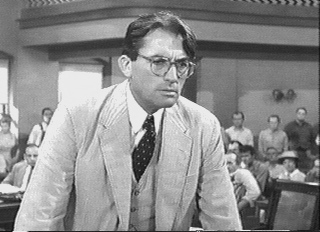
Atticus would have been flummaxed


July 9th and 10th (previous days are in earlier entries)

I think I am getting a taste of what it must have been like to sit in a courtroom in the Old South. The overwhelming sense of unfairness, the verdict a foregone conclusion because of race, the whole weight of a century’s old benighted system that just won’t die. The evidence laughable to anyone looking in from the outside.

From Thursday afternoon onward, the 2400 page KCK indictment is read aloud. And I mean that in the passive—no one particularly important (like the prosecutor who wrote it) reads the indictment. The court pulled in two TV anchormen to take turns at the mammoth text—they go until they give out, voices hoarse, at which point the other takes up the task. It’s sometimes comical—like when they read through the phone conversations in their sports announcers’ voices, playing both parts at the same time with the same dry monotone. Most people snooze or knit or read a book—the woman down the aisle from me is engrossed in the Turkish version of the latest Stephanie Meiers novel.

But occasionally one of the defense lawyers, our would-be Atticus Finches, stands up to lodge formal objections against the nature of the indictment itself.  Essentially, their argument is this:  It violates all known and acceptable criteria for evidence and consists mostly of hearsay, speculation, and anonymous accusations.

Here are some examples of the problems:

Number 1: It’s often gibberish—passages cited as evidence of terrorist activity are so filled with parenthetical (Incomprehensible)s that they are nonsense.  For instance….

‘(Incomprehensible) Now, after the woman’s natural community was brought down...(incomprehensible) and while there the issue at hand was the destruction of woman, society, and nature, I think that we need to consider that, together with these things, and actually, I mean, in fact, the correct place…(incomprehensible) in other words, it’s not just the fall of woman, the basis of it is also the whole fall of society and nature.’

Number 2: The wild guesses of informants are often taken as fact. Here’s this tidbit from Delil Botan Kahraman who is describing his first visit to the BDP academy in Ümraniye and his first encounter with Mamoste, Kemal Seven.

‘The rooms used for academic purposes at the building were normal. There were several photographs on the bulletin boards. Though I didn’t know these people personally, I guessed that they were members of a terrorist group, because they wore the sort of clothes that terrorists wear.’

One of these photographs he’s referring to is of Musa Anter, the Kurdish journalist murdered by the Turkish government in the 90s. I have no idea what he means by ‘terrorist clothes’ unless it is the traditional Kurdish shalvar and keffiyeh.  The absurd thing is that this statement is taken at face value. Imagine being dragged into court because your neighbor thought that you had pictures of people with the kind of clothes rapists wear, and that this was considered hard evidence.

Number 3:  Guilt by association? This term is not even accurate. Guilt by virtue of being present in the room while the accusations are read aloud is the correct description.  Pages 69 through 167 of the indictment are devoted to a play-by-play of the foundation of the KCK and its evolution through time and includes the organizations charter article by article. No names of the suspects appear in any of this. Then from page 168 to 186, the indictment lists internet sites that they believe have terrorist propaganda—again with not one suspect’s name appearing anywhere.  The justification for 127 pages of dry history lesson is this (from page 186)

‘The sites under discussion can be summarized as follows—they made propaganda for the PKK and it’s leader Abdullah Öcalan, they praised splittists and divisive terrorist activities, and by abetting the spread of detailed news of their activities to the masses and the public and of publishing the notes of the contents of Öcalan’s meetings with his lawyers as instructions for the organization, presented the convict Abdullah Öcalan as someone to be addressed as a head of state. By using the model of Democratic Confederalism to compromise the unitary structure of Turkey, they aim to break off parts of the countries East and Southeast and subsume it into a structure known as Kurdistan. This data is not the civil initiative of the KCK and DTK but merely a different extension of a terrorist organization and the details and matters presented within the scope of this indictment are not assertions but facts.’

I like that bit at the end—almost like a protesting child anticipating that no one is going to believe his wild story. ‘It’s not just assertions but facts! I swear!’ As if just saying so makes that the case—an argument you would expect from a ten year old but not a court of law.

This is essentially like me sitting you in a courtroom and reading an entry from a murderer’s diary and then saying you were the murderer because I read it with you present.

Number 4-the informants

Only when you reach the government’s hand-picked informants do you start seeing the names of any actual suspects, and while I can only speculate, some of the language of these ordinary people sounds too much like legalese for them to be word by word transcriptions (and in light of the Balyoz case, I simply assume them to be made up). Informants describe colleagues as ‘şahıs’, a police term for ‘individual’ or ‘personage’, for example.

Here’s a little sampling rendered in English:

First Witness Haydar’s statement given (21.04.2010)

For a long time I have worked in the terrorist organization, the PKK/KONGRA-GEL, as the person responsible for the DYG township and implemented its operations at various levels of the BDP organization. In particular, I wish to explain what I know in regard to the operations and activities in Istanbul by the KCK during the period I implemented these operations and activities.

Number 5 Another problem is the complete lack of objectivity—a presumed given in a court of law.

On page 72, when it’s trying to explain the bewildering number of acronyms (KKK, PKK, KCK, KONGRA-GEL) the indictment says,

‘The terrorist operations perpetrated by the terrorist organization the PKK for more than 30 years has hit dead ends from time to time and they have sought a way out. One of these methods is name changed by which they strive to hide their ugly face with camouflage.’

Number 6--And then there’s the good old fashioned circumstantial evidence (itself based on an informant’s questionable testimony) Where supporting the party of someone present in the same area as suspicious items that you have no idea how got there is considered admissible evidence of your terrorist activities.  Here is the first ‘Action’ described by informant Erkan Yanıt,

ACTION 1

On 24.05.2009 at 17:00, in Çağlayan Square, in Şisli, in an outdoor meeting of the DTP (predecessor to the BDP) called ‘Don’t Silence the DTP, Silence the Guns!’, in a clump of bushes to the right of the number 9 security check point, were found 20 flag staffs, 2 posters of Öcalan, 1 flag of a so-called terrorist organization, one flag belonging to the youth group of a so-called terrorist organization, 5 small knitting needles, 10 switch blades, 1 exacto knife, and one screw driver. It was not determined who left these items. Certain leaders of the Esenler branch of the DTP were announced…The DTP representative Sebahat Tuncel also joined.

No one knows how those items got there (hell, the police might have planted them!) but the future BDP parliamentarian Sebahat Tuncel was in the vicinity and they suspects in the courtroom support the BDP so they must be terrorists!

Back to inconsistency in tone and content.  Erkan Yanıt’s testimony, for example, starts off rather ordinarily, a young man explaining how his family came to Istanbul and got caught up in the activities of the BDP’s predecessor, the DTP.

“My older brother is Erol Yanıt and we came together from our fillage in Mardin to work in Istanbul. In the Mimar Sinan neighborhood of Esenler I took up residence and after working in a textile factory in Bayrampaşa for 1.5 years, I took a job at the Tadım Köfte restaurant.’’

He goes on to give very detailed accounts of appointments to the field by ‘the terrorist organization’ and despite being an uneducated villager from Mardin, continues later in a diction and tone that sound suspiciously like the prosecutor himself (from page 551)--“They organized the distribution of the so-called flag which symbolizes the Confederalism of the PKK/KONGRA GEL terrorist organization and the posters of Abdullah Öcalan. These posters and so-called flags came to this personage and other young personages from the youth of the DYG received materials from this personage.’

That phrase ‘so-called’ is a favorite of the Turkish government when describing almost anything they don’t like and not the day to day language of a waiter from a village in Mardin.

The defense team objected, and to all of the objections, the prosecutor, through his conduit Judge Ali answered with the same ‘Reddedildi’. (Rejected) (We hear this phrase so much that several of us in the audience develop quite good imitations of the squeaky Judge Ali delivering it).

Now if you sat through all that about the indictment, here is a more human switch—the only time the courtroom came to life during this monotonous reading was at the breaks when the prisoners filed in and out. This was the time when I saw the tragedy of all this most clearly—that wall of hopeful faces that rushed to the back row of the suspects’ section searching our faces for friends and loved ones. There was a big bosomed woman with a short haircut; she looked like she belonged in a commercial for frozen pizza playing an Italian grandma. There was the frizzy haired girl student and the skinny old man who wore a sky-blue suit way too big for him. There was Mamoste himself, sixty years old and adjusting his bifocals so as to see us better, and then the mother daughter team who blew kisses at a nine year old chubby girl to my left who kept calling out ‘Grandma! Grandma!’. There was the skinny waif of a boy in a rock and roll T-shirt and the moustachioed Kurd who spoke no Turkish and understood nothing of what was going on. There was Ragip Zarakolu, who looked like a bushy haired guru from an Ashram and the old lady with her hair pulled back in a tight bun, and the elegant professor Büşra Ersanlı.  Everyone called out ‘Hello!’  ‘How is everything at home?’ ‘Are you coming tomorrow?’  For me, the most compelling of all was the face of family friend Zekiye Ayık, a woman with long silver hair and big brown eyes who wore an elegant brown scarf loosely over the back of her head. She has been in and out of the hospital for heart trouble. She had trouble seeing, and though we called her name over and over, she could not quite make out who was in that crowd waving at her. ‘We get our morale from your visits,’ Mamoste had said. ‘When we see you in the audience supporting us, we know that everything has not been in vain.’ And yet Zekiye could not see who was in the audience supporting her. Her slightly bewildered smile as she waved first too far to the right of us, then too far to the left haunts me. This is the face of a terrorist for the Turkish government.

This is the witch hunt, this is the justice system in the South before the Civil Rights movement. 

While the reading of the indictment slowly progressed (100 pages a day on average—meaning at least 20 more days to go), some events on the outside promised to affect things on the inside. The first was the announcement by the Turkish government of changes in the judicial code. One change abolished the special authority courts, one of which we were attending.  (Replacing them with Regional Courts in the South East with Special Authority to Handle Terrorist Cases—the difference?  Who knows?) This had the absurd effect of making us present at something that technically didn’t exist.  At one point, a lawyer lodged a protest, saying, ‘We don’t even know if you will exist next week.  Even if you make a judgment, what authority can it possibly have?’

A second provision was a limit on the time that someone can remain in jail without trial and the declaration of ‘making propaganda’ as an ‘unjailable offense’.  Suspects in the Ergenekon trial quickly applied for release in light of the new codes, and our lawyers followed suit. Judge Ali announced a decision would be reached on Friday.  The result of all this was that we guessed some people might be released on Friday.  Tahliye.

(Now here’s another language lesson—the word tahliye is listed as ‘release’ in most dictionaries but it only means released on bond. Anyone who is tahliye-ed still stands trial. A full pardon is a beraat.)

Another important development regarded the professor, Büşra Ersanlı. I have tried to stay away from Professor Ersanlı if only because she is the most famous of the group and the media seems to cover only her and Ragip Zarakolu, as if their release would mean the end of the injustices. But Prof. Ersanlı gave a very moving interview in the Radikal—in which she described her despair and her lost hope in the justice system of Turkey and the future of democracy here. She sounded absolutely crushed. Inexplicably, the Foreign Minister Davutoğlu made a public statement saying that he did not believe Ersanlı was a terrorist (of course he had to say so--he had appointed her to her position at the University) but added that the courts were independent of the government and he could not intervene. (What the hell? Since when?) Announcements like this are not accidents in Turkey—everyone felt that Professor Ersanlı would be released one way of the other. Telling if she were as her crimes match Mamoste’s. If she were released, he should be too.

Which brings me to my final subject—the prosecutor himself. While Judge Ali hung out all his laundry on a personal site, prosecutor Adnan Çimen keeps his cards close. I could find absolutely nothing on him on the internet except that he authored the KCK indictment (probably more directly than anyone knows) and that he had once prosecuted cases against ‘Al Qaida and other right wing movements’. There was a curious tidbit relating to a bodyguard scandal, in which the state removed one body guard from his two person entourage and also took away the privilege of his armored car—he was reduced to using a service bus.  Everyone was speculating on what this meant. Had he lost favor with those in power. Were they showing him the big stick under the robes (a Turkish idiom not a phallic reference)? I find myself wondering as well. Does this mean I’ve become a local now that I seek the hidden meaning behind everything?

The fields of sunflowers this last week of the trial are blooming fiercely. What was just two blossoms is now wide stripes of yellow. Utterly beautiful.

Thursday, November 10, 2011

Part 2--My Father-in-Law's Arrest


The Court Hands Down Their Doom
Kandıra Prison


As a white American, I have never experienced firsthand how your own government can tear your life and family apart. I understood that blacks and Native Americans and other minorities suffered under a system built for whites, but never intuitively, never from the gut. Until now.

On Monday, my wife Delal and her family spent the whole day in front of the Beşiktaş courthouse with hundreds of other people waiting to hear the decision of the judge—would her father be released or charged and imprisoned? He was one of the fifty writers, teachers, and students detained in Istanbul for ‘affiliation with a terrorist group .  School was like torture—I was texting Delal every hour to ask for news, and when the last class finished, I raced as fast as one can race through Istanbul’s nightmarish traffic to get to her side.

The courthouse was next to Bahçeşehir University, right on the Bosporous. Amid the Kurdish women in Eastern dress, were students sipping Starbucks and lugging books back and forth--staring. A whole contingent of riot police lined the streets with billy clubs and shields. Most people huddled for warmth outside the courthouse gates, but we waited hours in the Simit Saray next door trying to stay warm. The waiting was torment, and the only entertainment came when one of the young policemen got his finger stuck in the wires of the gate outside. The whole crowd snickered in unison.

While waiting, we finally get details about how the raid went down. When the prosecutor decided to accuse the BDP academy of terrorism, they had the police sweep the entire school for fingerprints. Anyone who had been there within the past few days was taken—students, visitors, teachers, and even a man from a shop on the first floor who’d gone up one afternoon for tea. So much for evidence, due process, rule of law or even logic.

Around ten o’clock at night, we were having tea in the Simit Saray when a young girl dashed inside and hurled herself weeping into the arms of an old man at the table next to us.

‘They’ve taken him!’ she wails. ‘They’re pressing charges!’

‘Kızım,’ the man said, hugging her. ‘Hush. This only means they haven’t released him yet.’

We rushed outside.  The guards had announced that three students would be released. The rest of the prisoners, 47 people, were being referred to the high court for a final decision. A feeling of dread pricked at the hairs on the back of my neck even as the courthouse gates swung open and three bedraggled young people emerged. Women ululated. A rush of relatives broke through the crowds to embrace the released students, and a hundred people erupted in tears and applause and jubilant cries of Biji biratiya gelan! ‘Long live the brotherhood of the people!’ I was startled to find tears streaming down my cheeks. I’ve been trying to stay strong for my wife, she has been trying to stay strong for her family. Neither of us has cried yet at all. I wanted to hug these emerging strangers. I can’t explain how many years of my wife’s life I suddenly understood in that moment—her anger at the system, her instant solidarity with people she’s never met, her cynicism. 

‘What about the others?’ Everyone started to ask. ‘Did you see my husband? Do you know my sister? How is my mother doing?’

News came quickly from the lawyers inside—a final decision would not be reached until the wee hours of the morning, possibly four or five. We should all go home.  My wife’s uncle would not be budged however—he stood shivering, his breath visible on the cold November air. ‘I’m not moving till they tell me what they’re going to do with my brother.’

The problem is this. A Turkish arrest has two stages. First you are göz altına almak or ‘taken under the eye’. You’re held in detention as the courts evaluate your case and decide if you have committed a crime. Then  you are tutuklanmak—or formally charged. Once this happens, you languish in prison until your case comes to trial, sometimes more than a year later. For my father-in-law, this  would mean the dreaded F-Type prison condemned by human rights groups around the world. This is the fate we are praying desperately to avoid.

A verdict did not come till early the following afternoon, and the news was bad.  Forty-four people had been charged with membership in the KCK—including my father -in-law. The next day that number would become forty six as two more students were condemned. The defense attorneys, sixteen people in all, stormed out of the courthouse and flung their lawyers robes to the ground in a show of protest. ‘This is not justice. This is a mockery of the law,’ they said.

The  prosecutions case, one explained, consisted not of evidence or testimony or proof of any kind—but a single question posed to my father-in-law and his compatriots.

‘Are you a member of the KCK?’  Are you a witch? Are you a communist? No? Yes? There was no right answer? They also got to deliver a statement in their own defense, and God bless him, defiant to the end, my father-in-law demanded that his testimony be given in Kurdish--and of course was refused. As the prisoners were taken away in armored cars, the crowd erupted in grief.  ‘Take me!’ cried one young girl. ‘You’ve taken my father and mother! I’m all alone now! Why don’t you take me?!’

So many people had come to lend a hand that day, including Rakel Dink wife of the martyred activist Hrant Dink.  Reporters Without Borders, the PEN Foundation, and publishing rights groups across Europe and America were rising to action for their imprisoned comrades Professor Ersanli and Ragip Zarakolu. If he hadn’t been rounded up with such big names, my father-in-law might have vanished unheralded into prison like the 4000 BDP members before him. We worry now that Turkey will bow to pressure and release the two Turkish big names, but leave the others to languish. According to the Turkish news last night, over ten thousand people now sit in prison on the same charges, waiting for judgement, but they have no foundations petitioning embassies on their behalf. They’re just ordinary Kurds and Turks who ran afoul of Power.

Now it was left to us to go home and break it to his eighty three year old father—our Dede, grandfather.

When we arrive at his house, Dede is on the edge of the couch shivering and rocking himself. He rises when we come in, his eyes red. ‘You didn’t tell me!’ he said simply. ‘How could you keep this from me? I knew nothing! Nothing! I asked your uncle why he looked so angry yesterday—all day long he was raging around biting everyone’s head off. He told me something had happened, but couldn’t tell me what. It was torture. So many horrible things went through my head!’

I take the seat beside him and he stares down at the carpet. I talk about the weather, about the news, about what the lawyers are saying—anything to keep a flow of words up. Whenever there is silence, he starts to shake and sink down inside himself. You can see his shoulders crumpling. At one point he turns to me and says, ‘I’ve seen what they do at these prisons. I spent four months in one just a few years ago for God knows what. I just…’ He can’t finish the thought.

I know the story. When he was 78 years old, a captured guerilla gave Dede’s name to the police. Was he tortured or just afraid of torture? No one knew, but they accused Dede of supplying the PKK. Dede, knowing the trouble it could bring on his family, had always tried to stay out of the guerilla fight. I knew he was innocent, but his name had been offered up simply because it was one of the best-known in the village. They loaded him into an armored truck with only a slit open at the top for air and hauled him to a prison hours away in Muş—a man of 78 years. He stayed for four months.

It’s baffling, this sudden return to the mentality of the 90s.  When Turkey has been making an effort to find and exonerate those buried in anonymous mass graves in the East. When they have been trying men like Ayhan Çarkın who admitted to over 1000 assassinations of the government’s political opponents. When for the first time a Kurdish language classes open at universities.

Delal’s dad is being sent to Kandıra prison in Izmit two hours away—far enough from us to make visiting difficult. It will be more difficult for the poorer families. As mentioned before, it’s one of the notorious F-type prisons. The high security F-type was established in 1991 to house members of ‘armed groups’ in ‘a system of cells constructed for one or three people ... Convicted prisoners will not be permitted contact or communication with other convicted prisoners."(Quoted from the Report of Human Rights Watch: Small Group Isolation in Turkish Prisons 24 May 2000).  They became famous for extreme brutality and maltreatment.  Music would be blared for hours through the cells (This is called Disco Torture—and still goes on, a soldier Uğur Kantar, was tortured to death with this method by his superior officers this July). Prisoners would be isolated for days at a time in the dark. Beatings, sleepless nights where they were forced to sing nationalist marches again and again. ‘When I visited Sincan  F-Type prison,’ wrote Mehmet Bekaroğlu of the Turkish Human Rights Watch, ‘I went into the room of one young prisoner. He seemed to have difficulty orienting himself, and it was sometime before he realized who I was. When I asked if he had any complaint he said ‘Loneliness—save me from this loneliness.’

As is the letter writing campaign from my previous entry.

Thursday, January 6, 2011

'You're Marrying a Kurd!'

Today, in my seventh grade class, the usual band of giggly girls peppered me with ‘relationship questions.’ The conversation went like this:


Girls: Mr. Gibbs! Do you have any kids?

Jeff: Not yet.

Girls: Do you want any?

Jeff: Well, I used to have a son actually. But I traded him for an iPod.

Girls: Mr. Gibbs!

Jeff: It was a brand new iPod.

Girls: Seriously! Are you even married?

Jeff: Not yet. But I will be after this summer.

Girls: Who are you marrying?

Jeff: A street cat.

Girls: Do you have a girlfriend?

Jeff: Of course I have a girlfriend. Who else would I marry?

Girls: What’s her name?

Jeff: Delal.

Girls: Dilal?

Jeff: No, Delal.

Girls: Is she Turkish?

Jeff: No, she’s Kurdish. It’s a Kurdish name.

Girls: EEEWWWWW! You are marrying a Kurd! What’s wrong with you?

And this is where I start to regret being such a smartass, because they think I’m kidding. They decide that me saying I am marrying a Kurdish girl is a lot like me saying that I traded my son for a nifty piece of electronics and was engaged to a hobo street animal. There are shouts of ‘stop joking!’ until finally, from my angry, nasty, cutting remarks, they realize I am not kidding. The funny thing is, we have just read The Diary of Anne Frank and studied the Holocaust and are chock full of useful and pertinent vocabulary. It becomes a bit like an oral exam.  And there were doubts among the teachers about whether these words would be useful among seventh graders!

‘So you guys are racist, basically. Hey, that will be on the test, by the way. Just like prejudiced. Are you guys both racists and prejudiced, or just one or the other?’

‘No!’

‘Maybe you support discrimation. Remember that word?’

And the odd thing is half of this class is a hodgepodge of Turkish minorities—Greeks, Armenians, and Jews. One of the girls grilling me is Jewish. I don’t bother to tell her that one of my ex-students thought they she and her entire race should be wiped out of existence. He said this in class, ‘Hitler is my hero and it’s too bad he didn’t finish job he start. (sic)’ But then, unexpectedly, things take a bit of a different turn.

‘So can she even speak Turkish?’ one girl asked.

‘Better than most Turks,’ I answer. ‘Her father was a Turkish teacher.’

‘Can she speak Kurdish?’

‘Not as well as Turkish. Kurdish was forbidden. People were arrested for speaking it or having books in Kurdish or listening to music in Kurdish. So really, no, she never had a chance to learn her own language as well as Turkish.’

‘But that’s not fair.’

And then one of my boys pipes up, ‘It’s just like it was under the Nazis.’

‘And on that note,' I say after I let the remark sink in.  'Let’s get back to the past perfect tense.’

I was pissed off all day, preparing lectures I would harangue them with the next day, but then I thought about it—they are all thirteen. Maybe this past six weeks has been a sort of sowing period. I have planted the seeds. We’ve watched a film and read a book about a girl their age get hauled off to a death camp by her own people. We have talked about prejudice and racism and discrimination and segregation. Now that they have the language to discuss them, they can start to recognize when it happens around them. The concepts are starting to sprout--and they can apply what they’ve learned. My boy's comment came out of his own brain, I didn't tell him--Inception!  And after all, these kids for the past 7 years have stood up every morning and recited their own version of the Pledge of Allegiance. Some of the choicer lines include ‘I am a Turk! I am right! Let my Turkishness be a gift! Happy is he who calls himself a Turk!’ And on and on, which of course, is odd when you consider that thousands of the kids reciting this poppycock aren’t Turks (the Armenians, Greeks, and Kurds) So what do they think about themselves?  I am not a Turk!  I am not right!  My Non-Turkishness is not a gift to anyone!  Sad is he who can't call himself a Turk!'  So after all these years, someone is kind of introducing a new idea to them and how the hell can I expect them to just suddently become just and fair?

Min fam kir?

The language did indeed used to be forbidden. No books, no records, no cds, no magazines or TV shows. Things have been opening up recently--just in the past year. There is a Kurdish channel. A second Kurdish channel coming from outside the country is no longer blocked. There are Kurdish books coming out, music is thriving, and out East where most Kurds live, people are putting up signs in Kurdish—using the forbidden letters X, Q, an W, which don’t exist in Turkish. It is kind of funny, but as a kid these were my favorite letters, and in the case of X and Q at least, I became so obsessed with them that I memorized every word that began with them, spending hours at night pouring over my grandmother’s dictionary. I was a dork. To think, in Turkey, those letters and my dorkish obsession could have gotten me arrested!  Of course, as Delal points out, all of this is well and good but unprotected by any constitutional law.  The next government could undo it all in a day with no legal repercussions.  Still, I insist, it's progress.

Thursday, May 6, 2010

Guaranteed to Make Someone Angry that Shouldn't Be or Your Money Back! (All about poo poo)

The first lesson, of the first hour, of every Turkish student's first day of first grade should run like this. Teachers, take notes. First, write "Welcome to the First Day of the Rest of Your Life" on the board. Draw hearts over the i's instead of dots. Pass out cookies, fibrous bran cookies. Wait a few hours. Then, take each child aside and have them shit into a plastic bag. Now tape the plastic bag around their mouth and nose and ask them, point blank, "Does it stink?" Record each answer carefully. Video tape it, and then play it every day at the beginning of class. You'll be arrested for insulting Turkishness, but that's okay.

So this is a rather graphic illustration of an old English bit of verbal repartee, "You act as if your shit don't stink." Au contraire, you may say, my turds smell like a heady blend of mint and gumdrops. Some people even act as if they don't shit at all. Waste comes out of them in showers of family love and hospitality (each takes the form of rainbow colored sparkle-dust)

An incident with an alcoholic uncle comes to mind. We were all watching TV in the family room one night when he comes lumbering out of the bedroom, pulls his pants down in the hallway, and proceeds to take a big dump. As every good family of an alcoholic knows, you pretend that this sort of thing isn't happening. No one is crapping in the hallway. That big brown dump in the middle of the carpet is not there. That smell wafting through the air could not possibly be real. Well, like many countries, mine included, Turkey has taken a big dump on history, and like my drunken uncle, they're hoping that other countries and their own people will pretend that pile of shit isn't sitting on their expensive Turkish carpet.

I'm talking about the Armenian Genocide. Not the so-called genocide, or the alleged genocide, or the "genocide", but the Genocide. And normally I don't touch on this rather contentious issue (The only reaction you get is screaming, red faced denial. There's no hope really.)

BUT

Today, in class, one of my students told me he was too angry to study today. I asked why. "We just watched a film called Hiroshima," he explained. "It explained the atomic bomb and how evil America is. God, I hate America! And I hate President Truman. He was an evil monster! It was America's genocide against the Japanese." While I am no supporter of the atomic bombing, I also bristle at this sweeping generalization of the Americans being the source of some evil incomprehensible to the rest of God's children. And I might have left that alone, but for the next sentence out of his mouth. "How could America do something so horrible? I mean, we didn't kill one million Armenians." Don't let your brain explode. This does read a little bit like a Zen koan. The absence of logical flow is baffling--something along the lines of "How could that man have tried to bomb Times Square? After all, my mother gave my dad a birthday gift." But even more galling was the poster board hanging behind him that said, "Genocides of History" with the first one being "The Armenian Genocide Against the Turks". That's right folks, though Armenians have been nearly completely erased from Anatolia and Istanbul--it was the Turks who were exterminated.

I was conciliatory at first. "Well, Hiroshima was a monstrous thing to do, but it didn't just happen for no reason. There was a context. You can't just say 'they were evil' and hope to understand. And no country has a monopoly on evil. Every country has done something to hurt others, even Turkey."

"No," was the unequivocal answer. "What has Turkey done? We never killed any Armenians. They killed us. Just like the Kurds."

And I couldn't stop staring at that ugly poster.

More galling is my Australian bosses towing of the line. Her husband is a Turkish nationalist so I suppose she's legally obligated to agree with every asinine thing she's told. "There was never a genocide," she pish poshes to wide-eyed new teachers who want to know what all the screaming protesters on Rihtm Avenue were on about. She then delivers the three pronged trident of logic defying bullshit, the trinity of verbal trapezedom that the Turkish government unleashes under the name 'history'. "First, Turkey never massacred anyone. They just exiled them. And then not that many were killed anyway." (But no one was massacred in part one of the answer) "Second, there was lots of killing on both sides because it was a war, and in any case there simply weren't many Armenians in Turkey" (Then whence the mass killings on both sides?) and third, even if some Armenians were killed, it was because they were plotting against the Ottomans and had turned traitor and so the government was defending itself. (Against whom? There weren't that many Armenians in Turkey, right? And in any case no one was killed. So the defense must have been entirely symbolic, like a fierce game of backgammon or something. Winner take Kars.)

So I have a few questions. If there never was an Armenian genocide, then why can any tourist go to Syria's Der Zor and pick Armenian bones out of mass graves in the sand dunes, and why was Armenian journalist Hrant Dink assassinated by Turkish nationalists and why is it such a chore to have his murderer prosecuted and why when he was assassinated did vandals write death threats on the walls of the Armenian churches? And where are the Armenians who used to inhabit the ruined village above my friend's village in Tunceli? And why does Taner Akcam, noted Turkish historian of the genocide, get regular death threats from Turks trying to prove their ancestors were not murderers. (If you say my great grandfather was a murderer I'll kill you to prove we do not kill!!) And why does a Turkish historian, Hilda Potuoglu merit a fifteen year jail sentence for insulting Turkey because she wrote a footnote in an Encyclopedia that said "Cilicia was under the dominion of Armenians during the Crusades?" And why does my girlfriend have a great aunt who once was an Armenian but pretended to be a Kurd after the Turkish gendarmes massacred her village? I told this to my Turkish teacher who said, "Oh I know lots of people with hidden Armenian relatives." Well why did they have to hide? What were they running from? And why have they not been able to come out and say who they are? And why do Turks keep talking about the cultural richness of Istanbul--all the different communities and peoples--and yet draw a blank when asked to point out one of these largely vanished communities. (Oh yes, there are stragglers--but Kadikoy used to be filled with Greeks). And why do traces of this community keep popping up around me, in anecdotes, in ruins, in biographies of favorite authors, and yet official accounts deny their existence? Why can author William Dalrymple write about a graveyard with mixed Ottoman, Greek, and Armenian graves one year, and then go back the next to find all the Armenian graves gone; only to ask the locals about what happened and have them deny that they were ever there in the first place? Why were ancient churches in Kars destroyed with bombs and yet Selcuk mosques meticulously preserved? And what was Kemal Ataturk referring to when he called what was done against the Armenians as "a shameful act." And all this is just the circumstantial evidence. There's tons of official evidence (though a gaggle of revisionists deny every last piece of it with the aforementioned holy trinity of excuses) A few of which feels worth mentioning because they illustrate how badly the government is betraying its citizens by denying them access to their true heroes. Celal Pasha of Aleppo. Why was Celal Pasha dismissed from duty for not deporting elderly women and children from Zeytun? Or Mazhar Bey, who was removed from governorship of Ankara when he pretended not to understand the orders he was given. "Then one day," he said in his testimony at the Istanbul trials, "Arif Bey came to me and orally conveyed the minister's orders that the Armenians were to be murdered during the deportation. I said I am a governor, not a bandit. I cannot do this." Or Reshit Pasha of Kastamonu who was fired after he refused, quote, "to stain my hands with blood." Or any of the hundreds of people who hid Armenian children to protect them.

The craven, mendacious crap that passes for a history class at my high school is the true insult to Turkish people. It denies them the right to find their own better natures. It puts shit in their face and tells them to call it a rose and then punishes them if they don't.

I'm not trying to be uppity or holier than thou. I've been to Hiroshima. I've felt the sting of a kind of national shame. I've stared horrified at the bomb dome as little children came up to ask "Why did America do this?" And I've believed bullshit about my own history. But there's just something about that kid earnestly trying to grapple with world-shaking, historical tragedies, trying to find a moral voice, while sitting under a poster that makes the perpetrators of the first modern genocide sound like the victims, that in effect robs him of the ability to have any true moral voice, ever, because it teaches him to never take responsibility for past wrongs. And it made me sorry for him. Sorry for everyone in that doomed, wretched class.