Dede—Grandfather. Mr. Memli Seven.
Dede is a legend.
He’s the wise man of the mountains, the one all the others seem to aspire to. But seriously.
 |
| The hammock in the pine tree planted 60 years ago |
There is a phrase in Turkish, ‘Elinden her şey gelir.’ Everything comes from his hands. This is certainly a fact on the ground in Conag. Dede built the house. He planted the apple and pears in the orchards. He planted the giant pine tree down in the garden where we hang our hammock and have our barbecue. He built the picnic table at the mill. He found the famous Joni (after apparently breeding his mother with a bear).
And the others revere him.
For example.
We go over one night to the neighbors for a rakı and cheese party. (A common event in Turkey—anis, different cheeses, chilled green melon and watermelon). Our host is an exile returned—a German television producer with several documentaries under his belt—(check out his website, www.conag.org) It’s night, the winds are blowing hard up from the valley, and he’s talking about the village and how far it has fallen—‘people are selfish and small-minded nowadays. They can’t even turn off their faucets during the day when they know good and well everyone else has no water!’—but he also knows what the village needs to rise again. ‘We need more Memli Sevens.’ He turns to Delal and Zelal. ‘The trouble is there are not many like your grandfather in this village. Or in the world for that matter. For integrity, dignity, honesty, humility, open-mindedness—‘ He raises his glass. ‘He is one if a kind.’ And we drink a toast.
Another night, Delal’s second cousin has come over for tea (this is Celal, Dede’s nephew who I will call Uncle Celal from now on to avoid the complex calculus of extended family explanations.) Celal watches Dede leave the house on his way to have a bath, and then says to me, ‘There’s not one of us like that man, not in this world. When he goes, something important passes.’
‘Well hopefully those of us left behind can live up to his example,’ I say.
He flashes me a look like I have just blasphemed God.
Every village we go to, every town and every city, we introduce ourselves as Memli Seven’s grandchildren, and people just know. They become the Red Sea and make way for the Chosen Ones.
In the family, he’s famous for being unable to hurt another’s feelings or hold grudges. When Dede’s father was dying, he told Delal’s uncle (his grandson, mind you) ‘Make sure my sister doesn’t come to the funeral!’ There was a grudge between them at the time, apparently. Delal’s father quite naturally asked ‘Why are you telling me? Why don’t you tell my father, you know, your actual son?’ ‘Please!’ came the answer. ‘Your father is too soft hearted. He could never tell his own aunt not to come to her brother’s funeral!’
And despite heart problems and the occasional crisis with a blocked artery and his eighty-two years of hard life, he is rather spry. One day, we go on a walking tour of the village. We scale steep slopes, hop cow fences, dash across pastures, pick our way over streams through briar and bramble and he is there in the lead with his trusty cane. He loves his orchard. He leads us weaving through the trees, handing out pears and apples picked fresh off the branches. ‘This one is good! And this one!’ At one point, he calls out ‘Jem! Take my picture’. Jem is me. Everyone says ‘Jeff’ is too foreign for him to take to, so he’s latched on to a Turkish name in its stead. I whip out the camera and look in the direction of his voice only to find him emerging delicately from a gathering of pear branches, one leg coyishly stepping forward, chest pushed out, a girlish grin on his face. ‘Take the picture! Take the picture!’ And I snap the shot, Pre-Raphaelite Maiden in the form of Elderly Kurdish Man.


Dede is also a wizard at the oral tradition—in other words, he tells a good story—all with his own embellishments, gestures, imitations, and little role plays. If there is a question about the history of the village, everyone refers you to Memli Seven. Behind the orchard and up the hill are the ruins of the old school—no longer in use because there’s no one to use it. The young have all fled to the cities. ‘Hey Uncle Memli,’ Hussein says. ‘Didn’t a blizzard kill a bunch of students here one winter?’ ‘I heard it was teachers,’ Zelal says. ‘Twenty teachers died…or something like that.’
‘No no!’ Dede says scowling, as if the false stories were a bad smell that had suddenly filled the air. ‘People are exaggerating and changing the story. I was there! I know what happened.’
He doesn’t say anything for a long time. We are all waiting.
‘Well then!’ we say. ‘What happened?’
‘It was like this. I remember the date, February 24th. It was back before the school was even finished, because the students hadn’t even come yet. There were two teachers staying there, young men, getting their house set up and trying to ready things for the kids. The day before was very sunny, and so warm that a lot of people started talking about Spring coming early. Then in the afternoon, the snow began to fall. It was light and fluffy at first, and it didn’t stick, but it kept falling into the night, and by early the next morning it had turned into a full fledged blizzard. Oh and such a storm! The winds were howling so loud, we had to hold our ears. The doors shook, the windows rattled, the animals cowered and whined. Of course, we couldn’t go outside at all. I remember when it hit noon, our windows were still black. You couldn’t tell it was daytime. Now, I was hungry, but we didn’t have much in the house and so we gathered around the table for dorak and bread, and then we heard screams. I don’t know how in the world we could hear them over that wild howling of the wind, but we did! Imagine how loud and desperate those men must have been! We dashed outside. The whole village had heard them and everyone was in the street. We heard people from up the hill trying to make it down to us, ‘What is it?! What’s going on!?’ We shouted for them to go back inside. ‘Go back! We’ll take care of it! It’s too dangerous!’ We all raced down through the winds and snow toward the school—that’s where the screams were coming from. We got there to find it half covered in snow. We scrambled over each other, desperately digging and digging to get to the door .’
He pauses for effect, and continues in a slightly quiter voice. ‘When we finally got in, we saw that the roof was gone. It had been swept away in the wind. We found one of the teachers in his room, covered up to his neck in snow, ice in his hair. He couldn’t talk, but he pointed to the class room and some of us plowed a path through the snow in the hallway and kicked open the door. The other teacher was frozen—his hand still held to the chalkboard where he’d been writing a lesson—blue skinned, covered in ice and snow.’
‘Oh God, they died!’ says Delal.
Dede looks surprised. ‘What? No they lived, of course. We dug them out and warmed them up with blankets and soup and they were fine.’
Sometimes he starts stories at the end. One night, when talking about a neighbor having evaded military service with a fake passport, he says simply ‘And of course, that’s why the police raided your father’s house that time.’
What are you talking about? Everyone asks. What raid? When? Why did who raid where?
Sometimes I don’t understand or miss a detail—between my imperfect Turkish, and Dede’s accent, and his liberal use of Kurmanci Kurdish, I miss alot. ‘Have him retell them,’ Delal advises. ‘Believe me, he never tires of going over his stories again.’ One day I ask him to tell me the tale of his older sister and the Dersim massacres. I’ve heard them twice before, but mess up the details. We are in his kitchen, having tea after a rather large breakfast.
‘My older sister,’ he begins without pause, ‘Married someone just over the mountains. The family was a clan from Dersim proper, Zazas. We were just a border town. We’s heard about the massacres, and so the whole family gathered and went to bring my sister back to Conag. Now the government was having a lot of problem with the local tribes there. For centuries they had lived pretty independently. They didn’t pay any taxes. They didn’t send soldiers to the army. Then the government tried to force them to do these things, and they didn’t appreciate it. I also heard a story about a Turkish soldier raping a girl, a daughter of one of the clan heads, and the father gathering his men for a revenge raid. Maybe all the problems started like that, I don’t know, but in the end the Dersim people basically wanted their own state and…’
Right in the middle of the sentence, Uncle Celal comes over with a neighbor and the story is forgotten. The three older men venture off in search of a sheep (more on that later), and we young people (Delal, Hussein, Zelal, and I) set out on a walk to the nearby village of Mırun to pick up and pick on Murat—the driver from my previous entry who has avoided visiting us the whole time we’ve been in the village, apparently because a trip to Conag would interfere with his intense napping schedule.
We return late that night, too late for dinner, so instead we all repair to the balcony for tea and watermelon.
Dede is relaying some story or another to Hussein about Hussein’s grandfather (and Dede's uncle), whom everyone somewhat sarcastically calls Efendi, or ‘Honored Sir’. Apparently, when Dede was building his house, they were in the middle of a feud. Dede, feeling a bit guilty for fighting with an elder, went to make peace. 'Why don't you come help me build, Efendi?' he asked. 'We'll work together. You would be a huge help!' Efendi came and worked for a few weeks--the feud seemingly forgotten in the common labor. Then one day, he hand-delived a bill for services rendered.
‘I always forget your stories,’ Hussein says. ‘I need to record them or write them down or something. Tomorrow, I won’t remember a word.’
‘I know what you mean,’ I say. ‘Remember Dede? You were telling me about your sister and Dersim? I’ve already forgotten the details.’
He looks at me blankly for a second then its like someone’s flipped a switch, bringing him to life. ‘Right’ he says, ‘And of course the Turkish government couldn’t accept an independent state.’
Hours later, picking up at the exact point in the sentence where he’d left off! Everyone bursts out laughing.
‘They started rounding up the Dersimlis just like they had the Armenians, marching them away and murdering them. That’s why we decided to go fetch my sister before they could do it to her. It took a couple of days of travel over the mountains, but we got her and brought her back to Conag. A few days later, our in-laws show up. Her husband is there and starts shouting at us, ‘I’ve come for Hatun!’ We tell him, leave her with us! We brought her here to save her. It’s safer here. We’re on the border and in less danger. And do you know what their answer was? ‘If they come, they come. We will all die together!’ Hatun went back with them and luckily the massacres stopped before they got to their village.’
(Back in Istanbul it’s not okay to talk about any of this, by the way. That statement he started with about the Armenians is enough for death threats--and just a few years ago, arrest and prosecution. Telling the bit about Dersim amounts to treason, splittism, and terrorism in the eyes of some in the government. NO ONE talks about these things, but in the village, they’re simply part of a shared history, and the evidence is in the back yard.)
And a certain old fashioned magic hangs around the man.
Before we arrive in Conag, one of Dede’s neighbors has a dream (Uncle Celal’s wife, in fact). She sees Dede walking hand in hand with his grand daughter to the shrine of Nur Dede. (Nur Dede is a local ‘Saint’ sacred to the Alevis). They have a sheep, and together they sacrifice it at the shrine and give the meat to the poor. A few nights later, a woman in the village down by Özlüce dam calls Dede to tell him about her own dream, and it turns out to be the exact same one.
He decides its a sign. And its hard to argue. As soon as we, the grand children, arrive, the search for the sheep begins. It proves fruitless. Animals are hard to come by these days, and when you do find one, its prohibitively expensive. No one likes my idea of offering up Stew, who I think has gotten too uppity for an ruminant. After a long search, Dede turns up one afternoon with a black goat whose fur is matted with lumps of beggar weeds.
I have long wondered how I would react to seeing an animal butchered, but the goat proves so annoying that I would have volunteered to do the cutting myself, early, if it wouldn’t have ruined all the holiness. The goat starts bleating that afternoon—loud, furious screechy bleats--and it bleats on into the night (keeping everyone awake) and is still bleating madly in the morning. (Do goats sleep?) Only when we load it into Şerafettin’s van does it finally quiet down.
The ride to the shrine takes an hour almost, down long stretches of gravel roads winding through the mountains--and the goat is so calm that I forget it’s there and am somewhat startled to see it come calmly stumbling out at the end of the trip. It’s silence is eerie. It trots up the path to the shrine without resistance, as if it knows and has accepted what’s about to happen.
The shrine itself is a village house that the owners claim is eight hundred years old.
‘It was the first house built in Şixan, by the holy man Şıh Harun,’ explains a plump woman who welcomes us inside. ‘We call him Nur Dede—the Old Man of Light’. We’ve brought candles, and each of us grandchildren lights a few and sets them on a stone in front of a sort of altar, at the center of which is a large stone pitch black with centuries of soot. The walls are hung with portraits of the prophet Ali and his grandsons Hassan and Hussein. There is soot around the door, too. No one seems to know the explanation for anything here. ‘It’s tradition,’ is the only answer I can get. Of course, Alevis do take a few things from the Zoroastrians—including a reverence for fire, which might explain the candles. After kissing the black stone, we are hurried outside and up the hill behind the house. There we find Dede and the shrine keeper standing over the quivering body of the goat. It’s neck has been severed until the bone and blood streams out into the dirt in a stream of cartoon red that looks too bright to be real. The shrine keeper dips his finger into the goats blood and dabs it on each of our foreheads. The blotch on Delal’s looks like a cross. The one on Hussein’s looks like a Zen painting of zero. The one on mine feels cold.
‘Are these your grandchildren?’ the shrinekeeper asks.
Dede looks at us all and nods. It’s an odd moment. The blood is a mark somehow, an initiation. Wearing it brings me viscerally into the Mala Memli (The House of Memli—in the village, everyone wants to know what house you belong to, and this is the answer.) I came not particularly believing in any of this sacrifice stuff, but you can feel some kind of sacred space now—if only from the presence of Dede and the four of us, blood on our foreheads in his name.
 |
| The Sacrifice |
Delal films and takes pictures, and the rest of us simply watch silently as the man turns this once living animal into a pile of meat. Out pops the heart and liver and the brain. In the end, the meat is taken back inside the shrine and distributed to the poor of the village who have materialized out of thin air in our absence.
‘Vultures!’ Delal’s uncle calls them later. ‘The people in that village live off the donations to that shrine, and they’re neither poor nor needy!’
But it’s the intention, isn’t it? And Dede seems to have made peace with the dream. We journey back to Conag with the blood dried maroon on our foreheads, and Dede tells the story of the shrine (of course, he has a story). And it all has to do with cucumbers.
‘A long time ago (1200 AD according to some of the old folks), there lived a very important vizier. He was trying to have a road built through these mountains and one of his strongest mules fell and broke its leg. Now work couldn’t continue without that mule, and so he sent two of his finest soldiers in search of Sheikh Harun—a holy man that people said had mastered the power to heal. After some wandering, the soldiers find a man called Harun. He invites them into his garden for some tea and a rest. As they drink, he places cucumber seeds in one empty row of his garden. No sooner does he start the second row, than the seeds of the first sprout and begin to grow. When he begins the third, the first begins to flower and by the time he gets to the fourth row, the first is full of fat, ripe cucumbers!’
Harun picks two and says, ‘Take these to the vizier. But don’t eat them before you arrive! If you can manage this, I will not be far behind and heal the donkey.’
They left with the vegetables, but one of them was unable to contain his curiosity. ‘Can it be a real cucumber?’ he said and then took a bite. He immediately fell over, stone dead. The other soldier raced to the vizier and told him all that had happened. The vizier was incredulous, and stared in wonder at the cucumber, wisely deciding not to eat it. Just then, an old man appeared coming up the road. His face was radiant with light. He was shown to the mule and as soon as he touched its leg, it rose to its feet and began to work. A miracle! The dead soldier’s grave is still in the forest outside Şixan!’
Our last few days in Conag, we decide to take a trip East, to Lake Van. Not wanting to leave Dede alone, we try to cajole him into joining us the night before we leave. ‘My health is not good!’ he protests. ‘I have heart problems!’
‘We’ll drive you immediately to the hospital if something happens,’ we promise.
‘Then I’ll ruin all your fun!’
‘What fun? It’ll be boring without you.’
‘Or I’ll slow you down. I can’t take the heat you know. I always have to rest.’
‘We’ll keep the air on in the car.’
‘Traveling is for young people! Just leave me alone already!’
‘Your only eighty-three.’
‘Well,’ he groans miserably. ‘We’ll see.’
This is a chink opened in his armor. Delal opens it a bit further. ‘You can see that friend of yours that lives in Van. Your cellmate.’
When he was seventy-eight years old, Dede was arrested by the Turkish gendarmes and sent to prison for three months in the province of Muş. He was charged with, yes, the old classic, aiding and abetting terrorists. The army had captured a PKK guerilla and to save his own life, the captive gave the soldiers the names of several people in the surrounding villages as his ‘helpers’. ‘Memli Seven’, being one of the most well-known names in the region, was among them. And though innocent of the charges (I know, because he has shared stories of guilt for NOT helping the guerillas) and though seventy-eight years old with a serious heart problem, he was loaded in the back of an armored car and driven through the middle of the desert heat and tossed in a prison. There he met Ali, a merchant who worked in Van.
‘He told me where to find him if I should ever get out,’ Dede says as we load him into the back seat, having persuaded him in the more optimistic light of morning.
It takes as a couple of hours to clear the mountains of Bingöl. The highway climbs a steady slope for what seems like hours and then, as we round the top, an enormous plain comes into view, stretching in all directions toward the horizon. The far edges dissolve in a white haze of heat and dust. Dede sits up and looks excitedly through the windshield. This is the legendary Plain of Muş.
‘I’ve always wondered what it looked like!’ he says. ‘When they brought us through in the armored car there was only one slit in the very top of the wall and we took turns peeking through it. But we had to stand on our toes and you could hardly see a thing!’
In the city of Muş itself, we pass a sign for the State Prison. There is a rather uninteresting road plunging through some concrete housing and brush.
‘That must be where you were, Dede,’ says Delal.
‘It’s hard to say. We couldn’t see anything going in, nor anything going out.’
He’s wearing a wide brimmed women’s hat with a white cloth hanging down the back (the girls have stuck this on him to protect him from the sun coming through the window) and looks for all the world like a cross between an elderly Lawerence of Arabia and a fussy British country club lady. He pulls out his phone, ‘I think I’m going to call Elif.’ (his daughter).
‘Hey Cemile!’ he says. ‘Guess where I am! Nope! I’m on the road to Van!’
And one by one, he phones all of his children to brag about where he’s going.
‘Kemal, how are you? How am I? I’m on my way to Van! We’re in Muş now.’
‘Fatma, you’ll never guess where I am. No! On the road to Van!! We even went to the floating islands! We’re going everywhere!’
The floating islands are Bingöl’s claim to fame—three islands on a small lake over 180 feet deep. The islands literally glide over the surface of the water at the slightest breeze. To get to them, you have to turn off the highway and drive down a cracked and ruined road that passes through several deserted villages and a dry riverbed. The islands themselves are located in a valley just on the other side of a Kurdish village in the county of Solhan. At the entrance to the village is a guard box. Inside is a man dressed in camouflage and carrying a machine gun. We sight another gunman walking the streets of the village itself. Several serious face little girls run out to throw themselves at our car. They are trying to sell flowers or plums, but there’s something bizarre about them. A kind of gloom hangs over their faces, and when we stop to buy some purple daisies off of them, the do not smile at our jokes or answer our questions with anything more than a few monosyllables.
 |
| The floating islands--not impressive in a photo, maybe, but when they get moving, it's spooky |
 |
| The girls of the Home Guard village |
‘This is a Home Guard village,’ Delal says. ‘I have never seen one before!’
The Home Guards (Korucu) villages are villages who have agreed to work with the Turkish government against the PKK. At best, they are ostracized by other Kurds and targeted by the PKK. At worst, they also do a lot of the government’s dirty work for them. Another camouflaged guard waits at the park entrance, sleeping with his arms around his machine gun next to a rather depressed looking park guard. It’s the middle of Ramadan, and over a hundred degrees outside, so they can be excused their lethargy, but nevertheless Dede decides to try and talk to them.
‘I’m curious about these guys!’
By the time we return from our exploring, he’s in the middle of a rather lively conversation.
‘You don’t have home guards?’ the man is asking.
‘We sure don’t,’ Dede says.
‘But I thought all of our villages were controlled by the Home Guards!’
‘They gave us the choice, work for us or we will bomb you. We said we wouldn’t work for them, but somehow they never bombed us.’
This was the choice given most villages.
Later in the car, Dede says, ‘That was a strange place.’
Lake Van is majestic. At the Armenian church on Lake Akdamar, despite all his fussing about the heat and his health, Dede cannot hide his fascination with the carvings. We walk around together and he traces the intricate lace-work designs on the katchkar gravestones with his fingers. ‘Look at this stonework, Cem!’ he says. ‘The people who made these understood something we don’t. They’re just incredible!’ When the girls try to get him to sit in the shade, out of the heat, he gets frustrated and says, ‘But how will I be able to see everything if I sit down?’ I’ve never seen him so enthusiastic about anything. The inside of the church captivates him as well. ‘These are like the carvings in our Shrine back home!’ he says, marveling at the crosses and ivy designs in the arch above the entrance to the main sanctuary.
 |
| Inside Akdamar Church |
 |
| Akdamar Church from the Mountain Behind--Lake Van |
We pull into Van City late afternoon. The sun is setting, the sky a deep blue as lucid and unspoiled as the lake itself. From the top of Van Castle they look like one reflected into the other. When we first drive into the downtown area, it’s jammed with cars. At one point we sit for thirty minutes in a traffic jam made of horses, eskici carts, motorcycles, sports cars, minibuses, and cement mixers all seemingly pointed toward us. Then, miraculously, as the sun sets the traffic lifts and the streets are completely empty. We find a parking spot on the main artery through the city, and begin walking the back streets.
‘My friend works in the Old Wheat Warehouse,’ Dede tells passers-by. They point us down one side street or another, and for a long time we walk through a maze of shops whose owners are busy turning off lights, locking doors, and pulling down shutters. After living three weeks in Alevi Conag, I had forgotten about Ramazan in Sunni Muslim lands. That’s why the traffic had suddenly vanished. The İftar breaking of the fast was coming in the next ten minutes, and everyone was rushing toward a meal.
‘Dede,’ Delal says. ‘I don’t think we’ll find him. Everything is closing.’
But he won’t give up. He ducks into a bakery trying to fill all the last minute orders for Ramazan Pide. ‘Do you know Ali Çelebi? He used to work around here.’
‘No, uncle.’
‘We were in jail, together.’
‘Sorry uncle.’
He walks into a tea house, an old man shutting off its lights. ‘Sorry Uncle.’ He asks two men sitting out in front of their cloth shop with plates of food waiting for the dusk ezan to announce the end of the fast.
‘Sorry uncle,’ they say. ‘We don’t know.’
The streets are emptier now, everything shuttered tight. We see one tall young man coming toward us, but he is hurrying elsewhere and doesn’t look up. Dede catches another man with a load full of food in his arms on a delivery run.
‘Sorry uncle.’
His devotion to this friend is touching, and very characteristic of him. In the end we come to a lonely park hidden away in the center of this maze of streets. There is a group of old men sitting on the grass, silently staring at four sealed tupperware containers in front of them. Their hands clasp therir forks. They’re ready for İftar. The park is called Ahmed Xani Park—named for one of the most famous Kurdish poets, their first nationalist, and the first intellectual to write a Kurdish grammar.
‘Come on, Dede,’ Delal says. ‘Let’s stop and have a bite to eat. We’re not going to find him.’
A TV blasts from a tea house at the edge of the park. It’s the news. There’s been an attack in Hakkari—9 soldiers have been killed, including officers. The Prime Minister is promising retaliation. The talking heads on the screen are screaming for revenge. The voices echo through the empty streets in an eerie way. We stop everything and listen for a moment.
‘They’re angry,’ Delal says. ‘After all those promises, and all the hopes they raised. Then nothing changed, and now all that rage is coming out.’
Dede and I walk closer to the TV to see the screen. His eyes are wide, he looks shocked. ‘Nine Martyrs Lose Their Lives!’ flashes the headlines over pictures of one of the officers and his family. They had apparently just had a new baby. ‘PKK terrorists will pay, promises Erdoğan.’
‘I’m afraid its going to start all over again,’ Dede says to me, his voice cracking with an unconcealed despair. ‘All over again. This horrible and bloody civil war.’
There’s a man standing with us, a dark-skinned young teen in a bright yellow shirt. I watch his face, but he shows no reaction to what Dede says.
‘It’s starting all over again,’ Dede repeats miserably.
Dede lost a son to that old war. He was driven into exile and he will probably never see him again. Suddenly the ezan sounds. The call to prayer breaks over the little plaza and the men on the grass begin to eat. I return to our table where the girls have laid out a spread of bread, salad, cheese, and pırgaç (a Kurdish pastry we made before leaving the village). But Dede stands staring transfixed at the TV, until a commercial comes and breaks the spell. He notices our voices calling him over, and comes over to eat.


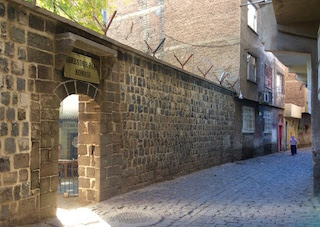
 Through the maze of black walls you stumble occasionally on a sudden burst of green, an opening into the garden of one of the old hans. We went to Iskender Pasha Han for menengiç coffee. The courtyard was gorgeous, full of golden leaved mulberry and sycamore trees. Magic.


