Showing posts with label prison. Show all posts

Sunday, November 4, 2012

54th Day--Hunger Strike


                Tonight was unusually warm for November—humid, everyone in short sleeves. I was coming from a friend’s house where we were doing some filming for an improv theater we are starting up on the Asian side. I went down to the wharf to fill up my Akbil (the card you use for busses, trains, and ferries) when I noticed a group gathering next to bus station. About a hundred people sat in front of a line of candles illuminating signs that read, ‘We are here on the 54th day to support the hunger strikers’ and ‘Ölüm değil, çözüm için’ (not for death, but for a solution) They chanted slogans—‘The murderers will have to answer for this crime!’  From the dark beneath Kadikoy’s Haldun Taner theater came another group marching with red flags. They called to each other across the newspaper sellers and sausage stands who started to notice. ‘What the hell are they shouting about?’ one asked. A crowd started to gather. Police began to notice.

I stopped in front of the candle flames like a moth. I don’t know what it was exactly—but the graveness of the situation seemed to flicker in that candle light. In Turkey, hunger strikes have always meant death. The prime minister denied their existence. ‘We have no hunger strikers!’ Or else called them terrorists. ‘The state will never bow its head to the pressure of terrorists’ or else said it was all a show. Every day there’s something else he says that is more crass. Some of the newspapers are saying that not much interest is being garnered by the hunger strikers—but here is this gathering crowd at the Kadikoy wharf. In Denizli 91 students from Pamukkale Univeristy were arrested for marching in support of the hunger strikers. Galatasaray students and others from universities all over the country have started sympathy strikes.

While we were filming tonight, a friend asked me if my father-in-law was striking. ‘Not yet,’ I said. There’s been an announcement tonight that all the prisoners will start striking—(some estimates put that at over 10,000 people, though it is still unclear just how many people have been arrested in the KCK case. The arrests continue—yesterday 21 people more people were arrested in Mersin.) This will include my wife’s dad, of course. And means…means what? There’s a storm coming. Shadows. I am proud of him. I want to help him somehow. But the government seems so ruthless, so indifferent. It throws as much propaganda as it can at the strikers. But I have felt how frustrating it is to be among these people and face the power of the Turkish state.

And I have seen a hunger strike before. In 1998, six Tibetans in New Delhi stopped eating to protest Chinese occupation. It ended when the Indian police stormed the tents and Thupten Ngodup, a 60 year old man set himself on fire. It changed nothing of course. For the past few months, people all over Tibet have been doing the same--self immolations, deaths, self-murder as the only weapon against the all-powerful State.
Those candles at the wharf tonight reminded me of the candles in front of the Tibetan strikers tents. And there’s this dread that spread over with the wind coming off the water, that the flames are rising again.

Tuesday, October 23, 2012

Sacrifice


It’s Friday. My sixth graders and I are going out to the football field. Their eyes are full of colors.

We’re going to write poetry.

‘I hate poetry,’ a girl announces. ‘It’s stupid.’

One of my clever boys smirks and asks, ‘Why are we going outside to do this, I mean, I’m not complaining mind you, but we could have done it in the class room just as easily.’

I gather them together and tell them to look up.

For a second there’s complete silence. You’ll never see such a sky, such Fall blue, not in Istanbul. It’s like we’re on a mountain in Bingöl, in Arizona—far from every house and car and smokestack in the world. A thousand white gulls pass in a swirl of wings.

‘Run,’ I tell the kids. ‘We’re going to run until we can’t run anymore and then we are going to sit down and look around and write about what we see.’

They write magic.

Some never sit. There’s a little blond girl who runs and runs, let’s her maroon jacket fall down to her elbows. She’s exhausted but won’t stop. Sometimes someone chases her, sometimes they don’t. A boy shows me a poem he’s written about her.

‘I see a girl running. Running and running and running.  Now she runs like a tired zombie. Falls. Her yellow hair on green grass.  She gets up. Red leaves on green leaves. We are lying on green grass. Green trashcans, green notebooks, green pines.’

Their heads are full of Carl Sandburg and Ezra Pound and William Carlos Williams. (They all agree Williams has a stupid name.) On the play ground, one girl writes while hanging from a rope swing. ‘The sky is blue, I hang in the air and I just don’t care! I just don’t care! I just don’t care!’ One little boy says, ‘I think I’ve written something strange.’ I read what he’s scribbled diagonally across the page, ‘My white sneakers run on green grass, like the white birds on blue sky. White shoes running on heaven.’

 Another boy, the smallest of all, writes eleven poems in a row. About the red maple, about the yellow sycamore, about the sky, about the Fall, about the service busses, about us running around and around and laughing and falling and writing, about how boring school is. He’s on fire.

‘I know why we’re out here!’ the girl who hates poetry says. ‘When you’re outside like this you’re feelings just bubble out! You can’t stop writing!’

Or running. The blond girl still can’t stop.

Whatever they do this coming week, we’ve had a burst of joy today. The 23 of them and me.

The school is getting ready for the October 29th holiday. The administration has selected a theme, ‘The eyes of Atatürk.’ In various places around the school hang pictures of the eyes of the Republic’s founder. Only the eyes, big and blue and staring at you wherever you go.  We will have a ceremony celebrating those staring eyes and none of the students will come (but not because they’re not learning to worship this man—simply because they’d still rather play). We teachers will come because we have to. Songs will be sung in his honor, dances danced, purple prose speeches made.

October 29th marks more than the anniversary of the Republic’s founding. It’s the day that Delal and I took a ferry to the Emniyet (the national security office) to find out if we could see her father. The police. The paranoia. The undercover agents. A black day. He’d just been arrested. We had no idea what would happen. The red Turkish flag was everywhere. No one questioned. The right wing papers were screaming ‘TERRORIST!’ It was the first time I really understood,  gut understood, why my in-laws found it so threatening.

The hunger strike that started weeks ago is on its 40th day—63 people have been striking since the beginning, 420 more have joined—political prisoners all, and not just in Istanbul, but all over the country.  The 63 are growing weak. Some are starting to vomit and show signs of disease.  An article in the Radikal say it’s no longer a hunger strike but a death watch.  And strangely, the government is taking notice. They are allowing stories about it in the papers (the Hürriyet says, ‘President Gül is unsettled by the direction things are moving’). People debate it in talk shows on TV. President Gül says talks with the strikers are possible. Even talks with the PKK are possible.  They may consider the strikers demands which include an end to solitary confinement for Abdullah Öcalan, being able to defend themselves in Kurdish, and general education in the mother tongue. (We don’t know the details because the prisoners are boycotting visits—strangely, the journalists are too. Not one paper, it seems, has sent anyone to find out first hand what is happening inside. Rumors are flying about Kurdish being allowed in the courtroom.)  There are signs for hope.

And yet at the same time, the random repression continues. A journalist, Hatice Duman, is sentenced to life in prison. Never mind that Necati Abay, tried in the very same case, was released. And the prime minister promises no compromise during a speech in Elazığ. He says, ‘We will not negotiate with terrorists! We will even talk to Yezidis (a Kurdish sect) as long as they are not terrorists.’  ‘Even’ with Yezidis.  Notice the wording. And the very same Radikal newspaper devotes three pages to a historian named ‘Ismail Küçükkaya’ who says that Turkey has never been multicultural, and then goes on to insult Kurds in particular.

‘Turkey is not a mosaic,’ he writes, ‘Because those other elements have never developed themselves. When I say this, you might counter with ‘The fascist Turkey never opened schools!’ But actually the problem is not with schools but with the elite. Kurdish leaders are not real leaders. They are not Iraqi Kurd. Put one of those guys across from them and let them see what real governing is!’

Never mind the extrajudicial killings, jailings and legal executions of hundreds of Kurdish intellectuals. How can you develop anything from a grave?

But at the same time, things are being discussed that have never been discussed before. For the first time since I’ve been here. On TV the other night, a commentator said the words ‘Armenian Genocide’ without the hitherto obligatory ‘so-called’.

At night, the smell of livestock and manure wafts through our apartment. The feast of the sacrifice is fast approaching when Muslims celebrate the sparing of Isaac by God. Instead of his son, Abraham kills a lamb.

The papers are full of people arguing one way or the other for the holiday. Editorials, articles. ‘How can we explain this to our children?’ City folk find it cruel and barbaric, this sacrificing of animals. I don’t see it—maybe I’m not used to the blood flowing right in front of my eyes, but it’s done behind the scenes every day. We like our meat already cut and packaged—no reminders of where it comes from. But so what? What, really, is the big deal?  But nothing is without political import here. The old guard does not like the reminder of religion or blood. The new boys in power want everyone to know that this is a MUSLIM country with MUSLIM holidays. The faithful will perform the sacrifice and give away the meat—ideally. The non-believers will go somewhere and have a drink just to show they can. We non-Muslims might hit the streets just to see what’s going on—or head to the beach while the warm weather lasts to take advantage of the days off.

I helped sacrifice a goat last year. It was in Dede’s dream—with his grandchildren he would sacrifice and animal at a holy place and give away the meat. They painted blood on our foreheads to mark as belonging to his house—Mala Memli.

All I know is that the goat meat kavurma we ate on Mt. Silbus tasted good.

That day the sky was blue too. Like the spirit of the mountain named for an Armenian saint of light had cleaned it just for us. We danced the halay with strangers and lit candles to the gods.

The better question to ask at this Kurban Bayram is this:

Many of Turkey’s own sons and daughters lie on the altar now—are they going to strike or spare them?

Saturday, September 29, 2012

Hunger Strike at Silivri and Beatings (Türkçeşi en aşağıda)


Anxiety.

That’s the prevailing mood for the past year. Sometimes the anxiety is aimless and sometimes it is a divination.

On Monday, my sister-in-law received a call from her father. Monday are the days prisoners at Silivri get a phone call. She said his voice sounded strange—subdued, morose. We found out that a hunger strike was planned among the prisoners in the KCK case. We had no idea if my father-in-law would be among the strikers. His name was missing from the official lists, but it was clear from his voice that something was wrong. The trial is resuming next week. The visitation this week was canceled—the prisoners themselves were boycotting visits as a means of protest. We would have no news for a while.

Tuesday, my wife, determined to see her father and find out if he was okay, arranged a car and a lawyer to go with her to Silivri—while family could not get in, most likely a lawyer would be let through. The only trouble was finding a driver—we called friends, friends of friends, and friends of those, but there was no one who knew how to drive (imagine having that problem in the States!) She was talking about driving out there on her own—a thought which terrified me, given her lack of experience. It looked like we might have to give up the trip, but something was nagging at her and she had to get out there somehow. I was about to call in to work to make the drive myself when a friend came through at the last minute.

The rest I heard from my wife herself.

The prison was eerily empty—the crowds of visitors for the KCK inmates missing, home because of the protest. The lawyer was let in and met with my father-in-law, Kemal Seven, who was extremely pleased to see him. Something had happened, and in their isolation, he had feared no one would ever find out.

My wife’s instincts had been correct.

Tuesday, September 25th, 10 of the 99 detainees remaining from this particular round-up began a hunger strike. They wrote a petition to the prison announcing the strike so that later the officials could not claim ignorance should something happen later on. The remaining 89 prisoners wrote a petition of their own declaring their support. Sometime the same day, roughly between  40 to 50 guards and riot police in full gear (this means shields, gas masks, billy clubs and pepper gas) gathered at the door of the prisoners wards. Among them were the assistant warden and the chief of the prison guards. They entered the cells to take away the hunger strikers. Apparently, they were taking them to one-person cells isolated from the others. Their comrades did not want to give them up—they feared that in a few days the strikers would no longer be able to take care of themselves, and expected little help or understanding from the prison officials. Thus, they tried to prevent the guards from taking them awa. The guards attacked. Everyone was beaten (Remember, please, that resistance or no, many of these men are around 60 years old with a host of ailments ranging from heart disease to diabetes). The ten hunger strikers and 2 other prisoners were taken away. None of their belongings were removed from the cells and they’ve had no word of where they’ve been taken. The others worry because, on hunger strike, of course, they need to drink water and sugar water quite regularly and there has been no sign of anyone making provisions for that.

The remaining 89 have refused food since Tuesday in solidarity. I’m posting this on a Saturday, so this might have changed. The trial will resume Monday. Most likely with the reading of the 2,500 page indictment-I think after 10 days in July we left off on page three hundred and something.


Türçesi (Özet)

Silivri L Tipi Cezaevinde, KCK davasından tutuklu bulunan 99 tutukludan 10 kişi süresiz dönüşümsüz açlık görevine başladılar.  Bir dilekçe yazıp, hapishaneye bildirmişler.  Kalan 89 kişiden bu arkadaşları destek verdiği diye bir dilekçe yazmışlar.  Sonra robokop şeklinde 20-25 hapishanenin gardiyanı ikinci müdür ve başgardiyan koğuş kapılarını açmışlar bu on kişi alıp bir tek kişilik hücre götürmek istemişler.  (Bu arada koğuşlar 18 kişilik. 99 kişi kalıyor, bu koğuşlarda, her koğuşa gardiyanlar dağıtılmış).   Dün Salı günü yaklaşık 40-50 kişi yarısı gardiyan yarısı robokop şeklinde, koğuşlara girmişler. Koğuşlardakiler tabii ki arkadaşlarını bırakmak istemdiler (Çünkü bu 10 kişi 10 gün sonra kendi ihtiyaçlarına bakamayacaklardı). Direnmişler. Gardiyanlar onlara darp etmişler.  10 grevlileri götürmüşler bir de direnen kişi den iki kişi daha. Bu 12 kişinin nereye götürüldüğünden koğuş arkadaşlarının haberi yok. Henüz gardiyanlar gelip onların eşyalarını götürmemişler. Açlık grevinde olan bu kişilerin su ve şekerli su almaları gerekiyor, bu yazı yazıldığında kendilerinden bir haber alınamamıştı. Tüm tutuklular Salı gününden beri arkadaşları destelemek amacıyla yemek ve ekmek almıyorlar.

Monday, July 23, 2012

The KCK Trials--the Last Days (continued from previous post)


The lawyers talking to the press in front of the courthouse

.
I spent seventeen months waiting in prison queues in
Leningrad. One day, somehow, someone 'picked me out'.
On that occasion there was a woman standing behind me,
her lips blue with cold, who, of course, had never in
her life heard my name. Jolted out of the torpor
characteristic of all of us, she said into my ear
(everyone whispered there) - 'Could one ever describe
this?' And I answered - 'I can.'
Anna Akhmatova
[The 1st of April in the year 1957. Leningrad]

I kept coming back to this poem during the writing of these entries—and I thought, what would I answer to the woman’s question? What if one of the Kurdish mothers in the courtroom asked me, ‘Who can describe this?’ I’d think, someone can, but not me. My heart’s in it, but my blood is not, and that seems to make a difference in who can get at what this is like.
But then this is not the Stalinist years in Russia, and we are not suffering all that much on a day to day basis. Every afternoon in Silivri, we have been going from the courthouse to the beach or to the coast where there is a nice nargile café. There, we sit on bean bags and smoke grape-mint water pipe and drink tea. This is a summer resort for wealthy Turks. They had a parade on Wednesday, all international, in celebration of the ‘Yogurt Festival’. Texan square dancers marched behind some old Korean men doing a harvest dance, followed up quickly by some Serbian folk dancers. Turkish Pop Stars closed the night.
While we are doing all of these things, whole families sleep in the BDP tents on the ground among the flies and heat and dust (We stay in a comfy apartment with one of Delal’s college buds). The campers have no money for food so they have to eat what the party can provide—usually a pretty decent meal of fresh tomatoes (this area is famous for them) rice, bread, cucumbers, and water melons.
We cook for each other every night in the apartment—I made black bean burritos on Tuesday. Our host made meftune on Wednesday.  Curry another night.
Many of these people have blown all their savings to come across the country from tiny villages in Siirt and Şırnak. And they are the lucky ones who had the cash to blow—others were left behind. Some have relatives in our group of political prisoners with severe heart problems or serious cases of diabetes. No, we are lucky--the petty bourgeoise of the political prisoner relative set.)
On Wednesday, after the Yogurt parade, we repair to the nargile joint.
‘What do you think they think we do after the trial every day?’ my wife’s sister says as she lets out a draught of minty smoke. ‘This almost feels wrong!’
‘Maybe they think we ululate in grief and slap our faces.’
We ululate for effect and laugh.
‘Or beat ourselves with whips and wear hair shirts,’ I add.
The moon rises over the town and makes a splash of milk-white on the water. It’s utterly beautiful. We stay up till late doing imitations of one another.
The thing is—there is an anxiety that underlies everything. It’s like—while watching that moon rise over the glittering town, there’s someone raking their fingernails down the chalkboard. And it has been that way for a year. This is the thing I cannot describe—it’s like that thought on the tip of your tongue that never materializes. It’s why everything you do comes with a slight stomach ache, a last minute hesitation, why your nights are filled with dreams of concentration camps and round ups and jails.
I think this anxiety is all very run of the mill for my in-laws. This kind of anxiety is just part and parcel of life those Kurds who won’t say they’re Turks.
And then there are those that do. We have a young visitor with us this Wednesday night, a family friend still in high school and only 16 years old, come to pay his respects to Mamoste in prison. As we walk the boardwalk around midnight, a concert is blasting the entire town with noise from the portside.
‘I guess we Turks will always love noise,’ he says, or something like it. I don’t quite catch the beginning of this.
‘Well, maybe,’ my wife answers. ‘But just remember, we aren’t the same as all these people. We’re Kurds, not Turks.’
‘Not me,’ he says. ‘I’m a Turk.’
‘How so?’
‘I reject my Kurdishness.  I don’t want it.’
This is not exactly the most socially aware thing to have said to a group of people going to a political show trial every day for a family member imprisoned for fighting for Kurdish rights.
‘But you are Kurdish,’ we protest. ‘You can do what you want with it, but you can’t get rid of it any more than you can get rid of the fact that you were born a male.’
‘No, it’s a choice,’ he insists. ‘I don’t want to be Kurdish. I’m Turkish. That’s how I feel!’
I’d like to tell him that any true hater of Kurds won’t care what he chooses.  They’ll arrest him if they feel like it, or beat him up, or kill him like the guy in the bar in Ankara did when he heard a man singing a Kurdish song.  I remember the eleven year old girl who told me, upon learning my wife was Kurdish, that the only good Kurd is a dead Kurd. The 7th grader who, again, when she found out my wife was Kurdish, told me ‘you should be careful.’ The friend who told me the best thing I could do for Turkey was kill Kurds. ‘It’s just like killing chickens.’ The 8th grader who got angry at me because I said my wife came from the village of Conag. ‘Conag is not a Turkish word,’ he growled. The teacher at school—half American at that—who stopped talking to me because I said that Kurdish and Turkish weren’t the same thing.
‘You’ve been brainwashed,’ We tell our denying teen.  Of course, it’s true. He has had 12 years of nationalist schooling feeding him this mentality. He’s had classes in Ataturk’s thought and National Security where’s he learned about internal enemies (his own people) and the imperative of the unity of the nation. He’s recited every day of his school life the school-kid oath that ends ‘Happy is he who calls himself a Turk.’ Everywhere he turns, on the news, in the music he listens to, the magazines he reads, is the same message. 
‘No, it’s you who’ve been brainwashed,’ he retorts. ‘You don’t have to be Kurds either, but you buy into it. I don’t have to.’
There’s the rub.  I imagine that, at 16, the idea of ‘being Kurdish’ would give anyone pause in Turkey. I imagine that as you are coming out of high school, you stand at a fork in the road.  To the right, are fairly normal, fun filled days of going to concerts with friends, drinking beer by the water, trying to feel up girls, getting sentimental over rock songs, playing video games, reckless road trips, part time jobs and midnight swims in the Bosphorous.  On the left is what he’s seen today—a people always feeling victimized, camping out in shabby tents in front of a courthouse that’s arrested hundreds of their family members, political battles that go nowhere, people shouting at demonstrations and then getting tear gassed, guerilla war, anchormen calling you a splittist and a terrorist, exile from poor villages to ghettos in the city.  What teen looking for a normal life would deliberately walk down the left fork? I remember a quote from an interview somewhere.  ‘What do you do for a living?,’ was the question. ‘I’m a Kurd for a living,’ came the answer. ’If I hadn’t been a Kurd, maybe I would have been an engineer instead.’ In some cases, identity subsumes everything.
I listen to his arguments and make the silent promise never to send my children to school here. I think of a Kurdish girl I met in Nashville.  She was about 17 and running the register at her father’s store.  I asked her where her family was from.
‘Sırnak,’ she answered.
‘Oh we have an aunt there,’ I told her.
‘You live in Turkey?’
‘Yep.’
‘I went to Istanbul once. Fun city. There was some girl there, though. I remember telling her my dad was from there and that I was Kurdish. She said, ‘but Kurds are just a myth,’ and I was like, yeah okay, whatever. Who needs you…’
I want to produce a kid who can say breezily, ‘I was like, whatever. Who needs you?’
It reminds me of a story—a friend of a friend. Her grandmother was Lakota and grew up on the Lakota Reservation when it was definitely not cool to be native—brought up in white schools, assimilated. To this day, in her seventies or eighties she will not admit to being Indian. Her granddaughter—the friend of a friend—turned down a scholarship because she knew it would hurt her grandmother to hear the word ‘Sioux’ spoken out loud, even if it did mean money for college.
THURSDAY
For the first half of the day, there is more droning through the indictment. At the lunch break, I see that little nine year old girl again. She’s wearing a red tank top and white shorts. She’s very chubby and manages to push past up security and stand at the railing of the lawyers section where she starts to blow kisses to the two women I assume are her grandmother and mother—one is much older than the other and wears a headscarf patterned with red and purple flowers. Both look alike. The little girl’s  fat ankles squeeze out of the white straps of her shoes.
We lunch in the BDP’s tent—it’s hot and full of flies. They buzz around the red slices of water melon. Our meal is had communally on the floor—a sandwich of peppers and kaşar cheese, chicken and rice, fresh tomatoes. It is very dusty today—clouds of dust roll in from parking lot on hard gusts of wind. The sound of power drills and hammers fills the air. There’s construction going on at the prison.  On TV the night before, an academic discussed the Assistant Prime Minister’s announcement that 196 new prisons would be built by 2017. 
‘This is way more than necessary to relieve overcrowding,’ he’d said. ‘It seems the government is clearly anticipating thousands of new prisoners, but who?’
After lunch, Judge Ali announces that he will now hear statements from the suspects and lawyers—‘talep’ he calls them, which means requestbut in the legal sense , is better translated as ‘plea’. ‘But only for those willing to give their pleas in Turkish,’ he adds. This is the day before the announcement of who will be released.
A husky woman with short hair stands. The mike is passed.  She explains in Turkish that she never really joined all the meetings that she was accused of joining in the indictment—and that the ones she did join were half-hearted and few and far between. There’s a collective intake of breath. They’re giving in. They’re breaking ranks. 
A man named Erdoğan Baysan rises and the mike passes to him. ‘I joined the BDP at a friend’s recommendation,’ he says. ‘But I never really attended many of the meetings.’ A frizzy haired student named İdil Aydınoğlu says that she was part of the women’s auxillary of the BDP but didn’t really attend the meetings.’ A young college girl named Büşra Önder says that she joined the BDP, yes, but couldn’t really keep up with the meetings with all her school work and her aunt getting cancer. She was Tunisian by heritage anyway. Kemal Karagöz says he was not so much a member of the BDP as he was the leader of the Alevi Association. He is Alevi first and foremost. (This is significant because it is a classic escape of many Zaza Alevis—we are not Kurds, we are Alevis) Another man, barely able to speak Turkish at all, says in a heavily Kurdish accent, ‘I would like to ask for release. Thank you.’ One by one, like dominoes. One or two, like Pervin Tunbul, feel the need to stand and make a kind of protest. ‘I don’t wish to defend myself like this,’ Tunbul says, but their voices are drowned in the pleas for release. And the odd thing is, they defend themselves by distancing themselves not from the KCK but from BDP—a legal political party in Parliament.  They have, subconsciously perhaps, accepted the court’s judgment that being part of the opposition is a crime. I can’t judge (goes the classic phrase before a withering judgement)—I have never spent 9 months in prison, what do I know? But I feel embarrassed for these people and sad—that they have been brought to this, begging for the freedom after doing nothing to deserve losing it. 
Then Büşra Ersanlı stands up. 
Her voice is quivering with emotion—rage, sorrow, despair?  It’s hard to tell. She speaks about her academic record, her years of fighting for peace and equality—her absolute insistence on discussion and dialogue and non-violence.
‘I became a member of the BDP because of a desire to make a contribution to an opposition movement that offered a solution. I don’t regret that now. I feel ashamed of the word ‘request’. I don’t ‘request’, I demand my acquittal!’
I want to stand up and applaud (but that will get us kicked out of course). The silence that follows is ominous. A lawyer stands up and says, ‘The ones who can speak Turkish have a voice. What about the more than one hundred people who cannot? I again make the request that the other defendants be allowed to make their statements in Kurdish.’
‘Request denied,’ says Judge Ali.
And so over 100 people are silenced.
FRIDAY
The last day of the trial before the summer recess. The day they make the announcements about who is released and who is not. We expect a huge crowd—over ten people are coming from our family alone, and there are 205 prisoners—so we set out at 8:00. The bus turns from the coastal road into the Silivri sunflower fields and I notice that absolutely every plant is in full bloom, a rolling sea of gold all the way down to the real sea. It is unbelievably gorgeous, and so strange that these plants have followed the progress of the trial so precisely—almost no blooms the first day, hitting full flower only on the last. 
The tanks are back, and the 21 troop transports.
We arrive over an hour early at the courthouse gate and find it already swarming with people.  At the gate itself are three lines of gendarmes in full riot gear and regular prison guards with Kalishnikovs.  More soldiers line the fence. They have blocked the doors to the building before, but never the gate.
‘There are no more visitor passes,’ the officer in charge tells us.
‘Liar!’ screams an old woman. ‘You’re lying!’
‘There’s no one in the building!’ says a portly mom.  ‘We can see that it’s empty from here!’
‘I’m sorry,’ says the commander again. ‘But each of the people inside has taken between ten and fifteen passes for members of their families, and there’s none left.’
‘Then make them give them back!’ a woman in a headscarf protests. ‘There should be a limit to how many each family can bring in! We all want a chance. We came all the way from Hakkari! Over 24 hours on the bus and we used all our money to come here. Are you telling us we should just go home!?’
The soldiers look tense. They tighten up their wall and raise their riot shields. They are fully armed with Turkey’s favorite weapons against its citizens—pepper gas and billy clubs. More people come pouring down from the BDP tents.
‘What’s going on here?’ they shout.
‘They’re lying to us! They say there are no more visitors’ passes!’
An aside here—my wife’s family often talks about random strip searches when they visit the prison, of harsh interrogations and harassment when there was nothing of the sort the previous time.  They say this is all the State’s efforts at psychological intimidation. I thought that maybe they were being a little paranoid, that maybe it was true that these random searches were, as the soldiers explained, part of the prison routine. I believed the commander when he said there were no more visitor badges because the few people we saw inside had commandeered them all.
I was naïve. For in the next second, the soldiers parted and we rushed the security desk to find over one hundred visitor passes unclaimed.
‘There are only a few,’ the officer distributing them shouted. ‘So each family can only have one! No more taking a dozen!’
So they were still sticking by that story. And this produced a mad rush of people pushing and shoving and trampling each other—who knew when they would run out or when the soldiers would decide to stop handing them out. After the madness and everyone had gotten their badge, there were still plenty left and any stragglers could pick up as many as they liked.
What the hell was all of this about? Why did they deliberately lie about something that didn’t really matter at all? And then change their minds? The ubiquitous Turkish disorder or something else?
Inside there were frisks and strip searches. I was checked more thoroughly than I ever had been—in fact, until today most of the security had been calling me ‘Enişte’ (meaning ‘Man married into the family’) and waving me through with nothing more than a ‘Good Morning.’
With about fourteen family members there that day and only four visitor passes, we were on rotations.  Four in to wave at the breaks and then four out so that a new group could come in and wave at the next break. I was with the first team in.
The previous day, the trial had ended with the lawyers making their pleas for the clients. Only three had been able to speak. The last one asked the judge for an hour’s extension.
‘Your honor, we request to continue until six o’clock today. There are two hundred and five suspects and we think at least five minutes for each one would be fair.’
In the Ergenekon trial going on just down the road, the judge had extended proceedings to 7:00 for the same reason just the other day.
Judge Ali, despite the precedent, despite the fact that he had been over half an hour late that morning, refused. And so now, this morning, we witnessed the absurd sight of over one hundred lawyers trying to speed-read their pleas before the noon deadline. I could understand nothing they said. They sounded like auctioneers. They are out of breath when they finished. I would have laughed if the consequences had not been so dire, but then, the end of this play had long been written—of that I was becoming more and more convinced. It’s not paranoia anymore, but a common sense observation.
After thirty minutes, my turn is through and I file out and hand my pass to an aunt. The rest of the day is spent waiting outside the gate in the sun. It’s over 90 degrees outside and windy. More than a hundred people squat in the dirt or in the middle of the road. The BDP’s tents are already full—there’s no shelter there.
Around 11:30, the commander abruptly announces that all women can go inside, visitor pass or no, and so they flood the courtroom—no seats, no place to stand even. The crowd pours out the doors and down the steps. The cafeteria, entrance hall, and restaurant are teeming with people waiting. We men hang outside the gate.  So the women are there at noon when the judge announces a break (again refusing extra time to finish the legal pleas).
‘The court will convene again at 3:30 or 4:00,’ he says, ‘Without any observers.’
Apparently (the girls tell me) when court adjourned and the suspects started to file out, the audience had once again burst into applause. This was their slap on the hand.
The heat was unbearable. I went with an uncle to a van parked outside the tents where we could at least sit in the shade. A pretty young woman jumped in with us, holding a cell phone.
‘Can I use your van to make a call?’ she asked after sitting down.
‘Sure.’
‘I’m from the IMC news team. I just need to call in an update on the story.’
It turns out that the IMC news channel has a few journalists among the suspects as well.
‘The government doesn’t like us very much,’ the woman explains. No wonder—they’re the best news channel in the country.
Eventually, Delal sends for me with a visitor’s pass (It’s my turn again) and I go to the courthouse and find her in a cafeteria packed with people. There’s nowhere to sit and barely anywhere to stand. People have been taking off their visitor cards, passing them through the fence to those without them, and then repeating the process until the whole place was crammed fuller than before.
3:30 came and went without any sign from Judge Ali. Delal and I decided to go out for some fresh air. We were crossing through the hall when suddenly the doors to the courtroom burst open and reporters leapt through the crowd and ran through the security check (knocking over tables) to get to their news vans. The crowd thronged toward the doors to see what was going on.
‘They’ve been released!’ Someone shouts.
The whole room erupts into an excited panic. Who’s been released?  I catch sight of that little chubby girl from the day before. She’s sobbing and holding onto a woman’s waist as if she might sink. Other  people are collapsing into their chairs, overcome with tears. Some are hugging each other.
16 people have been released on bond including Büşra Ersanlı, Zekiye Ayık (the old woman I spoke about in an earlier blog) and several of the people who had broken ranks yesterday and made pleas in Turkish. And though Mamoste was on trial for the same crime as Büşra Ersanlı, he was not among those let go.  We had not expected him to be. But still many of the family were crushed.  Clearly, some of us had hoped.
The trial will continue on October 1st. At first they told us that all the prisoners would be moved back to their original prisons—in our case, Kandıra—but now it looks like they’re staying in Silivri till the trial resumes. New security measures have been put into place that we’ve never had to deal with before—more harassment--the prisoners are being searched before every visit, and so far they’ve boycotted these visits in protest.  This week the trial of the KCK lawyers began in Istanbul--the lawyers of many of the people at Mamoste’s trial—in fact, many of the defense team went straight to their own case from the Silivri courthouse. They’re defending themselves. Meanwhile Erdoğan’s government continues to arrest people in the KCK case.  An academic on TV the other night estimated that over 11,000 people were now in jail and more on the way.
As for us, we are taking a break from all this. My next entry will hopefully have nothing to do with politics and will be something about music and travel in the Appalachians.

Thursday, July 19, 2012

Day 6-7 The KCK Show Trials

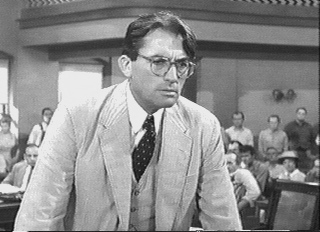
Atticus would have been flummaxed


July 9th and 10th (previous days are in earlier entries)

I think I am getting a taste of what it must have been like to sit in a courtroom in the Old South. The overwhelming sense of unfairness, the verdict a foregone conclusion because of race, the whole weight of a century’s old benighted system that just won’t die. The evidence laughable to anyone looking in from the outside.

From Thursday afternoon onward, the 2400 page KCK indictment is read aloud. And I mean that in the passive—no one particularly important (like the prosecutor who wrote it) reads the indictment. The court pulled in two TV anchormen to take turns at the mammoth text—they go until they give out, voices hoarse, at which point the other takes up the task. It’s sometimes comical—like when they read through the phone conversations in their sports announcers’ voices, playing both parts at the same time with the same dry monotone. Most people snooze or knit or read a book—the woman down the aisle from me is engrossed in the Turkish version of the latest Stephanie Meiers novel.

But occasionally one of the defense lawyers, our would-be Atticus Finches, stands up to lodge formal objections against the nature of the indictment itself.  Essentially, their argument is this:  It violates all known and acceptable criteria for evidence and consists mostly of hearsay, speculation, and anonymous accusations.

Here are some examples of the problems:

Number 1: It’s often gibberish—passages cited as evidence of terrorist activity are so filled with parenthetical (Incomprehensible)s that they are nonsense.  For instance….

‘(Incomprehensible) Now, after the woman’s natural community was brought down...(incomprehensible) and while there the issue at hand was the destruction of woman, society, and nature, I think that we need to consider that, together with these things, and actually, I mean, in fact, the correct place…(incomprehensible) in other words, it’s not just the fall of woman, the basis of it is also the whole fall of society and nature.’

Number 2: The wild guesses of informants are often taken as fact. Here’s this tidbit from Delil Botan Kahraman who is describing his first visit to the BDP academy in Ümraniye and his first encounter with Mamoste, Kemal Seven.

‘The rooms used for academic purposes at the building were normal. There were several photographs on the bulletin boards. Though I didn’t know these people personally, I guessed that they were members of a terrorist group, because they wore the sort of clothes that terrorists wear.’

One of these photographs he’s referring to is of Musa Anter, the Kurdish journalist murdered by the Turkish government in the 90s. I have no idea what he means by ‘terrorist clothes’ unless it is the traditional Kurdish shalvar and keffiyeh.  The absurd thing is that this statement is taken at face value. Imagine being dragged into court because your neighbor thought that you had pictures of people with the kind of clothes rapists wear, and that this was considered hard evidence.

Number 3:  Guilt by association? This term is not even accurate. Guilt by virtue of being present in the room while the accusations are read aloud is the correct description.  Pages 69 through 167 of the indictment are devoted to a play-by-play of the foundation of the KCK and its evolution through time and includes the organizations charter article by article. No names of the suspects appear in any of this. Then from page 168 to 186, the indictment lists internet sites that they believe have terrorist propaganda—again with not one suspect’s name appearing anywhere.  The justification for 127 pages of dry history lesson is this (from page 186)

‘The sites under discussion can be summarized as follows—they made propaganda for the PKK and it’s leader Abdullah Öcalan, they praised splittists and divisive terrorist activities, and by abetting the spread of detailed news of their activities to the masses and the public and of publishing the notes of the contents of Öcalan’s meetings with his lawyers as instructions for the organization, presented the convict Abdullah Öcalan as someone to be addressed as a head of state. By using the model of Democratic Confederalism to compromise the unitary structure of Turkey, they aim to break off parts of the countries East and Southeast and subsume it into a structure known as Kurdistan. This data is not the civil initiative of the KCK and DTK but merely a different extension of a terrorist organization and the details and matters presented within the scope of this indictment are not assertions but facts.’

I like that bit at the end—almost like a protesting child anticipating that no one is going to believe his wild story. ‘It’s not just assertions but facts! I swear!’ As if just saying so makes that the case—an argument you would expect from a ten year old but not a court of law.

This is essentially like me sitting you in a courtroom and reading an entry from a murderer’s diary and then saying you were the murderer because I read it with you present.

Number 4-the informants

Only when you reach the government’s hand-picked informants do you start seeing the names of any actual suspects, and while I can only speculate, some of the language of these ordinary people sounds too much like legalese for them to be word by word transcriptions (and in light of the Balyoz case, I simply assume them to be made up). Informants describe colleagues as ‘şahıs’, a police term for ‘individual’ or ‘personage’, for example.

Here’s a little sampling rendered in English:

First Witness Haydar’s statement given (21.04.2010)

For a long time I have worked in the terrorist organization, the PKK/KONGRA-GEL, as the person responsible for the DYG township and implemented its operations at various levels of the BDP organization. In particular, I wish to explain what I know in regard to the operations and activities in Istanbul by the KCK during the period I implemented these operations and activities.

Number 5 Another problem is the complete lack of objectivity—a presumed given in a court of law.

On page 72, when it’s trying to explain the bewildering number of acronyms (KKK, PKK, KCK, KONGRA-GEL) the indictment says,

‘The terrorist operations perpetrated by the terrorist organization the PKK for more than 30 years has hit dead ends from time to time and they have sought a way out. One of these methods is name changed by which they strive to hide their ugly face with camouflage.’

Number 6--And then there’s the good old fashioned circumstantial evidence (itself based on an informant’s questionable testimony) Where supporting the party of someone present in the same area as suspicious items that you have no idea how got there is considered admissible evidence of your terrorist activities.  Here is the first ‘Action’ described by informant Erkan Yanıt,

ACTION 1

On 24.05.2009 at 17:00, in Çağlayan Square, in Şisli, in an outdoor meeting of the DTP (predecessor to the BDP) called ‘Don’t Silence the DTP, Silence the Guns!’, in a clump of bushes to the right of the number 9 security check point, were found 20 flag staffs, 2 posters of Öcalan, 1 flag of a so-called terrorist organization, one flag belonging to the youth group of a so-called terrorist organization, 5 small knitting needles, 10 switch blades, 1 exacto knife, and one screw driver. It was not determined who left these items. Certain leaders of the Esenler branch of the DTP were announced…The DTP representative Sebahat Tuncel also joined.

No one knows how those items got there (hell, the police might have planted them!) but the future BDP parliamentarian Sebahat Tuncel was in the vicinity and they suspects in the courtroom support the BDP so they must be terrorists!

Back to inconsistency in tone and content.  Erkan Yanıt’s testimony, for example, starts off rather ordinarily, a young man explaining how his family came to Istanbul and got caught up in the activities of the BDP’s predecessor, the DTP.

“My older brother is Erol Yanıt and we came together from our fillage in Mardin to work in Istanbul. In the Mimar Sinan neighborhood of Esenler I took up residence and after working in a textile factory in Bayrampaşa for 1.5 years, I took a job at the Tadım Köfte restaurant.’’

He goes on to give very detailed accounts of appointments to the field by ‘the terrorist organization’ and despite being an uneducated villager from Mardin, continues later in a diction and tone that sound suspiciously like the prosecutor himself (from page 551)--“They organized the distribution of the so-called flag which symbolizes the Confederalism of the PKK/KONGRA GEL terrorist organization and the posters of Abdullah Öcalan. These posters and so-called flags came to this personage and other young personages from the youth of the DYG received materials from this personage.’

That phrase ‘so-called’ is a favorite of the Turkish government when describing almost anything they don’t like and not the day to day language of a waiter from a village in Mardin.

The defense team objected, and to all of the objections, the prosecutor, through his conduit Judge Ali answered with the same ‘Reddedildi’. (Rejected) (We hear this phrase so much that several of us in the audience develop quite good imitations of the squeaky Judge Ali delivering it).

Now if you sat through all that about the indictment, here is a more human switch—the only time the courtroom came to life during this monotonous reading was at the breaks when the prisoners filed in and out. This was the time when I saw the tragedy of all this most clearly—that wall of hopeful faces that rushed to the back row of the suspects’ section searching our faces for friends and loved ones. There was a big bosomed woman with a short haircut; she looked like she belonged in a commercial for frozen pizza playing an Italian grandma. There was the frizzy haired girl student and the skinny old man who wore a sky-blue suit way too big for him. There was Mamoste himself, sixty years old and adjusting his bifocals so as to see us better, and then the mother daughter team who blew kisses at a nine year old chubby girl to my left who kept calling out ‘Grandma! Grandma!’. There was the skinny waif of a boy in a rock and roll T-shirt and the moustachioed Kurd who spoke no Turkish and understood nothing of what was going on. There was Ragip Zarakolu, who looked like a bushy haired guru from an Ashram and the old lady with her hair pulled back in a tight bun, and the elegant professor Büşra Ersanlı.  Everyone called out ‘Hello!’  ‘How is everything at home?’ ‘Are you coming tomorrow?’  For me, the most compelling of all was the face of family friend Zekiye Ayık, a woman with long silver hair and big brown eyes who wore an elegant brown scarf loosely over the back of her head. She has been in and out of the hospital for heart trouble. She had trouble seeing, and though we called her name over and over, she could not quite make out who was in that crowd waving at her. ‘We get our morale from your visits,’ Mamoste had said. ‘When we see you in the audience supporting us, we know that everything has not been in vain.’ And yet Zekiye could not see who was in the audience supporting her. Her slightly bewildered smile as she waved first too far to the right of us, then too far to the left haunts me. This is the face of a terrorist for the Turkish government.

This is the witch hunt, this is the justice system in the South before the Civil Rights movement. 

While the reading of the indictment slowly progressed (100 pages a day on average—meaning at least 20 more days to go), some events on the outside promised to affect things on the inside. The first was the announcement by the Turkish government of changes in the judicial code. One change abolished the special authority courts, one of which we were attending.  (Replacing them with Regional Courts in the South East with Special Authority to Handle Terrorist Cases—the difference?  Who knows?) This had the absurd effect of making us present at something that technically didn’t exist.  At one point, a lawyer lodged a protest, saying, ‘We don’t even know if you will exist next week.  Even if you make a judgment, what authority can it possibly have?’

A second provision was a limit on the time that someone can remain in jail without trial and the declaration of ‘making propaganda’ as an ‘unjailable offense’.  Suspects in the Ergenekon trial quickly applied for release in light of the new codes, and our lawyers followed suit. Judge Ali announced a decision would be reached on Friday.  The result of all this was that we guessed some people might be released on Friday.  Tahliye.

(Now here’s another language lesson—the word tahliye is listed as ‘release’ in most dictionaries but it only means released on bond. Anyone who is tahliye-ed still stands trial. A full pardon is a beraat.)

Another important development regarded the professor, Büşra Ersanlı. I have tried to stay away from Professor Ersanlı if only because she is the most famous of the group and the media seems to cover only her and Ragip Zarakolu, as if their release would mean the end of the injustices. But Prof. Ersanlı gave a very moving interview in the Radikal—in which she described her despair and her lost hope in the justice system of Turkey and the future of democracy here. She sounded absolutely crushed. Inexplicably, the Foreign Minister Davutoğlu made a public statement saying that he did not believe Ersanlı was a terrorist (of course he had to say so--he had appointed her to her position at the University) but added that the courts were independent of the government and he could not intervene. (What the hell? Since when?) Announcements like this are not accidents in Turkey—everyone felt that Professor Ersanlı would be released one way of the other. Telling if she were as her crimes match Mamoste’s. If she were released, he should be too.

Which brings me to my final subject—the prosecutor himself. While Judge Ali hung out all his laundry on a personal site, prosecutor Adnan Çimen keeps his cards close. I could find absolutely nothing on him on the internet except that he authored the KCK indictment (probably more directly than anyone knows) and that he had once prosecuted cases against ‘Al Qaida and other right wing movements’. There was a curious tidbit relating to a bodyguard scandal, in which the state removed one body guard from his two person entourage and also took away the privilege of his armored car—he was reduced to using a service bus.  Everyone was speculating on what this meant. Had he lost favor with those in power. Were they showing him the big stick under the robes (a Turkish idiom not a phallic reference)? I find myself wondering as well. Does this mean I’ve become a local now that I seek the hidden meaning behind everything?

The fields of sunflowers this last week of the trial are blooming fiercely. What was just two blossoms is now wide stripes of yellow. Utterly beautiful.